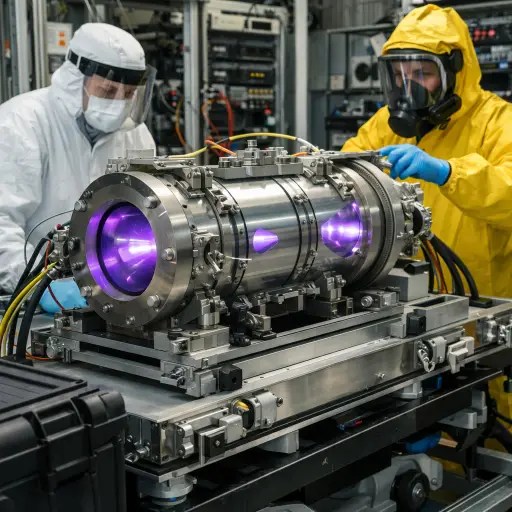
In a controlled but daring step forward, physicists are developing the first systems capable of safely moving antimatter—a substance so unstable that it vanishes in a burst of energy upon contact with ordinary matter.
Deep inside one of the world’s leading particle physics laboratories, an unusual kind of cargo is being prepared for its first journey. It is invisible, weightless to the human touch, and extraordinarily fragile. Yet it represents one of the most important frontiers in modern science: antimatter.
For decades, antimatter has been created and studied only in tightly controlled environments. Using powerful particle accelerators, scientists produce tiny quantities of antiparticles and confine them inside sophisticated electromagnetic traps. These devices suspend the particles in a near-perfect vacuum, preventing even the slightest interaction with the surrounding world. Any contact with matter would instantly destroy both.
Now, researchers are attempting something that was once considered impractical—moving antimatter from one place to another.
The motivation behind this effort is not spectacle, but precision. The same electromagnetic fields used to hold antimatter in place can interfere with delicate measurements. By transporting these particles to quieter environments, scientists hope to observe their properties with greater clarity than ever before.
The task is far from simple. Antimatter cannot be stored in conventional containers. Instead, it must remain suspended at all times, held in place by a careful balance of electric and magnetic forces. Engineers have designed compact transportable traps that maintain these conditions even while in motion. These systems incorporate ultra-high vacuum chambers, cryogenic cooling, and multiple layers of redundancy to ensure stability.
Movement introduces a new layer of complexity. Even minor vibrations or shifts in orientation could disrupt the trap, causing the particles to collide with the walls of their container and disappear instantly. To counter this, the transport units are engineered to absorb shocks and maintain consistent internal conditions regardless of external disturbances. Independent power supplies ensure that the containment system remains active at all times.
Despite its reputation, the antimatter involved in these experiments poses no significant danger. The quantities are incredibly small—far too small to produce any large-scale release of energy. The real challenge lies not in preventing an explosion, but in preserving something that is constantly on the verge of ceasing to exist.
The first transport tests are expected to take place over short distances, allowing researchers to evaluate how well the system performs outside a static laboratory setup. If successful, this approach could eventually enable antimatter to be delivered to specialized facilities optimized for precision measurement.
Such advances could have profound implications for our understanding of the universe. One of the central mysteries in physics is why matter dominates the cosmos. According to current theories, matter and antimatter should have been created in equal amounts. Yet the observable universe is overwhelmingly composed of matter, suggesting that subtle differences must exist between the two.
By studying antimatter under improved conditions, scientists hope to detect these differences and gain insight into the forces that shaped the early universe. Even the smallest deviation could help explain why anything exists at all.
The effort to transport antimatter marks a shift in how cutting-edge physics experiments are conducted. Instead of bringing every experiment to the particles, researchers are beginning to bring the particles to the experiment. It is a change that could expand the possibilities of research in ways previously unimaginable.
For now, the focus remains on the first journey. A device no larger than a piece of laboratory equipment will carry its delicate contents with extreme care, monitored at every moment. It is a modest step in scale, but a significant leap in capability.
If the experiment succeeds, antimatter will no longer be confined to a single location. It will become a mobile tool for discovery, opening new paths toward answering some of the most fundamental questions in science.




 The Tower Post