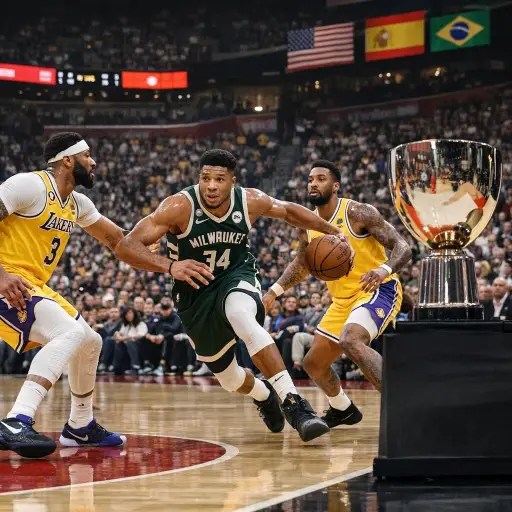
Strong fan response fuels plans for global games, richer incentives, and a reimagined midseason spectacle
The National Basketball Association is quietly preparing its next evolution. After the surprising early success of its in-season tournament concept, league officials are now exploring ways to expand the competition into a more ambitious, globally resonant event. What began as an experiment to inject urgency into the regular season is quickly becoming a centerpiece of the NBA calendar—and potentially a new commercial and cultural engine for the league.
Behind the scenes, discussions have intensified around broadening the tournament’s scope. According to league insiders, the NBA is evaluating multiple proposals that would increase the number of participating teams in later rounds, raise financial incentives for players, and—perhaps most notably—introduce international games as part of the tournament structure. While nothing has been formally approved, the direction is clear: the league sees an opportunity to transform a promising concept into a signature global product.
The original in-season tournament exceeded expectations in one crucial area—engagement. Television ratings saw notable spikes during tournament matchups, especially in knockout rounds, while social media interaction surged. Players, initially skeptical, began to embrace the format as the stakes became tangible. Coaches adjusted rotations. Fans tracked standings more closely. In short, the games felt different.
“It added a layer of meaning,” said one league executive familiar with internal evaluations. “You could feel it in the arenas and see it in the numbers. That’s rare for something introduced midstream.”
That success has emboldened the league to think bigger.
One of the most intriguing ideas under consideration is the inclusion of international venues during key tournament phases. Cities in Europe and Asia—already hosts to preseason NBA games—could become staging grounds for high-stakes matchups. Such a move would not only amplify the tournament’s global appeal but also align with the NBA’s long-term strategy of deepening its international footprint.
From a business standpoint, the implications are significant. A midseason tournament that spans continents could unlock new broadcasting deals, sponsorship opportunities, and localized fan engagement. It would also differentiate the NBA from other major North American leagues, many of which have struggled to meaningfully globalize their regular-season products.
Players, meanwhile, could see a substantial increase in financial rewards. The current prize structure—while notable—may be expanded to create even stronger incentives. Discussions include escalating bonuses tied to advancement, as well as potential revenue-sharing mechanisms linked to tournament success.
“Money always gets attention,” said a veteran agent. “But what really matters is prestige. If the league can make this feel like something players want on their résumé, that’s when it really takes off.”
Prestige is indeed central to the NBA’s long-term vision. League officials are aware that for the tournament to endure, it must carry symbolic weight beyond its monetary rewards. That could mean enhanced branding, unique trophies, or even long-term statistical recognition tied to tournament performance.
There are, however, challenges.
Scheduling remains one of the most complex hurdles. The NBA calendar is already dense, and introducing additional travel—especially international—would require careful coordination to avoid player fatigue and logistical strain. The league is reportedly analyzing various models, including condensed tournament windows and neutral-site hosting formats, to mitigate these concerns.
Competitive balance is another consideration. Expanding the tournament could risk diluting its intensity if not structured properly. League officials are said to be studying formats from global soccer competitions, where group stages and knockout rounds are designed to maintain high stakes throughout.
Despite these complexities, momentum appears firmly behind expansion.
Team executives have largely responded positively to early proposals, seeing both financial upside and marketing potential. Broadcasters, too, are eager for more high-leverage games during a traditionally quieter portion of the season. And fans—arguably the most important constituency—have already demonstrated a willingness to embrace something new.
The timing is also strategic. As media consumption habits evolve, the NBA is competing not just with other sports leagues but with an increasingly fragmented entertainment landscape. Creating must-watch moments outside of the playoffs is essential for maintaining relevance and driving year-round engagement.
In that context, the in-season tournament represents more than just a scheduling tweak—it’s a structural innovation.
If expanded thoughtfully, it could reshape how the regular season is perceived, turning what has often been criticized as a long and uneven marathon into a series of distinct, high-stakes chapters. It could also provide younger fans—accustomed to fast-paced, event-driven content—with a more compelling reason to tune in consistently.
Still, the league is proceeding with caution. Any major changes would likely be phased in gradually, allowing for adjustments based on feedback from players, teams, and fans. The NBA has learned from past innovations that flexibility is key.
What is clear, however, is that the experiment has already succeeded in one important respect: it has opened the door to reinvention.
The NBA has long positioned itself as the most progressive of the major American sports leagues, willing to test new ideas and adapt to changing dynamics. The potential expansion of the in-season tournament is the latest example of that philosophy in action.
As discussions continue, one thing seems increasingly certain—the midseason lull that once defined the NBA calendar may soon be a thing of the past. In its place could stand a globally recognized competition, rich with stakes, spectacle, and significance.
And if the league gets it right, the in-season tournament may not just complement the NBA season—it could redefine it.


 The Tower Post