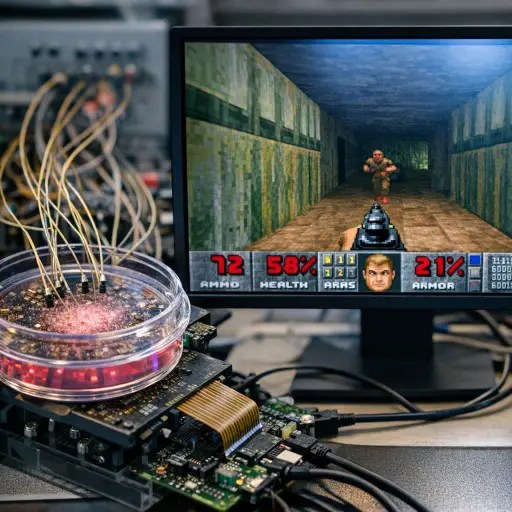
Lab-grown human brain cells are learning video games, blurring the line between biology and machine intelligence
When a cluster of human brain cells begins to learn how to play a video game, it sounds like the premise of speculative fiction. Yet inside laboratories in Australia, this is no longer imagination but experiment. Researchers at Cortical Labs have successfully connected living human neurons—grown in a petri dish—to a computer system, enabling them to interact with and gradually improve at playing the iconic game Doom.
The achievement marks a striking development in what scientists are beginning to call “biological computing.” Unlike traditional artificial intelligence, which relies purely on silicon-based hardware and code, this system merges living tissue with digital infrastructure. At its core are approximately 200,000 neurons, cultivated from human blood cells and grown on a microelectrode array—a glass chip capable of both stimulating the cells and recording their responses.
The process begins with an unusual transformation. Scientists reprogram ordinary human cells into induced pluripotent stem cells, effectively rewinding their biological clock. These cells are then coaxed into becoming neurons, which form networks once placed onto the chip. Electricity becomes the bridge between biology and machine: the computer sends signals the neurons can interpret, and the neurons respond with electrical activity that is translated into in-game actions.
To the outside observer, the setup is deceptively simple. A video game runs on a computer. Somewhere else, a dish of neurons pulses faintly with electrical activity. But between these two systems lies a sophisticated interface that converts visual and gameplay data into electrical patterns. When an enemy appears on one side of the screen, corresponding electrodes stimulate a region of the neural network. The neurons respond, and their activity is interpreted as commands—move, aim, shoot.
At first, the cells perform poorly. They do not understand the game, nor do they “see” it in any human sense. Early attempts show erratic movements, missed targets, and frequent failure. But over time, something remarkable happens: the neurons begin to adapt. They respond differently to feedback, gradually improving their performance. Researchers describe this as a form of learning—primitive, but unmistakable.
This learning is not evidence of consciousness. Scientists involved in the project emphasize that the system is not sentient, nor is it aware of its actions. It does not think, feel, or perceive in the way a human does. Instead, it demonstrates adaptive behavior—changing its responses based on input and feedback, much like basic reinforcement learning systems in artificial intelligence.
Still, the implications are profound. The ability to train living neurons to perform tasks suggests that biological systems may offer advantages over traditional computing. The human brain, shaped by millions of years of evolution, excels at tasks that remain difficult for machines, such as pattern recognition, motor control, and decision-making under uncertainty. By harnessing these properties, biological computers could complement or even surpass certain forms of AI.
The Doom experiment builds on earlier work by Cortical Labs, which previously trained neurons to play the simpler game Pong. That milestone demonstrated that neural cultures could exhibit goal-directed behavior when connected to a simulated environment. But Doom represents a significant leap in complexity. Its three-dimensional space, moving enemies, and unpredictable scenarios require a more sophisticated interaction between input and response.
To bridge that gap, engineers developed systems capable of translating the chaotic, fast-paced world of the game into structured electrical signals. The neurons, in turn, learn to navigate this environment—not by understanding it, but by adapting their firing patterns in response to feedback.
Beyond gaming, the potential applications are vast. Biological computing could transform medical research by allowing scientists to test drugs on living neural systems without involving patients. It could lead to more energy-efficient computing, as neurons operate with far lower power requirements than conventional processors. Some researchers even envision hybrid systems where biological and digital intelligence work together, enhancing robotics or enabling machines to better navigate complex, real-world environments.
Yet the technology also raises difficult questions. As neural systems become more complex, concerns about ethics and consciousness will inevitably grow. At what point does a network of neurons become something more than a tool? How should such systems be regulated? For now, scientists insist the current experiments remain far from anything resembling awareness. But the trajectory of the field suggests these questions may not remain theoretical for long.
For the moment, however, humanity’s first biological computers are engaged in a far more familiar activity: playing games. The neurons are far from expert players, often behaving like complete beginners. But they are improving. They are learning.
And in that simple fact lies the real breakthrough—not that brain cells can play Doom, but that living matter, interfaced with machines, can be trained, guided, and perhaps one day harnessed in ways that redefine what computing itself means.




 The Tower Post