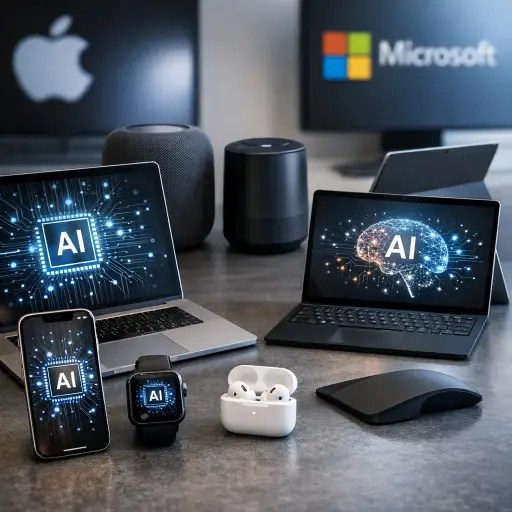
On-device intelligence reshapes consumer technology as speed, privacy, and autonomy redefine the next generation of hardware
The race to define the future of artificial intelligence is no longer confined to cloud infrastructure or data centers. Instead, it is rapidly shifting into the devices people use every day. In a decisive turn for the technology industry, Apple and Microsoft are accelerating efforts to embed advanced AI capabilities directly into consumer hardware, signaling a broader transition toward AI-first computing.
This shift reflects a fundamental change in how digital experiences are designed and delivered. Rather than relying heavily on remote servers, new generations of smartphones, laptops, and wearable devices are increasingly equipped to process AI tasks locally. The implications are significant: faster response times, enhanced privacy, and a reimagining of what personal devices can do independently.
At the center of this transformation is the concept of on-device AI—systems capable of performing complex tasks such as language processing, image recognition, and predictive automation without sending data to the cloud. Apple, long known for its emphasis on vertical integration, has deepened its investment in custom silicon optimized for machine learning workloads. Its latest chips are designed not only for performance efficiency but also for handling increasingly sophisticated AI models directly on the device.
Microsoft, meanwhile, is pushing forward with its own vision of AI-powered computing, particularly through its integration of AI capabilities into Windows-based hardware and its growing ecosystem of AI-enhanced applications. The company is aligning software innovation with hardware advancements, encouraging manufacturers to build devices that can fully leverage local AI processing.
The strategic convergence between hardware and AI reflects a shared understanding: the next era of consumer electronics will be defined not by raw processing power alone, but by intelligence embedded at the core of the device.
One of the most immediate benefits of this shift is speed. On-device AI eliminates the latency associated with cloud-based processing. Tasks such as voice recognition, photo editing, and real-time translation can now occur almost instantaneously. For users, this translates into smoother interactions and a more seamless integration of technology into daily life.
Equally important is the growing emphasis on privacy. By keeping data processing local, companies can reduce the need to transmit sensitive information across networks. This approach aligns with increasing consumer awareness around data security and regulatory pressures worldwide. Apple, in particular, has positioned privacy as a central pillar of its AI strategy, promoting on-device processing as a safeguard against data misuse.
Microsoft’s approach, while more hybrid in nature, also reflects this trend. By combining cloud intelligence with local processing, it aims to offer flexibility while still addressing concerns about data control and responsiveness. The result is a layered model of AI computing, where tasks are dynamically allocated between device and cloud depending on complexity and context.
This evolution is also reshaping hardware design itself. Devices are no longer built solely around CPUs and GPUs but are increasingly centered on specialized AI accelerators. These components, often referred to as neural processing units (NPUs), are optimized for machine learning tasks and are becoming a defining feature of modern chips.
As a result, the line between hardware and software continues to blur. AI is no longer an application layer—it is becoming an intrinsic part of the system architecture. This integration enables new categories of features, from predictive user interfaces to context-aware assistants that anticipate needs before they are explicitly expressed.
For developers, the rise of on-device AI opens new possibilities but also introduces new challenges. Applications must be designed to operate within the constraints of local hardware while still delivering advanced functionality. This requires a shift in development paradigms, with greater emphasis on efficiency, model optimization, and edge computing techniques.
The competitive dynamics between Apple and Microsoft are also evolving in response to this shift. While Apple maintains tight control over its ecosystem, allowing for deep hardware-software integration, Microsoft leverages its broader platform reach to influence a wide array of device manufacturers. Both approaches have advantages, and their coexistence is likely to drive innovation across the industry.
Beyond the two companies, the impact of this transition is being felt across the entire technology landscape. Semiconductor firms, device manufacturers, and software developers are all adapting to a world where AI capabilities are expected to be built into every layer of the computing stack.
Looking ahead, the move toward AI-first devices suggests a future where personal technology becomes more autonomous, adaptive, and intuitive. Devices will not simply respond to commands—they will understand context, learn from behavior, and act proactively.
This transformation raises important questions about user control, transparency, and the ethical use of AI. As devices become more intelligent, ensuring that they remain aligned with user intent and values will be critical. Both Apple and Microsoft have acknowledged these challenges, emphasizing responsible AI development as part of their broader strategies.
What is clear, however, is that the direction of travel is set. The integration of AI into hardware is no longer an experimental frontier—it is becoming the foundation of modern computing.
As consumers begin to experience the benefits of faster, more private, and more capable devices, expectations will continue to rise. In response, the industry will be compelled to innovate not just incrementally, but fundamentally.
In this emerging landscape, the device in your hand or on your desk is no longer just a tool. It is becoming an intelligent partner—one that processes, learns, and adapts in real time, reshaping the relationship between humans and technology in the process.



 The Tower Post