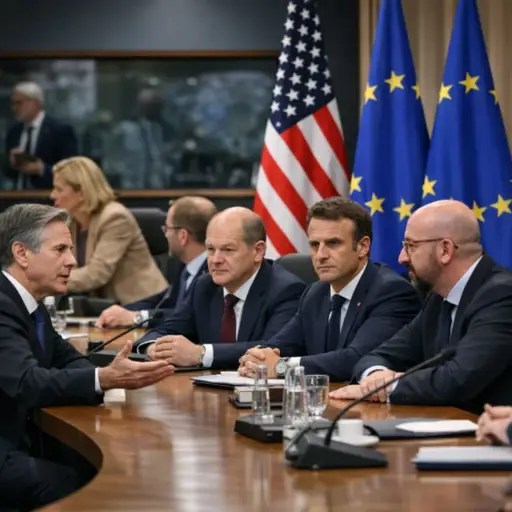
European leaders resist U.S. pressure, prioritizing diplomacy and economic stability as transatlantic divisions deepen
As tensions intensify in the Middle East following escalating hostilities involving Iran, European leaders have drawn a firm line: the European Union will not take part in direct military operations. Despite mounting pressure from Washington to present a united Western front, Brussels has instead emphasized diplomacy, de-escalation, and the protection of economic stability.
The decision, shaped by urgent consultations among EU member states, reflects a growing divergence in strategic priorities between Europe and the United States. While Washington has signaled readiness to expand military engagement in response to Iranian actions, European capitals are increasingly wary of being drawn into another prolonged conflict in the region.
Senior EU officials have framed their position as one rooted in lessons from past interventions. Many leaders point to the long-term consequences of earlier Middle Eastern wars, which contributed to regional instability, migration pressures, and domestic political strain across Europe. Against this backdrop, the appetite for direct military involvement remains limited.
Instead, the EU is advancing a multi-track diplomatic strategy. This includes renewed engagement with regional actors, support for backchannel negotiations, and coordination with international organizations aimed at preventing further escalation. European diplomats are also exploring mechanisms to revive elements of previous nuclear and security frameworks that once helped contain tensions with Tehran.
Economic considerations are central to the European stance. The prospect of a wider conflict has already triggered volatility in global energy markets, raising concerns about inflation and supply disruptions across the continent. For many EU governments, safeguarding economic resilience is inseparable from maintaining political stability at home.
“Escalation is not in Europe’s interest,” one senior official noted, echoing a sentiment widely shared among member states. “Our priority is to prevent a regional war that could have global consequences.”
The divergence in approach has exposed underlying strains in the transatlantic alliance. While cooperation between Europe and the United States remains strong in many areas, particularly in security and trade, differences over the use of military force have become more pronounced. Analysts suggest that Europe’s reluctance reflects not only strategic caution but also a broader shift toward greater autonomy in foreign policy decision-making.
Public opinion across Europe has also played a role. Surveys and political signals indicate limited support for military engagement, with many citizens favoring diplomatic solutions over armed intervention. This domestic context has reinforced leaders’ inclination to resist external pressure.
At the same time, European governments are not disengaging entirely from the crisis. The EU continues to provide humanitarian assistance, enhance regional monitoring efforts, and coordinate closely with allies on sanctions and containment measures. However, these actions stop short of direct participation in combat operations.
The current moment underscores a complex reality: while Europe and the United States remain partners, their perspectives on how to manage global crises are not always aligned. The EU’s decision to reject a military role in the Middle East conflict marks a significant assertion of its strategic priorities—one that could shape the future of transatlantic relations.
As diplomatic efforts intensify, the effectiveness of Europe’s approach will be closely watched. For now, the message from Brussels is clear: in a region once again on the brink, Europe is choosing negotiation over confrontation, and stability over escalation.

 The Tower Post