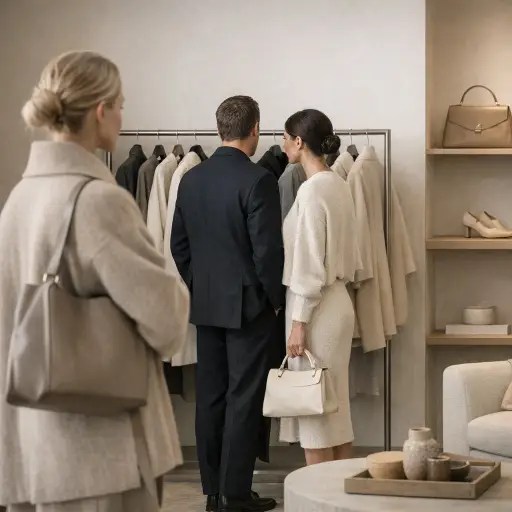
Minimalist, logo-free design reshapes high-end collections as consumers embrace discretion over display in an era of economic caution.
In boutique showrooms from New York to Los Angeles, the most coveted luxury items are no longer the loudest. Gone are the oversized logos and instantly recognizable monograms that once defined status. In their place: cashmere coats in muted tones, precisely tailored silhouettes, and handbags so discreet they require a trained eye to identify.
The shift toward “quiet wealth” — a minimalist, logo-free aesthetic — is rapidly redefining the American luxury market. It signals not only a change in taste but a deeper transformation in how consumers express status, particularly in a climate shaped by economic unease and evolving cultural values.
Designers across major fashion houses have been steadily stripping back visual excess. Collections now favor neutral palettes, refined textures, and craftsmanship that speaks through detail rather than branding. In recent runway seasons, the absence of logos has become the defining statement. Subtlety, once considered secondary, is now the ultimate marker of sophistication.
Retail data and industry observations suggest that high-end consumers are increasingly prioritizing longevity over visibility. Rather than purchasing items that broadcast wealth, buyers are investing in pieces that whisper it — garments designed to endure both physically and stylistically. A well-cut wool coat or an impeccably constructed leather bag carries more value than a trend-driven item emblazoned with a logo.
This transition reflects a broader recalibration of status signaling. In previous decades, conspicuous consumption — the overt display of wealth through branded goods — dominated luxury culture. Today, that model is losing ground to a more coded form of distinction. Knowing what to wear, rather than showing what one can afford, has become the new currency of taste.
Cultural influences have accelerated the trend. The growing popularity of “stealth wealth” aesthetics in television, social media, and celebrity wardrobes has normalized understated dressing among affluent and aspirational consumers alike. Influencers and stylists now highlight fabric quality, tailoring, and fit rather than brand visibility, reinforcing the appeal of subtle luxury.
At the same time, economic uncertainty has played a critical role. Periods of financial instability often reshape consumer behavior, and the current environment is no exception. Even high-net-worth individuals are exhibiting more measured spending patterns, favoring investment pieces over conspicuous splurges. Discretion, in this context, is not just stylistic — it is strategic.
Luxury brands, long reliant on recognizable logos to maintain visibility, are adapting quickly. Many are expanding their offerings of minimalist staples while reinterpreting heritage designs with reduced branding. Some labels are even introducing entirely logo-free lines, emphasizing craftsmanship, materials, and timeless design as their primary selling points.
This pivot does not signal the end of branding altogether, but rather its evolution. Logos have not disappeared; they have become more subtle, often integrated into stitching, hardware, or silhouette rather than displayed prominently. The message remains, but it is conveyed through nuance rather than declaration.
Younger consumers are also shaping this landscape. Millennials and Gen Z buyers, who increasingly dominate luxury spending, tend to value authenticity, sustainability, and individuality. For them, quiet wealth aligns with a desire to avoid overt displays of status while still appreciating high-quality design. The appeal lies in exclusivity without ostentation.
Importantly, the quiet wealth movement also blurs traditional boundaries between luxury and minimalism. What was once associated with restraint or even austerity is now synonymous with refinement and confidence. Wearing less visible branding suggests a level of assurance — a confidence that does not rely on external validation.
For retailers, the challenge lies in communicating value without relying on visual shorthand. Sales strategies are shifting toward storytelling around craftsmanship, sourcing, and design integrity. The emphasis is on educating consumers to recognize quality beyond logos, fostering a more informed and discerning clientele.
As the trend continues to gain momentum, it is reshaping not just collections but the identity of luxury itself. The new definition of prestige is quieter, more intentional, and less performative. It favors those who understand the language of subtlety — and are fluent in its signals.
In an industry historically driven by visibility, the embrace of invisibility marks a profound shift. Luxury, it seems, is no longer about being seen. It is about being known — by those who know.



 The Tower Post