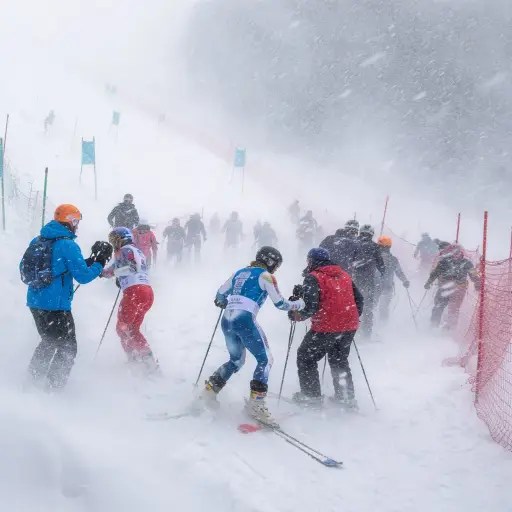
Race Halted as Sudden Whiteout Turns Elite Competition into Emergency Situation
The Alpine Ski World Cup was abruptly halted midway through a major race this week after extreme weather conditions swept across the course within minutes, forcing organizers to suspend the event for safety reasons.
What began under relatively stable conditions quickly deteriorated as a fast-moving storm engulfed the mountainside. Athletes already on the course found themselves navigating increasingly hazardous terrain as visibility dropped sharply, transforming a world-class competition into a high-risk environment almost instantaneously.
Competitors described the moment conditions shifted as both sudden and disorienting. Several athletes reported that visibility fell to near zero in a matter of moments, leaving them unable to distinguish the course ahead.
“It was like a wall of white,” one skier said after being escorted down the slope. “One second you could see the gates clearly, and the next, everything disappeared. It felt like skiing blind.”
Race officials acted swiftly, issuing an immediate stop to the competition and coordinating the safe evacuation of all participants. Skiers were guided down the course while safety personnel worked to secure the area amid intensifying snowfall and strong winds.
“The decision was not difficult,” said a race official. “When visibility collapses that quickly, continuing is simply not an option. Athlete safety comes first.”
The incident highlights a growing challenge facing winter sports: the increasing volatility of mountain weather. While sudden storms are not new to alpine environments, the speed and intensity of this shift have raised concerns among athletes, organizers, and experts alike.
Veteran competitors noted that such rapid changes are becoming more frequent. “You expect difficult conditions in the mountains,” one racer explained, “but what’s changing is how fast things escalate. There’s less time to react.”
The disruption has also reignited broader discussions about the impact of climate instability on elite sporting events. Unpredictable weather patterns are increasingly interfering with schedules, logistics, and safety planning, forcing organizers to adapt in real time.
Experts warn that these interruptions may become more common as atmospheric conditions grow more erratic. For sports dependent on precise environmental conditions, such as alpine skiing, even small shifts can have significant consequences.
Event organizers are now facing mounting pressure to rethink contingency planning, including more flexible scheduling, enhanced forecasting tools, and stricter safety thresholds.
In the aftermath of the cancellation, teams and officials were left managing the logistical fallout of an unfinished race, with uncertainty surrounding rescheduling and overall standings.
As the storm continued to intensify over the mountains, one thing became clear: the future of winter sports may increasingly depend not only on athletic performance, but on the ability to adapt to a rapidly changing natural environment.




 The Tower Post