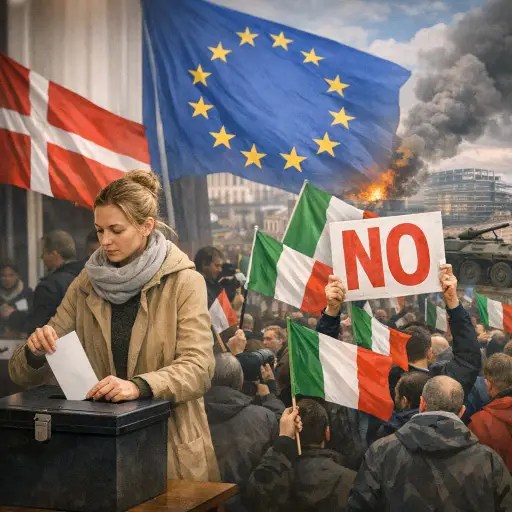
Denmark’s election and Italy’s reform vote expose a restless electorate as inflation and war pressures reshape the European political landscape
Across Europe, a new wave of political uncertainty is taking shape as voters head to the polls with growing skepticism toward traditional leadership. Elections and referendums are no longer routine democratic exercises; they have become high-stakes barometers of public frustration, reflecting deeper anxieties about economic security, geopolitical instability, and the future of governance within the European Union.
In Denmark, a closely watched national election has revealed a shifting political mood. Once known for its stable consensus-driven politics, the country is now witnessing a fragmentation of voter preferences. Rising living costs, driven in part by prolonged geopolitical tensions and supply chain disruptions linked to war, have pushed economic concerns to the forefront. Voters are increasingly questioning whether established parties can adequately respond to the pressures of inflation and maintain the welfare standards long associated with Danish society.
Political analysts note that the Danish vote is less about a dramatic ideological shift and more about erosion of trust. Smaller parties and new political movements have gained traction, capitalizing on dissatisfaction with incremental policymaking. While Denmark remains a pillar of institutional stability, the election underscores a broader European pattern: voters are demanding faster, more decisive action in the face of mounting challenges.
Meanwhile, in Italy, a national reform referendum has become a focal point for public discontent. The vote, centered on institutional and economic reforms, has evolved into a referendum not just on policy, but on political credibility itself. Public debate has been marked by sharp divisions, with supporters arguing that reform is necessary to modernize governance, and opponents warning of overreach and erosion of democratic safeguards.
The Italian case highlights a recurring tension within European democracies: the balance between reform and representation. As governments attempt to adapt to new economic realities, including persistent inflation and energy insecurity, they face resistance from voters wary of rapid change. The referendum has amplified concerns about transparency, accountability, and the perceived distance between political elites and everyday citizens.
Underlying both developments is the lingering impact of war-driven inflation. The economic ripple effects of ongoing conflict have been felt across the continent, from rising energy prices to increased costs of basic goods. For many households, the promise of post-pandemic recovery has been overshadowed by financial strain, creating fertile ground for political volatility.
This economic pressure is reshaping political narratives. Governments are increasingly judged not only on long-term policy vision but on their ability to deliver immediate relief. In this environment, traditional party loyalties are weakening, and voters are more willing to explore alternatives that promise swift and tangible results.
The consequences for the European Union are significant. Political instability within member states can complicate collective decision-making, particularly on issues such as economic coordination, defense policy, and energy strategy. Diverging domestic priorities risk slowing down consensus at the EU level, at a time when unity is crucial.
Moreover, the rise of protest voting and anti-establishment sentiment poses challenges to the EU’s broader integration project. While dissatisfaction does not necessarily translate into outright rejection of the Union, it does signal a demand for reform in how decisions are made and communicated. Citizens are increasingly calling for greater responsiveness and accountability from both national governments and EU institutions.
Experts suggest that the current moment represents a critical juncture. The combination of economic strain and geopolitical uncertainty is testing the resilience of European democracies. Governments must navigate a delicate balance: implementing necessary reforms while maintaining public trust, addressing immediate concerns without losing sight of long-term stability.
As ballots are cast and results unfold, one message is becoming clear: European voters are no longer content with gradual change. They are seeking leadership that can adapt quickly to a rapidly evolving world, without compromising democratic principles. Whether political systems can meet these expectations will shape the continent’s trajectory in the months ahead.
In the end, the elections in Denmark and the referendum in Italy are more than isolated national events. They are part of a broader European story—one defined by uncertainty, transformation, and the enduring challenge of aligning governance with the will of the people.


 The Tower Post