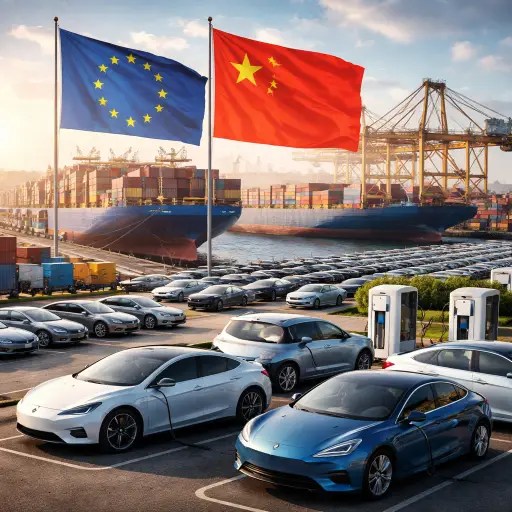
Protectionism, pricing battles, and a new geopolitical race define the electric vehicle market’s next phase
The global electric vehicle (EV) industry is entering a decisive new chapter as Europe moves toward imposing higher tariffs on Chinese-made electric cars. What began as a targeted effort to shield domestic manufacturers is quickly evolving into a broader shift with global consequences, forcing automakers to rethink pricing, supply chains, and long-term strategy.
Across European capitals, policymakers argue that Chinese EV producers benefit from substantial state support, allowing them to undercut local competitors on price. The proposed tariff measures are framed not only as economic protection but as a safeguard for industrial sovereignty in a sector seen as critical to the continent’s green transition.
Yet the ripple effects extend far beyond Europe’s borders.
A Defensive Move With Global Reach
European automakers have long warned that an influx of low-cost Chinese EVs could erode their market share just as they scale up electrification efforts. Brands across Germany, France, and Italy are investing heavily in battery production and new EV platforms, but many remain cost-disadvantaged compared to their Chinese counterparts.
By raising tariffs, the European Union aims to level the playing field. However, the move risks triggering retaliation and accelerating a fragmentation of the global EV market into regional blocs.
For consumers, the implications are immediate: higher tariffs could translate into higher prices, at least in the short term. For manufacturers, the stakes are even higher.
Automakers Adjust Strategy in Real Time
Chinese EV giants are already adapting. Companies such as BYD are expanding production footprints outside China, exploring manufacturing in Europe and other regions to bypass tariffs. This shift mirrors earlier strategies used by traditional automakers navigating trade barriers.
Meanwhile, Tesla is recalibrating its global operations. With production facilities spread across multiple continents, the company has more flexibility than most—but it is not immune. Pricing strategies are being fine-tuned market by market, reflecting changes in tariffs, logistics costs, and competitive pressure.
The result is a dynamic reshuffling of supply chains. Automakers are increasingly prioritizing “local-for-local” production—building vehicles closer to where they are sold—to reduce exposure to geopolitical risk.
The Supply Chain Becomes the Battleground
Beyond finished vehicles, the tariff debate is accelerating competition across the EV supply chain, particularly in batteries and critical minerals.
Europe has been racing to build its own battery ecosystem, seeking to reduce reliance on imports from Asia. Tariffs on vehicles may reinforce this push, encouraging investment in local gigafactories and raw material processing.
However, the transition is complex. Many components still depend on global networks, and sudden shifts can introduce inefficiencies and cost pressures. Industry executives warn that a fragmented system could slow innovation and delay the rollout of affordable EVs.
A New Era of Pricing Volatility
One of the most immediate consequences of Europe’s tariff policy is pricing uncertainty. As companies adjust to new trade realities, price differences between regions are likely to widen.
Chinese manufacturers may redirect surplus inventory to markets in Southeast Asia, Latin America, or Africa, intensifying competition there. In North America, where its own trade restrictions are already in place, the market could become even more insulated.
This divergence challenges the idea of a unified global EV market. Instead, pricing and availability may increasingly depend on regional policies rather than purely on technological progress or economies of scale.
Risk of a Broader Trade Shift
What is unfolding in Europe may signal the beginning of a wider global trade realignment. Governments are placing strategic industries under closer scrutiny, and electric vehicles—central to both climate goals and industrial policy—are at the heart of this shift.
If other regions follow Europe’s lead, the EV market could fragment into competing spheres of influence. Trade flows would adjust accordingly, with companies optimizing production and distribution within political as well as economic constraints.
Such a scenario carries both risks and opportunities. While it may protect local industries, it could also reduce efficiency and slow the global transition to cleaner transport.
Industry at a Crossroads
The EV sector has been defined by rapid growth, falling costs, and increasing global integration. Europe’s tariff push introduces a new variable: geopolitics.
Automakers must now navigate not only technological challenges and consumer demand but also shifting trade policies. Flexibility, scale, and geographic diversification are becoming as important as innovation.
For policymakers, the challenge is balancing protection with progress. Shielding domestic industries may provide short-term relief, but long-term success will depend on competitiveness, not just barriers.
Looking Ahead
As the policy takes shape, its full impact will unfold over the coming months. What is already clear is that the EV race is no longer just about batteries and software—it is about borders, alliances, and economic strategy.
Europe’s decision marks a turning point. Whether it leads to a more resilient industry or a more divided market will depend on how governments and companies respond.
One thing is certain: the global auto industry is being reshaped in real time, and electric vehicles are at the center of the transformation.



 The Tower Post