European forces intercept suspected sanctions-busting vessel as maritime tensions escalate and energy security faces new risks
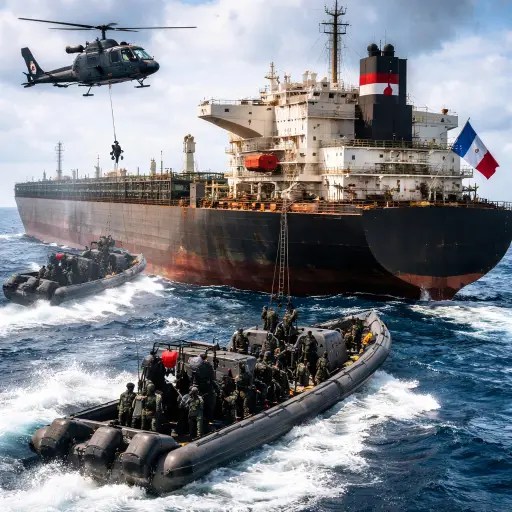
The French Navy has intercepted and seized a tanker suspected of belonging to Russia’s so-called “shadow fleet,” marking a significant escalation in Europe’s enforcement of maritime sanctions. The operation, conducted in the Mediterranean, underscores growing concerns that covert shipping networks are being used to bypass international restrictions on Russian oil exports.
According to European defense officials, the vessel had been operating under ambiguous ownership structures and frequently changing flags—hallmarks of a shadow fleet tanker. These ships are often used to obscure the origin of sanctioned cargo, allowing oil to reach global markets despite sweeping Western restrictions. The seizure represents one of the most assertive actions taken by a European navy to disrupt such operations at sea.
The intercepted tanker was reportedly navigating through a strategic corridor in the Mediterranean when French forces, supported by allied surveillance assets, moved in. Maritime patrol aircraft and naval units had been tracking the vessel for days amid suspicions of illicit cargo transfers. Officials say the operation was executed without resistance, though investigations into the ship’s ownership, cargo, and recent movements are ongoing.
The incident comes amid heightened geopolitical tensions tied to the ongoing conflict involving Russia, where economic warfare has increasingly extended into global shipping lanes. European authorities have stepped up monitoring of maritime routes, particularly those linking Russian ports to markets in Asia, the Middle East, and Africa. Analysts warn that enforcement actions like this could trigger retaliatory measures or further complicate already strained energy supply chains.
Compounding concerns, a separate but related maritime emergency has intensified fears over the vulnerability of energy infrastructure. A liquefied natural gas (LNG) tanker in the Mediterranean was left adrift after sustaining damage in what officials describe as a suspected drone attack. The vessel, carrying volatile cargo, reportedly lost propulsion and communication capabilities, prompting urgent intervention by nearby naval units.
While no group has officially claimed responsibility for the drone strike, security experts point to a troubling pattern of asymmetric attacks targeting critical energy assets. The use of unmanned aerial systems against commercial shipping represents a significant evolution in maritime threats, raising the stakes for naval forces tasked with protecting vital supply routes.
The drifting LNG tanker posed immediate environmental and safety risks. Emergency crews worked to stabilize the vessel and prevent potential leakage or explosion, while nearby shipping traffic was rerouted as a precaution. The incident highlights the fragile balance between commercial maritime activity and emerging security challenges in contested waters.
Together, these developments signal a broader shift in how modern conflicts are influencing global trade and energy flows. What was once a largely invisible network of sanctions evasion is now increasingly exposed—and actively disrupted—by coordinated military action. At the same time, new forms of attack are introducing unpredictable hazards that extend far beyond traditional battlefields.
Energy markets have reacted cautiously, with traders closely monitoring both the enforcement of sanctions and the security of transport routes. Any sustained disruption in Mediterranean shipping could ripple across global supply chains, affecting prices and availability of both oil and natural gas.
European officials have emphasized that the seizure of the suspected shadow fleet tanker is part of a wider effort to uphold international law and maintain the integrity of sanctions regimes. However, they also acknowledge that the situation remains fluid, with risks of escalation ever-present.
As naval patrols intensify and surveillance expands, the Mediterranean is emerging as a focal point in the intersection of military strategy, economic pressure, and energy security. The recent incidents serve as a stark reminder that the consequences of geopolitical conflict are no longer confined to land—they are increasingly unfolding across the world’s most vital समुद routes.
In this evolving landscape, the line between commerce and conflict continues to blur, leaving governments, industries, and consumers alike navigating an uncertain and increasingly volatile maritime environment.



 The Tower Post