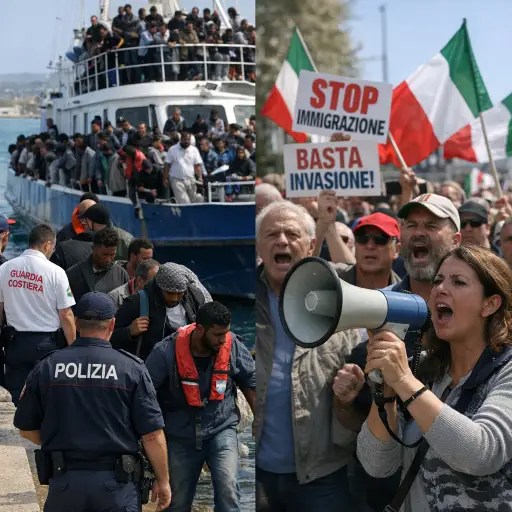
New border controls, asylum reforms, and EU divisions expose deep fractures in Italian leadership and society
Italy’s leadership is facing one of its most defining political tests in recent years as it pushes forward a sweeping overhaul of migration policy. The new measures—designed to tighten border controls and accelerate asylum processing—have ignited debate not only within Italy but across the European Union, where divisions over responsibility-sharing remain unresolved.
At the heart of the government’s strategy is a renewed emphasis on deterrence and efficiency. Officials argue that the current system is overstretched and vulnerable to abuse, requiring stricter enforcement at entry points and faster decisions on asylum claims. Plans include expanding detention facilities, increasing naval patrols in the central Mediterranean, and streamlining legal procedures to reduce backlogs that have long plagued the system.
Supporters within the ruling coalition frame the reforms as necessary to restore order and credibility. “Italy cannot continue to act as Europe’s primary landing point without adequate support,” a senior government figure stated, reflecting a widely held sentiment among policymakers. The administration insists that its approach balances security concerns with humanitarian obligations, though critics question whether that balance can realistically be maintained.
The policy shift comes amid sustained migration flows across the Mediterranean, driven by instability in parts of North Africa and the Middle East. Italy’s geographic position has made it a frontline state, receiving thousands of arrivals each year. While rescue operations continue, authorities are increasingly focused on preventing departures and strengthening agreements with transit countries.
Yet these efforts have exposed persistent fractures within the European Union. Italy has long called for a more equitable distribution of asylum seekers among member states, but consensus remains elusive. Northern and Eastern European countries have resisted mandatory quotas, favoring voluntary mechanisms or stricter external border controls instead.
Recent negotiations have underscored these tensions. While some EU partners have expressed willingness to provide financial and logistical support, others remain reluctant to accept relocated migrants. The result is a patchwork approach that leaves frontline states like Italy bearing a disproportionate burden.
Diplomatic sources suggest that Italy is leveraging its position to push for broader reforms at the European level, including stronger external partnerships and a unified asylum framework. However, progress has been slow, and frustration is growing in Rome over what officials describe as a lack of solidarity.
Domestically, the government’s proposals have triggered a wave of protests, revealing deep political polarization. Demonstrations have taken place in major cities, with activists, humanitarian organizations, and opposition parties accusing the government of undermining human rights and international obligations.
Protesters argue that stricter measures risk criminalizing migration and placing vulnerable individuals in precarious conditions. “This is not just about policy—it’s about values,” said one organizer at a recent rally. Civil society groups have also raised concerns about conditions in detention centers and the potential for accelerated procedures to compromise due process.
On the other side of the political spectrum, supporters of the reforms have rallied in favor of tougher controls, citing concerns over security, economic strain, and social cohesion. For many, the issue has become emblematic of broader anxieties about national identity and the capacity of public services.
The opposition landscape itself remains fragmented, with parties divided over how to respond. While some advocate for a more humanitarian approach and stronger EU cooperation, others emphasize pragmatic solutions that acknowledge public concerns. This lack of a unified alternative has allowed the government to maintain momentum despite mounting criticism.
Analysts note that migration has once again become a central axis of Italian politics, shaping electoral dynamics and public discourse. The issue cuts across traditional ideological lines, influencing debates on sovereignty, economic policy, and Italy’s role within Europe.
As the government moves forward, the success of the reforms will depend not only on their implementation but also on their broader political and diplomatic context. Without meaningful cooperation at the European level, Italy’s efforts may face structural limitations.
At the same time, the domestic response will continue to play a crucial role. Sustained protests and political opposition could pressure the government to adjust its approach, while public opinion remains a key factor in determining the durability of the reforms.
In the coming weeks, Italy’s migration overhaul is likely to remain at the forefront of both national and European agendas. The stakes are high: the outcome will not only shape Italy’s internal political landscape but also influence the future direction of migration policy across the European Union.
For now, the country stands at a crossroads—caught between the demands of governance, the realities of migration, and the enduring challenge of finding common ground in an increasingly divided political environment.




 The Tower Post