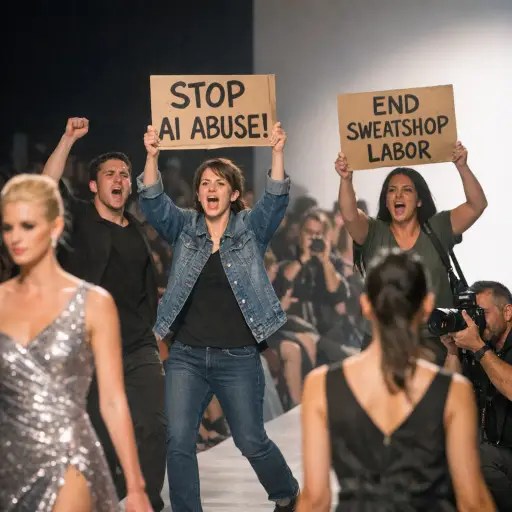
As protests sweep through New York and Los Angeles, activists challenge the fashion industry’s embrace of artificial intelligence, opaque labor systems, and environmental costs—turning catwalks into contested political spaces.
The lights dim, the music swells, and a model steps onto the runway. But before the audience can settle into the familiar rhythm of Fashion Week spectacle, a different kind of performance takes over. Protesters emerge—sometimes from the crowd, sometimes from backstage—holding signs, chanting slogans, and halting shows mid-stride. What was once a controlled display of style is now an unpredictable stage for dissent.
Across New York and Los Angeles, activists are increasingly disrupting Fashion Week events, drawing attention to what they describe as the industry’s deepening ethical crisis. Their grievances span three interconnected fronts: the growing use of artificial intelligence in design and marketing, persistent concerns over labor exploitation, and the environmental toll of fast and luxury fashion alike.
For organizers and designers, the interruptions have been jarring. For activists, they are long overdue.
A New Target: Artificial Intelligence in Fashion
One of the most visible flashpoints is the rise of AI-driven design tools. From generative models producing garment concepts to virtual influencers replacing human faces, technology is rapidly reshaping the creative process. While brands tout efficiency and innovation, critics argue that these systems often rely on uncredited human labor—scraping artistic works, cultural motifs, and independent designs without consent.
“AI is being marketed as futuristic,” said one protester outside a downtown venue, “but it’s built on invisible labor and questionable data practices.”
Designers themselves appear divided. Some embrace AI as a collaborative tool, while others worry about authorship, originality, and the erosion of craftsmanship. Behind the scenes, stylists and illustrators express concern that their roles may be quietly diminished, even as the industry celebrates technological advancement.
Labor Behind the Luxury
Beyond the debate over AI lies a more longstanding issue: labor conditions across global supply chains. Protesters have used runway disruptions to spotlight the disconnect between high-end branding and the realities of garment production.
Activist groups claim that many labels—despite public commitments to ethical sourcing—continue to rely on underpaid workers in loosely regulated environments. The contrast is particularly stark during Fashion Week, where exclusivity and opulence are on full display.
Some demonstrators have entered venues wearing garments turned inside out, revealing tags and stitching as symbolic gestures. Others have staged “die-ins” on runways, forcing audiences to confront the human cost embedded in fashion’s glossy exterior.
Industry representatives often point to incremental progress, citing sustainability reports and transparency initiatives. But critics argue that these measures fall short of systemic change.
The Climate Cost of Style
Environmental concerns form the third pillar of the protests. From textile waste to carbon-intensive production cycles, fashion’s ecological footprint has come under increasing scrutiny. Activists argue that seasonal collections and rapid trend turnover encourage overconsumption, even within luxury markets.
In Los Angeles, a group unfurled fabric banners dyed with natural pigments, contrasting them with synthetic materials used in many contemporary collections. In New York, demonstrators carried garments made entirely from discarded textiles, challenging designers to rethink production models.
“Fashion is storytelling,” one organizer said. “Right now, the story is unsustainable.”
Brands have responded with capsule collections labeled as eco-conscious, but activists question whether these efforts represent genuine transformation or strategic branding.
Runways as Political Arenas
What makes the current wave of protests distinct is not just their frequency, but their visibility. Social media has amplified each disruption, turning moments of interruption into viral statements. A halted runway show can now reach millions within minutes, extending the impact far beyond the venue.
This shift has effectively transformed Fashion Week into a contested cultural space—one where aesthetics and ethics collide in real time.
Some designers have begun to acknowledge the tension directly, incorporating themes of sustainability and labor into their collections. Others have tightened security, attempting to preserve the traditional format of their shows.
Yet even as organizers adapt, the disruptions continue.
An Industry at a Crossroads
The protests unfolding this season suggest that fashion can no longer separate image from impact. As technology evolves and consumer awareness grows, the industry faces mounting pressure to reconcile creativity with accountability.
For now, the runway remains both a platform and a battleground—where beauty is not just displayed, but debated.
And as the next show begins, there is an unspoken expectation in the room: not just anticipation of what will be worn, but uncertainty over what might unfold.
 The Tower Post