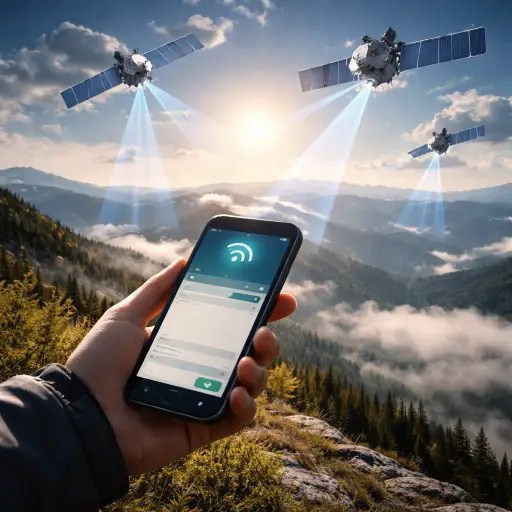
New trials let smartphones send messages without cellular networks—potentially redefining global connectivity in an era of disruption and distance.
In a quiet but potentially transformative shift in global communications, major technology companies are accelerating trials of satellite-to-phone systems that allow smartphones to connect without relying on traditional cellular networks. The emerging concept—often described as “offline internet”—is gaining traction as a solution for some of the most persistent gaps in global connectivity.
Unlike conventional mobile service, which depends on ground-based cell towers, these new systems enable devices to communicate directly with satellites orbiting the Earth. The result is a form of connectivity that can function in remote regions, disaster-stricken areas, and locations where infrastructure is unreliable or entirely absent.
The implications are significant. If successful at scale, satellite-to-phone communication could mark a turning point in how the world stays connected—especially in moments when connectivity matters most.
A Network Without Towers
The core idea behind these trials is deceptively simple: eliminate the need for terrestrial infrastructure by linking everyday smartphones directly to satellites. Recent advances in low-Earth orbit satellite constellations, combined with improvements in smartphone antenna design, have made this concept increasingly viable.
Early testing phases suggest that users can send text messages, receive emergency alerts, and access limited data services using standard devices, without any specialized hardware. In some cases, connectivity is automatic—activating when traditional signal coverage drops out.
For technology companies, this represents more than a technical milestone. It is a strategic expansion into a new layer of the connectivity market, one that blurs the line between telecommunications and space-based infrastructure.
Reaching the Unreachable
One of the most immediate applications of satellite-to-phone systems lies in extending connectivity to underserved regions. Vast areas of the world still lack reliable mobile coverage due to geographic, economic, or political barriers. Mountain ranges, deserts, oceans, and sparsely populated rural zones have long remained outside the reach of traditional networks.
Satellite connectivity offers a way around these limitations. By bypassing the need for towers, it provides a direct link to users regardless of terrain. For communities that have historically been disconnected, this could open access to communication, information, and emergency services in ways previously unimaginable.
The technology is also drawing attention from humanitarian organizations and governments seeking resilient communication systems in crisis scenarios. When earthquakes, hurricanes, or conflicts damage infrastructure, restoring connectivity can take days or weeks. Satellite-to-phone systems, by contrast, can function independently of local conditions.
A Lifeline in Emergencies
Disaster response is quickly emerging as one of the most compelling use cases for this technology. In emergency situations, the ability to send even a simple text message can be life-saving.
Recent trial reports indicate that satellite-enabled messaging can operate under conditions where traditional networks fail entirely. This includes areas with widespread power outages, damaged towers, or overloaded systems.
Emergency services could benefit from more reliable communication channels, while individuals in affected regions would gain a direct line to assistance. Some systems are already being designed to prioritize emergency traffic, ensuring that critical messages are transmitted even under limited bandwidth conditions.
This capability is particularly relevant as climate-related disasters become more frequent and severe, placing additional strain on existing infrastructure.
Industry Momentum Builds
The push toward satellite-to-phone connectivity is being driven by a convergence of interests across the tech and telecommunications sectors. Satellite operators, smartphone manufacturers, and network providers are increasingly collaborating to bring these systems to market.
For satellite companies, direct-to-device connectivity represents a new revenue stream and a way to expand beyond traditional services such as broadcasting and broadband. For smartphone makers, it adds a new layer of functionality that could differentiate future devices.
Telecom operators, meanwhile, face both opportunity and disruption. While satellite integration could enhance coverage and reduce infrastructure costs, it also challenges the traditional model of network ownership and control.
As trials expand, competition is intensifying. Companies are racing to refine performance, increase data capacity, and reduce latency—all critical factors for making the technology viable for everyday use.
Technical and Regulatory Hurdles
Despite promising early results, significant challenges remain. Satellite-to-phone communication must contend with limited bandwidth, signal interference, and the physical constraints of transmitting data across vast distances.
At present, most systems are optimized for low-data applications such as messaging and emergency alerts. Expanding to higher-bandwidth services, like voice calls or internet browsing, will require further advances in satellite capacity and network efficiency.
Regulatory frameworks also present a complex obstacle. Spectrum allocation, cross-border coordination, and licensing requirements vary widely between countries. Ensuring seamless global coverage will depend on cooperation between governments, regulators, and private companies.
There are also concerns around privacy, security, and the potential for misuse. As with any new communication technology, balancing accessibility with safeguards will be a critical consideration.
Redefining Connectivity
What sets satellite-to-phone systems apart is not just their technical novelty, but their potential to reshape expectations around connectivity itself.
For decades, access to communication has been tied to physical infrastructure—towers, cables, and local networks. The rise of direct satellite connectivity challenges that paradigm, suggesting a future where coverage is no longer constrained by geography.
In such a world, the concept of being “offline” may take on a new meaning. Instead of total disconnection, it could simply reflect a shift from one type of network to another—one that operates far above the Earth’s surface.
This shift could have far-reaching consequences, from enabling new business models to improving resilience in critical systems. It may also redefine how individuals experience connectivity in their daily lives, particularly in regions where access has long been limited.
The Road Ahead
As trials continue, the focus is shifting from proof of concept to scalability. Can these systems support millions of users simultaneously? Can they deliver consistent performance across diverse environments? And perhaps most importantly, can they do so at a cost that makes widespread adoption feasible?
Industry experts remain cautiously optimistic. While challenges persist, the pace of development suggests that satellite-to-phone connectivity is moving steadily toward mainstream viability.
In the coming months, further trials and early deployments are expected to provide clearer answers. For now, the technology stands at a pivotal moment—poised between experimental promise and practical reality.
What is certain is that the race to build an “offline internet” is no longer theoretical. It is unfolding in real time, with the potential to reshape the global communication landscape in ways that were once the realm of science fiction.




 The Tower Post