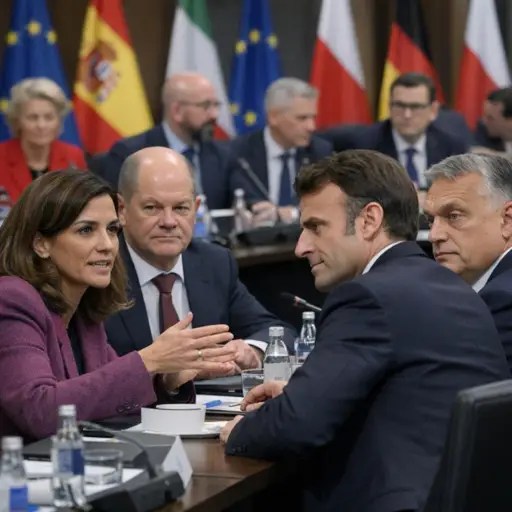
Spain takes a firm moral and financial lead while EU unity fractures under pressure of diverging military and diplomatic strategies
Europe is facing one of its most profound internal rifts in recent years, as disagreement over how to respond to what some leaders are calling an “illegal war” exposes widening divisions across the continent. While several governments continue to back a cautious, unified front, others are breaking ranks—most notably Spain, which has emerged as one of the most outspoken critics of the conflict and is now coupling rhetoric with significant financial action.
Spain’s government has taken a decisive step, publicly condemning the war in unequivocal terms and announcing a €5 billion relief initiative aimed at humanitarian aid, reconstruction assistance, and support for displaced populations. The move signals not only moral positioning but a strategic attempt to redefine leadership within Europe on foreign policy and crisis response.
Prime Ministerial sources in Madrid describe the initiative as both “a responsibility and a necessity,” framing Spain’s stance as aligned with international law and human rights principles. The plan includes direct funding for humanitarian corridors, medical infrastructure, and refugee resettlement programs, as well as partnerships with non-governmental organizations operating in affected regions.
Yet Spain’s clarity has only underscored the lack of consensus across the European Union. In Brussels, discussions among EU leaders have revealed starkly different interpretations of the conflict and, more critically, divergent ideas about how far Europe should go—militarily, economically, and diplomatically.
At the heart of the disagreement lies a fundamental question: should Europe escalate its involvement, including deeper military alignment, or maintain a more restrained approach focused on sanctions and diplomacy?
Countries in Eastern Europe, many of which perceive the conflict through the lens of regional security threats, have pushed for stronger military coordination and a more assertive stance. These governments argue that hesitation risks emboldening further aggression and undermining the credibility of European defense commitments.
In contrast, several Western and Southern European nations have expressed concern about escalation. Leaders in these countries emphasize the importance of de-escalation, warning that increased military involvement could widen the conflict and destabilize the broader region. Economic considerations also weigh heavily, as energy security, inflation, and domestic political pressures complicate decision-making.
Germany and France, traditionally seen as pillars of EU cohesion, have found themselves navigating an increasingly delicate balancing act. While both support a unified European response, their approaches differ subtly but significantly—particularly on the pace and scale of military engagement. Diplomatic sources suggest that behind closed doors, tensions are growing over leadership, messaging, and long-term strategy.
The result is a European Union that, while still formally united, is showing visible signs of strain. Joint statements have become more carefully worded, often reflecting compromise rather than conviction. Policy coordination, once a hallmark of EU strength, is now slower and more fragmented.
Analysts warn that the current divisions could have lasting implications. “This is not just about one conflict,” said a senior European policy expert. “It’s about the future of Europe’s role in the world. Are we a cohesive geopolitical actor, or a collection of national strategies loosely aligned?”
Spain’s assertiveness may mark the beginning of a broader shift. By combining strong political language with concrete financial commitments, Madrid is positioning itself as a moral and practical leader at a time when traditional power centers appear cautious or divided.
However, this leadership comes with risks. Acting ahead of consensus can deepen fractures within the EU, potentially complicating future negotiations on defense, budget contributions, and foreign policy alignment. Smaller member states, in particular, may feel pressured to choose sides in an increasingly polarized environment.
Public opinion across Europe is also evolving. In several countries, citizens are questioning both the costs and the objectives of involvement, leading to growing political pressure on national governments. Protests, parliamentary debates, and shifting poll numbers reflect a continent grappling not only with external conflict but internal uncertainty.
As European leaders continue to meet and negotiate, the challenge will be to bridge these divides without sacrificing either unity or principle. Whether that balance can be achieved remains unclear.
What is certain, however, is that Europe stands at a critical juncture. The decisions made now—about war, peace, and the limits of solidarity—will shape the continent’s political identity for years to come.
In the meantime, Spain’s bold move has ensured that the debate is no longer abstract. It is now anchored in action, forcing Europe to confront a difficult question: can it still speak with one voice, or has that voice already begun to fracture?


 The Tower Post