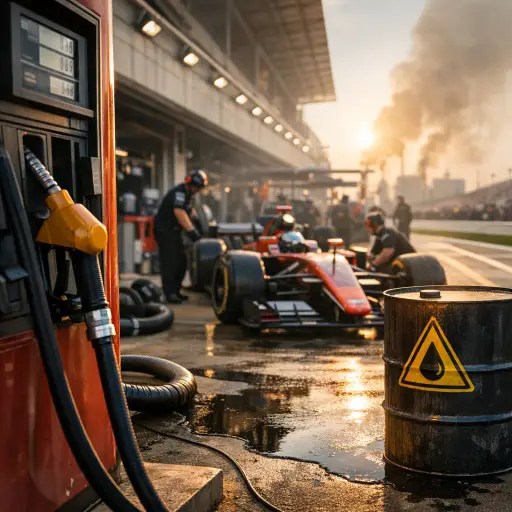
Rising oil costs and energy instability force racing teams to rethink logistics, budgets, and the future of global competition
The global motorsport calendar is facing mounting uncertainty as a renewed fuel crisis begins to ripple through the foundations of elite racing. From Formula racing series to endurance championships, teams and organizers are grappling with rising oil prices that are rapidly inflating operational costs and threatening the delicate balance of season planning.
What was once considered a manageable logistical challenge—transporting cars, equipment, and personnel across continents—has now become a central concern for the sport’s sustainability. Industry insiders warn that the situation is no longer hypothetical. It is already reshaping decisions behind the scenes.
Logistics Under Strain
Modern motorsport is a global enterprise. A single racing season can span multiple continents, requiring complex coordination of air freight, sea shipments, and ground transport. With fuel prices climbing unpredictably, these logistics chains are becoming increasingly expensive and volatile.
Teams report that freight costs have surged significantly in recent weeks, particularly for long-haul segments. Air transport, which is often necessary for tight race schedules, has become especially costly. As a result, some teams are reconsidering how equipment is shipped—or whether certain upgrades can even be transported at all.
“There’s a growing sense that the calendar may need to adapt,” said one senior logistics coordinator from a leading Formula team. “The current structure assumes stable energy prices. That assumption is no longer valid.”
Budget Pressures Mount
For top-tier teams with extensive sponsorship backing, the financial strain is significant but manageable—for now. However, for smaller teams operating with tighter margins, the situation is far more precarious.
Fuel costs impact nearly every aspect of operations: from transporting cars and spare parts, to running generators at circuits, to the travel expenses of hundreds of team personnel. The cumulative effect is forcing teams to reassess budgets mid-season, an uncommon and unwelcome development.
Several team principals have privately expressed concern that cost caps—originally designed to create competitive parity—are now being stretched by external economic forces beyond their control. While regulations account for some inflationary pressures, the current surge in energy costs is testing those safeguards.
“There’s a real risk that performance development will slow,” one team executive noted. “If resources are diverted to simply getting to races, there’s less left for innovation.”
Calendar at a Crossroads
The structure of the racing calendar itself is now under scrutiny. Traditionally, races are scheduled to maximize global reach and commercial value. However, with travel costs rising, the efficiency of that structure is being questioned.
Back-to-back races in distant regions—once seen as a logistical challenge but commercially viable—are now becoming financially burdensome. Some stakeholders are advocating for more geographically clustered events to reduce travel distances and fuel consumption.
There is also renewed discussion about the viability of certain venues. Circuits located far from major logistics hubs may face increased pressure, particularly if transportation costs continue to escalate.
While no official changes have been announced, sources indicate that contingency planning is underway. Alternative scheduling scenarios are being explored, including regional groupings and potential adjustments to the number of events.
Energy Instability and Sport
Beyond immediate cost concerns, the broader issue of energy instability is forcing motorsport to confront deeper questions about its future. The sport has long been tied to technological innovation, particularly in the automotive sector. Now, it finds itself at the intersection of performance and sustainability.
Many racing series have already begun transitioning toward more sustainable fuels and hybrid technologies. However, the current crisis underscores the urgency of that transition. It is no longer solely about environmental responsibility—it is also about operational resilience.
Experts suggest that the sport may accelerate its investment in alternative fuels and energy-efficient logistics. Synthetic fuels, electric transport solutions, and streamlined freight operations are all being discussed as part of a longer-term strategy.
“This is a wake-up call,” said an energy analyst familiar with the industry. “Motorsport has the opportunity to lead, but it also has a responsibility to adapt quickly.”
Teams Seek Stability
In the short term, teams are focusing on managing uncertainty. Some are renegotiating contracts with logistics providers, while others are exploring cost-sharing arrangements for freight and transport.
There is also increased collaboration between teams and governing bodies, as stakeholders seek to find solutions that preserve the integrity of competition while addressing economic realities.
Despite the challenges, there remains a strong commitment to maintaining the full racing calendar—at least for now. Fans, sponsors, and broadcasters all depend on the continuity of events, and there is a collective effort to avoid disruptions.
However, the tone has shifted. Where there was once confidence in the system’s resilience, there is now cautious pragmatism.
A Turning Point for Motorsport
The current fuel crisis may prove to be a defining moment for global motorsport. It has exposed vulnerabilities in a system built on mobility and speed, highlighting the extent to which the sport depends on stable energy markets.
At the same time, it has opened the door to innovation and change. If managed effectively, this period of instability could accelerate the evolution of motorsport into a more sustainable and adaptable industry.
For now, the engines continue to roar, and the races go on. But behind the spectacle, teams are navigating a new reality—one where every kilometer traveled comes at a higher cost, and every decision carries greater weight.
As the season unfolds, the question is no longer whether the fuel crisis will impact motorsport. It already has. The real question is how the sport will respond.


 The Tower Post