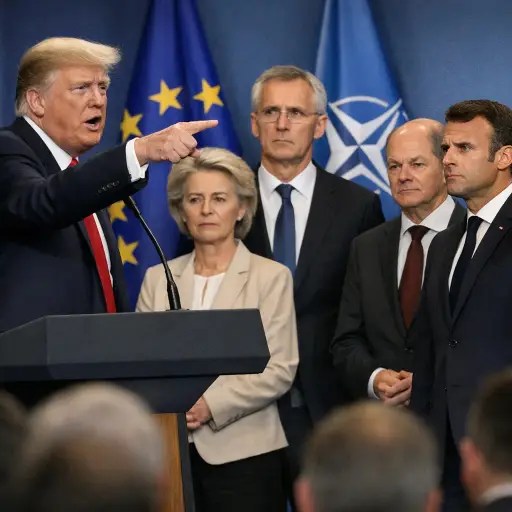
U.S. rhetoric labeling European allies as “cowards” fuels tensions over defense commitments, raising urgent questions about the future of the alliance
In a stark escalation of transatlantic tensions, former U.S. President Donald Trump has reignited a long-simmering dispute within NATO by openly criticizing European allies as “cowards” over their military contributions. The remarks, delivered with characteristic bluntness, have reverberated across capitals from Washington to Brussels, exposing fractures within an alliance that has long been considered the cornerstone of Western security.
The controversy comes at a moment of heightened geopolitical uncertainty, with ongoing conflicts on Europe’s periphery and increasing global competition testing NATO’s cohesion. Trump’s comments, while not entirely unprecedented, mark a new level of rhetorical intensity—one that European officials warn could have lasting consequences for unity and deterrence.
A Familiar Dispute, Sharpened
At the heart of the dispute lies a familiar issue: burden-sharing. For years, U.S. leaders across political lines have urged European NATO members to increase their defense spending and take a more active role in collective security. While progress has been made, Washington has continued to express frustration over what it sees as uneven contributions.
Trump’s latest intervention, however, departs from traditional diplomatic language. By framing European allies as unwilling to “pull their weight” and questioning their resolve in the face of threats, he has injected a confrontational tone that many analysts say risks undermining trust.
European officials have responded with a mix of concern and defiance. Some point to recent increases in defense budgets and expanded military deployments as evidence of growing commitment. Others argue that such public criticism overlooks the political and economic constraints many governments face.
Rising Stakes for NATO Unity
The timing of the remarks has amplified their impact. NATO is currently navigating one of its most challenging periods in decades, with security concerns ranging from Eastern Europe to the Middle East and beyond. The alliance’s credibility, experts say, depends not only on military capabilities but also on the perception of unity among its members.
Public disagreements—especially those involving the United States, NATO’s most powerful member—risk sending mixed signals to adversaries. “Deterrence is as much about perception as it is about capability,” said one European defense analyst. “When allies appear divided, it creates opportunities for others to test those divisions.”
Trump’s rhetoric has also reignited debates within Europe about strategic autonomy—the idea that the continent should develop greater independent defense capabilities. While some leaders see this as a necessary evolution, others worry it could duplicate NATO structures and weaken the alliance over time.
Domestic Politics, Global Consequences
Observers note that Trump’s comments are not solely about foreign policy. They also reflect domestic political dynamics within the United States, where questions about international commitments and defense spending continue to resonate with voters.
By portraying European allies as insufficiently committed, Trump taps into a broader narrative that the United States bears an outsized burden in global security. This argument has found traction among segments of the American public, particularly in times of economic uncertainty.
Yet the international implications are significant. European leaders are increasingly concerned that such rhetoric could translate into policy shifts that alter the U.S. role within NATO. Even the perception of reduced American commitment could prompt allies to reconsider their own strategies.
European Responses: Between Alarm and Adaptation
Across Europe, reactions have varied. Some governments have sought to downplay the comments, emphasizing the enduring strength of the alliance and the importance of continued cooperation. Others have taken a more assertive stance, defending their contributions and calling for mutual respect among allies.
In several capitals, the episode has accelerated discussions about increasing defense spending and enhancing military readiness. While these moves align with long-standing NATO goals, the motivation now appears more urgent—and more politically charged.
At the same time, there is a growing recognition that communication matters as much as capability. European diplomats have stressed the need for careful messaging to avoid escalating tensions further, even as they push back against what they view as unfair criticism.
A Defining Moment for the Alliance
The current dispute highlights a broader question facing NATO: how to adapt to changing political landscapes while preserving the unity that has defined the alliance for decades. The challenges are not new, but the intensity of the rhetoric underscores how fragile consensus can become under pressure.
For many observers, this moment represents a critical test. Can NATO reconcile differing expectations among its members while maintaining a credible collective defense? Or will internal divisions erode the trust that underpins its effectiveness?
Despite the tensions, there are reasons for cautious optimism. NATO has weathered crises before, often emerging stronger through adaptation and compromise. The alliance’s institutional framework, combined with shared strategic interests, continues to provide a foundation for cooperation.
Still, the path forward is uncertain. As political rhetoric sharpens and global challenges mount, the need for clear leadership and mutual understanding has never been greater.
Looking Ahead
In the coming weeks, attention will turn to how both sides navigate the fallout from the latest exchange. Diplomatic efforts are likely to focus on reaffirming commitments and addressing underlying concerns, even as public discourse remains charged.
What is clear is that the transatlantic relationship is entering a new phase—one defined by both continuity and change. The core principles of NATO remain intact, but the dynamics within the alliance are evolving in ways that will shape its future.
Whether this period of tension leads to renewed cohesion or deeper division will depend on the choices made by leaders on both sides of the Atlantic. For now, the alliance stands at a crossroads, facing one of its most significant tests in years.



 The Tower Post