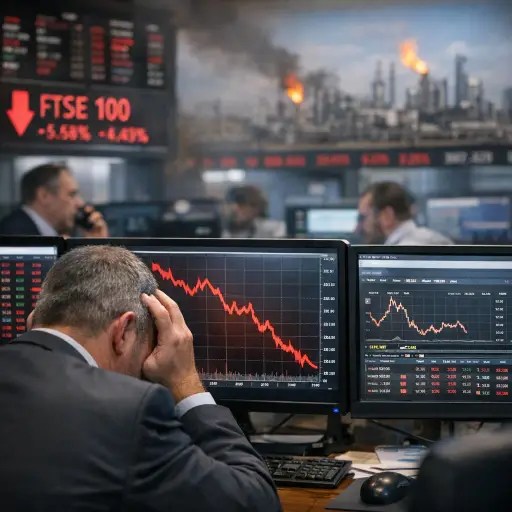
Energy fears surge, borrowing costs spike, and households brace for a new wave of financial strain
Britain’s financial markets have been thrown into sharp turmoil, as escalating war tensions trigger a sweeping sell-off that has wiped out all gains made since the start of the year. The benchmark FTSE 100, once buoyed by resilient corporate earnings and steady global demand, has now slipped back into negative territory, reflecting deepening investor anxiety over the economic fallout of prolonged conflict.
The reversal marks a dramatic shift in sentiment. Only weeks ago, markets appeared to be stabilizing after a period of cautious optimism. Now, the outlook has darkened considerably. Traders describe a rapid flight from risk, as geopolitical instability feeds into fears of supply disruptions, particularly in energy markets, and threatens to reignite inflationary pressures.
At the heart of the crisis lies a renewed surge in global energy prices. As the war intensifies and supply routes face mounting uncertainty, oil and gas markets have reacted sharply. For the United Kingdom—already grappling with fragile energy security—the implications are immediate and severe. Wholesale prices have climbed, raising the prospect of another spike in household energy bills just as many families had hoped for relief.
This energy shock is reverberating through financial markets. Energy-intensive sectors have come under pressure, while broader indices have suffered from widespread sell-offs. Investors are increasingly pricing in the risk of prolonged economic disruption, with concerns that higher input costs will squeeze corporate margins and dampen growth prospects.
At the same time, borrowing costs have surged to levels not seen since the global financial crisis. Government bond yields have climbed sharply as markets anticipate tighter monetary conditions and higher inflation. The rise reflects both global trends and domestic vulnerabilities, as investors demand greater returns to offset heightened uncertainty.
For policymakers, the situation presents a difficult balancing act. On one hand, there is mounting pressure to contain inflation, which could be exacerbated by rising energy costs. On the other, the economic slowdown triggered by market instability raises concerns about growth and employment. The risk of policy missteps looms large, particularly as central banks navigate an increasingly volatile global environment.
The housing market, long a pillar of British economic stability, is now showing signs of strain. Mortgage rates have risen in tandem with borrowing costs, placing additional pressure on homeowners and prospective buyers. For many households, the combination of higher energy bills and rising mortgage repayments is creating a severe squeeze on disposable income.
Financial advisers warn that the cumulative impact could be significant. “We’re seeing a convergence of pressures that households haven’t faced simultaneously in years,” said one market analyst. “Energy costs, borrowing costs, and broader economic uncertainty are all moving in the same direction—and that direction is up.”
Consumer confidence, already fragile, is expected to weaken further. Retailers and service providers are bracing for a potential slowdown in spending, as households prioritize essential expenses over discretionary purchases. This shift could have wider implications for the economy, particularly if it persists over an extended period.
Businesses, too, are adjusting to the new reality. Companies exposed to international supply chains are reassessing risks, while those reliant on energy inputs are facing rising operational costs. Some firms have begun to pass these costs onto consumers, adding to inflationary pressures and complicating the broader economic outlook.
Despite the turmoil, some investors are seeking opportunities amid the volatility. Defensive sectors, including utilities and certain commodities, have attracted renewed interest as market participants look for relative stability. However, the overall mood remains cautious, with many opting to reduce exposure until clearer signals emerge.
Government officials have signaled that support measures may be considered if conditions worsen. However, the scope for intervention is limited by fiscal constraints and the need to maintain market confidence. Any policy response will need to strike a delicate balance between providing relief and preserving economic stability.
Looking ahead, much will depend on the trajectory of the conflict and its impact on global energy markets. A prolonged disruption could entrench higher prices and deepen economic challenges, while any signs of de-escalation may offer a path to recovery. For now, uncertainty remains the defining feature of the landscape.
Market participants are closely watching developments, aware that conditions can shift rapidly. In the meantime, households and businesses alike are preparing for a period of heightened financial pressure, as the consequences of geopolitical instability continue to unfold.
The events of recent days serve as a stark reminder of the interconnected nature of modern economies. What begins as a distant conflict can quickly ripple through markets, affecting everything from stock prices to household budgets. For the United Kingdom, the challenge now is to navigate this turbulent period while laying the groundwork for a more resilient future.



 The Tower Post