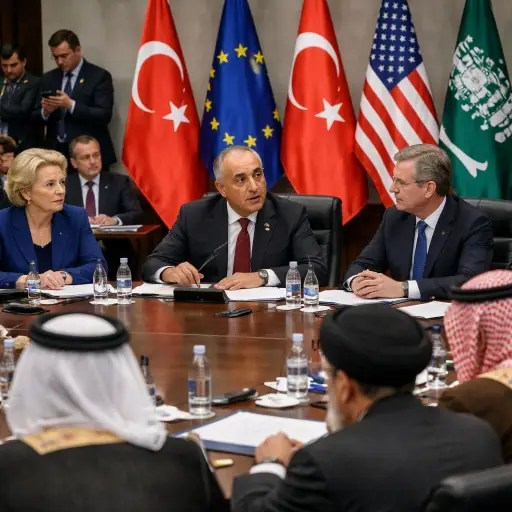
Turkey spearheads urgent talks with Western and regional powers as Europe steps into a pivotal mediating role to prevent the widening of an Iran-linked conflict
A wave of high-stakes diplomacy is unfolding across multiple capitals as global leaders race to prevent a dangerous escalation of conflict tied to Iran and its regional alliances. With tensions intensifying across key flashpoints, Turkey has emerged as a central diplomatic actor, hosting and coordinating urgent discussions involving the United States, European powers, and influential Middle Eastern states.
The renewed push for dialogue comes amid mounting fears that localized confrontations could spiral into a broader regional war with global consequences. Analysts warn that the convergence of military posturing, proxy engagements, and fragile political balances has created one of the most volatile geopolitical environments in recent years.
At the center of this diplomatic effort is Ankara, leveraging its unique geopolitical position and relationships across both Western and Eastern spheres. Turkish officials have initiated a series of closed-door meetings aimed at de-escalation, confidence-building, and the creation of communication channels between adversarial parties.
Diplomatic sources describe the talks as “intense and ongoing,” with a focus on preventing further military entanglements linked to Iran’s regional network of allies and partners. These include armed groups and political movements operating across several Middle Eastern theaters, where recent incidents have heightened the risk of retaliation cycles.
The United States has signaled cautious support for Turkey’s mediation efforts, while maintaining a firm stance on deterrence. Washington’s approach appears to balance military readiness with diplomatic engagement, seeking to avoid direct confrontation while ensuring regional stability.
Meanwhile, European nations are playing an increasingly visible and strategic role in the negotiations. European diplomats have positioned themselves as intermediaries capable of bridging gaps between opposing sides, particularly where direct communication remains politically sensitive or diplomatically strained.
This mediating role reflects Europe’s growing concern over the potential spillover effects of a wider conflict. Economic disruption, energy insecurity, and renewed migration pressures are among the key risks driving European involvement. As a result, several European capitals have intensified diplomatic outreach, coordinating closely with Turkey to maintain momentum in the talks.
Observers note that Europe’s influence lies not only in its diplomatic channels but also in its ability to offer incentives for de-escalation, including economic cooperation and political engagement frameworks. This has allowed European negotiators to present themselves as credible brokers in a highly polarized environment.
Despite these efforts, significant challenges remain. Deep mistrust between key actors continues to hinder progress, and the rapidly evolving situation on the ground complicates diplomatic timelines. Each new incident carries the potential to derail negotiations or shift strategic calculations.
Regional powers, for their part, are navigating a delicate balance between asserting influence and avoiding full-scale confrontation. Several governments have expressed support for diplomatic solutions while simultaneously reinforcing their defensive capabilities, underscoring the fragile nature of the current moment.
Turkey’s role has been widely described as both pragmatic and strategic. By maintaining open lines of communication with a broad range of actors—including those with conflicting interests—Ankara has positioned itself as an indispensable facilitator. Its efforts highlight a broader trend toward multipolar diplomacy, where regional powers play increasingly decisive roles in global crisis management.
As negotiations continue, the international community is watching closely for signs of progress. Even limited agreements—such as temporary de-escalation measures or coordinated restraint—could help stabilize the situation and create space for longer-term solutions.
For now, the diplomatic push represents a critical test of whether dialogue can outpace escalation. With multiple actors engaged and stakes rising, the coming period will likely determine whether these efforts succeed in containing the crisis—or whether the world edges closer to a broader and more dangerous conflict.


 The Tower Post