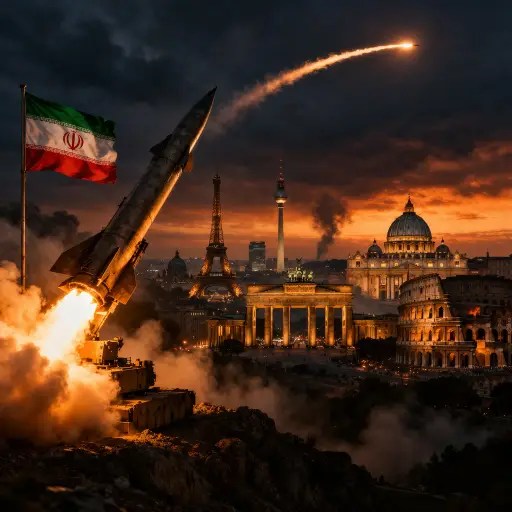
Reports of Tehran’s long-range arsenal raise alarms as major European capitals emerge within potential strike distance
Concerns across Europe have intensified following emerging intelligence assessments indicating that Iran may possess ballistic missile capabilities extending up to approximately 4,000 kilometers. Such a range would place several of Europe’s most prominent cities, including Berlin, Paris, and Rome, within potential reach, marking a significant shift in the continent’s strategic security landscape.
Security analysts and defense officials describe the development as a turning point. What was once considered a regional deterrence framework centered on the Middle East is now being reevaluated in light of a broader geographic scope. The implications are profound: Europe, long insulated by distance from direct missile threats originating in the region, now faces a scenario in which that buffer may no longer exist.
According to multiple intelligence briefings circulating among Western defense circles, Iran’s evolving missile program reflects both technological advancement and strategic recalibration. The reported range of these systems suggests the capability to project power far beyond traditional theaters of tension.
Experts caution that the issue is not solely about capability, but also about perception and deterrence. Even without deployment, the existence of such range potential alters military planning and diplomatic calculations. European defense infrastructures, including missile defense systems and early-warning networks, are now under renewed scrutiny.
This represents a shift from regional containment to continental vulnerability, one senior security analyst noted. The psychological and strategic impact alone is enough to trigger policy reassessments across Europe.
Berlin, Paris, and Rome have been frequently cited in defense discussions as illustrative examples of cities now theoretically within reach. These capitals are not only symbolic centers of political power but also critical hubs of economic and cultural influence.
Officials have been careful to avoid alarmist rhetoric, emphasizing that capability does not equate to intent. Nevertheless, the identification of these cities within projected range scenarios has intensified conversations around preparedness and resilience.
European governments are increasingly focused on strengthening integrated defense systems, including NATO-aligned missile shields and coordinated response strategies. The issue has also reentered diplomatic channels, with renewed calls for transparency and arms control dialogue.
The broader implication of these developments is a redefinition of conflict boundaries. What has historically been categorized as a regional dynamic now carries the potential for cross-continental consequences.
This expansion of scope complicates existing security frameworks. NATO, in particular, faces the challenge of adapting its posture to account for threats that blur the line between regional instability and global risk. Collective defense principles may need to evolve in response to longer-range technologies and shifting geopolitical alignments.
At the same time, European leaders are balancing deterrence with diplomacy. While defense readiness is being reinforced, there remains a parallel emphasis on preventing escalation through negotiation and international oversight.
The reported missile range capability arrives at a moment of already heightened global tension. Energy security concerns, shifting alliances, and ongoing conflicts in neighboring regions have created a complex backdrop against which this development unfolds.
For policymakers, the challenge lies in responding proportionately, acknowledging the seriousness of the threat without contributing to further destabilization. Increased investment in defense technology, intelligence sharing, and civil preparedness is expected, but so too are efforts to maintain open lines of communication.
Public awareness is also evolving. While the technical details of missile range may seem abstract, the framing of major European cities within potential strike distance has a tangible psychological effect. Governments are therefore tasked not only with physical defense but also with maintaining public confidence.
As Europe reassesses its strategic position, one conclusion is becoming increasingly clear: geographic distance is no longer a reliable safeguard. Advances in missile technology are compressing space, redefining proximity, and reshaping the concept of threat.
Whether this moment leads to renewed arms control efforts or further militarization remains uncertain. What is clear, however, is that Europe’s security conversation has entered a new phase, one in which the boundaries of conflict are no longer confined to familiar regions, but extend across continents.
In this emerging reality, vigilance, coordination, and diplomacy will play equally critical roles in determining the path forward.




 The Tower Post