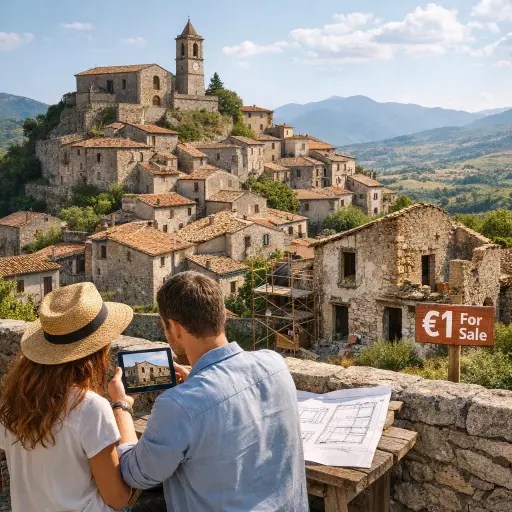
Expanding schemes, smarter incentives, and a clearer message redefine the country’s effort to revive its fading villages.
Italy’s famous €1 home initiative is not only alive in 2026—it is evolving.
Across the country, new municipalities continue to join the scheme, offering abandoned properties at symbolic prices in an effort to reverse decades of depopulation. The core objective remains unchanged: attract foreign buyers willing to invest in restoration and, ideally, become part of local communities that have been steadily shrinking.
But while the headline-grabbing €1 price still captures global attention, the reality behind the program is becoming more transparent—and, in many ways, more practical.
This year is shaping up to be one of the most active phases of the initiative so far. Local administrations are rolling out new listings, refining their offers, and actively promoting opportunities to international audiences. Interest remains strong, particularly from remote workers, retirees, and lifestyle-driven buyers seeking a foothold in Italy’s quieter regions.
What has changed is how the program is being presented.
In earlier years, the €1 homes scheme was often criticized for oversimplifying what was, in practice, a complex and costly process. Buyers were drawn in by the symbolic purchase price, only to discover that renovation expenses, bureaucratic hurdles, and strict deadlines could quickly escalate the total investment.
Now, that narrative is shifting.
Municipalities and national platforms are increasingly upfront about the true cost of ownership. Renovations typically range from moderate upgrades to full structural restorations, with expenses commonly falling between tens of thousands and well into six figures depending on the property’s condition. Rather than discouraging interest, this greater transparency appears to be attracting more serious and better-prepared buyers.
“It’s no longer about selling a dream at €1,” says one local official involved in promoting the scheme. “It’s about offering a real opportunity—with clear expectations.”
To support that shift, many programs now include a broader package of incentives. Tax breaks on renovation work, grants for sustainable upgrades, and relocation support are becoming standard features in several regions. Some towns are even offering assistance with permits, connections to local contractors, or partial funding tied to project milestones.
These additions reflect a growing understanding that revitalization requires more than symbolic pricing—it requires sustained investment and long-term commitment.
At the same time, a new layer of experimentation is emerging.
Recognizing that not all buyers are willing—or able—to take on extensive renovation projects, some municipalities are testing alternative models. Instead of offering derelict properties for €1, they are marketing low-cost homes that are already structurally sound and, in some cases, immediately livable. While these properties come at higher prices than the symbolic €1, they significantly reduce the time, cost, and uncertainty associated with restoration.
This hybrid approach is expanding the pool of potential buyers, appealing to those who want the experience of living in a historic Italian village without the burden of a full-scale construction project.
The broader context also plays a crucial role in the program’s renewed momentum.
Remote work continues to reshape how and where people choose to live. For many professionals, geographic flexibility has opened the door to relocation opportunities that would have seemed impractical just a few years ago. Italy’s rural villages—once overlooked—are now being reimagined as viable bases for work and life.
Foreign buyers, particularly from the United States, remain at the forefront of this trend. Drawn by cultural appeal, relative affordability, and lifestyle considerations, they are increasingly exploring options beyond major cities.
Yet officials are careful to manage expectations.
Despite improvements, the process still requires patience and planning. Heritage regulations, local building codes, and the logistical realities of renovating older properties remain part of the equation. The difference now is that these challenges are being communicated more clearly from the outset.
There is also a growing focus on long-term sustainability.
Some municipalities are introducing measures to encourage permanent residency rather than seasonal use. Incentives tied to year-round living, community participation, or business development are being explored as ways to ensure that revived villages do not become empty again outside tourist seasons.
Early signs suggest that the more pragmatic approach is working.
Higher completion rates for renovation projects, more engaged buyers, and increased collaboration between local authorities and private partners point to a maturing program. What began as a bold, attention-grabbing idea is gradually transforming into a structured policy tool aimed at addressing a complex demographic challenge.
Italy’s €1 homes initiative may still be rooted in symbolism, but its future is increasingly defined by substance.
By expanding participation, embracing transparency, and diversifying its models, the country is refining one of its most distinctive strategies for rural revival. And as global interest continues to grow, the initiative is proving that even the smallest price tag can carry significant weight—when backed by a clearer vision and a more realistic path forward.



 The Tower Post