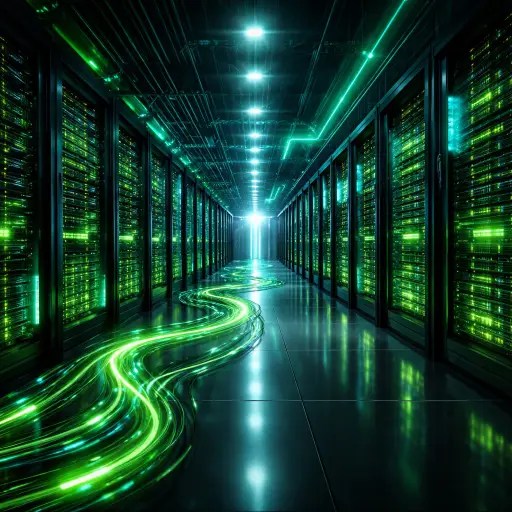
From chips to production lines, a new infrastructure model emerges as AI demand reshapes computing
Nvidia has introduced a concept that could redefine the foundation of the artificial intelligence era: “AI factories,” massive, purpose-built systems designed not merely to run software, but to produce AI models at industrial scale.
Unveiled during the company’s latest GTC conference, the idea marks a significant shift in how computing infrastructure is conceived. Rather than treating AI workloads as just another application running on general-purpose machines, Nvidia is positioning them as a form of manufacturing — one that requires dedicated facilities, optimized pipelines, and continuous output.
At the heart of the AI factory is a tightly integrated system that combines hundreds of GPUs into a single, unified unit. These are not loosely connected clusters, but highly synchronized environments engineered to function as one massive computational engine. The goal is simple: maximize throughput, minimize inefficiencies, and treat intelligence generation as a repeatable, scalable process.
For years, the technology industry has focused on building faster chips and larger data centers. But as AI models have grown in size and complexity, that approach has begun to show its limits. Training a single advanced model can require enormous computational resources over extended periods, often straining infrastructure and driving up costs.
Nvidia’s response is to rethink the system entirely.
Instead of scaling horizontally by adding more servers, AI factories scale as cohesive units. High-speed interconnects allow GPUs to communicate with minimal latency, while advanced memory architectures keep data flowing efficiently between components. Liquid cooling systems maintain stability under constant, heavy workloads, enabling these machines to operate continuously without degradation.
The result is an environment designed not for versatility, but for specialization.
“Training AI is no longer just a computing task — it’s production,” Nvidia executives emphasized during the keynote. The comparison to traditional manufacturing is intentional. Just as factories transformed industries by standardizing and accelerating output, AI factories aim to do the same for machine learning.
This shift has implications far beyond hardware.
On the software side, Nvidia is aligning its ecosystem to support this new model. Orchestration platforms manage workloads across thousands of processors, ensuring optimal utilization and minimizing downtime. Engineers are no longer expected to manually tune systems at a granular level; instead, they oversee automated pipelines that handle training, validation, and deployment as part of a continuous cycle.
In this framework, AI development becomes less about isolated experiments and more about sustained production.
The timing of the announcement reflects broader pressures across the industry. Demand for AI capabilities has surged across sectors, from enterprise software to healthcare and finance. Organizations are no longer content with occasional model training; they require constant updates, fine-tuning, and customization.
Traditional infrastructure struggles to keep pace with this demand. Bottlenecks in compute availability, rising energy costs, and long training cycles have created a growing gap between ambition and execution.
AI factories are designed to close that gap.
By treating model training as a pipeline — fed by data, processed continuously, and optimized for output — these systems promise to increase efficiency while reducing cost per model. The approach mirrors the evolution of cloud computing, where hyperscale data centers transformed how software is delivered and consumed.
Now, a similar transformation may be underway for AI itself.
Nvidia is not positioning AI factories as a closed ecosystem. The company has indicated that it will work with cloud providers, enterprises, and public-sector initiatives to deploy these systems across a range of environments. From sovereign AI projects to large-scale commercial deployments, the concept is intended to be adaptable, not exclusive.
Still, the scale of investment required suggests that early adoption will be concentrated among major players with significant resources.
That raises questions about access and concentration of power. If AI production becomes increasingly industrialized, control over these factories could shape who leads in the next phase of technological development. Smaller organizations may find themselves reliant on shared infrastructure, much as they are with today’s cloud platforms.
At the same time, proponents argue that standardization could ultimately democratize access. As systems become more efficient and widely deployed, the cost of producing advanced models may decrease, opening new opportunities for innovation.
For now, the concept remains in its early stages. But its implications are already clear.
The era of viewing computers as general-purpose tools is giving way to something more specialized. In its place, a new category of infrastructure is emerging — one built not just to compute, but to create intelligence at scale.
If Nvidia’s vision takes hold, the future of AI may not be defined by individual breakthroughs alone, but by the factories that produce them.




 The Tower Post