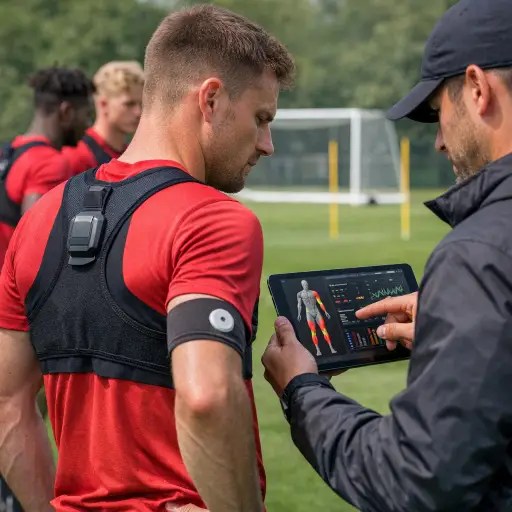
From GPS vests to sleep analytics, elite clubs are using predictive models to anticipate injuries before they occur—reshaping competition behind the scenes.
In the high-stakes world of European football, where a single injury can derail a title challenge or define a season, clubs are turning to a new and largely invisible ally: artificial intelligence. Across training grounds in England and beyond, players are now monitored not just by coaches and medical staff, but by algorithms designed to predict injuries before they happen.
What was once reactive—treating injuries after they occur—is rapidly becoming proactive. By combining wearable technology, biometric tracking, and machine learning, clubs are attempting to answer one of football’s most persistent questions: can injuries be prevented altogether?
The modern footballer is, in many ways, a walking data point. During training sessions, players wear lightweight GPS vests that track distance covered, sprint intensity, acceleration, and deceleration. These metrics, once used simply to measure performance output, are now feeding complex predictive systems.
Beyond the pitch, clubs are gathering data on sleep quality, heart rate variability, muscle fatigue, and even psychological stress levels. This information is collected through wearable devices and mobile apps, creating a continuous stream of physiological insight.
The key shift lies not in the data itself, but in how it is interpreted. Machine learning models analyze patterns across weeks and months, identifying subtle warning signs that may indicate elevated injury risk. A slight drop in sleep quality combined with increased sprint load, for instance, could trigger an alert for medical staff.
Injury prediction has long been considered one of football’s most elusive challenges. Muscle strains, ligament tears, and overuse injuries often emerge without clear warning. But AI systems are beginning to detect correlations that would be impossible for humans to track manually.
These models do not claim certainty. Instead, they operate on probabilities—flagging players whose risk profile has shifted beyond a safe threshold. In practical terms, this might lead to reduced training intensity, modified drills, or even rest during key sessions.
At top clubs, these decisions are increasingly data-informed. Coaches and sports scientists now consult dashboards that visualize player readiness in real time, blending medical insight with algorithmic predictions.
While transfer budgets and tactical innovations dominate headlines, the use of AI in injury prevention is emerging as a quieter but equally significant competitive edge. Clubs that keep their key players fit for longer periods gain consistency, stability, and ultimately, better results.
In leagues as demanding as England’s top division, where fixture congestion tests squad depth, the ability to reduce even a handful of injuries can have a decisive impact. Fewer absences mean stronger lineups, more cohesive team dynamics, and less reliance on rotation.
Importantly, this advantage is largely invisible to fans. There are no celebrations for a hamstring strain that never happened. Yet within clubs, the value is clear—and increasingly prioritized.
Despite its promise, the integration of AI into injury prevention is not without challenges. Coaches must balance data-driven recommendations with intuition and experience. Players, too, must trust systems that may advise them to train less or rest when they feel capable of continuing.
There is also the question of data privacy and ownership. As clubs collect increasingly detailed biometric information, concerns about how that data is stored and used are becoming more prominent.
Still, resistance appears to be fading. As predictive models improve and early successes accumulate, AI is becoming less of an experiment and more of a standard tool in elite football operations.
The shift toward predictive injury management reflects a broader transformation in football. The sport is becoming more scientific, more analytical, and more reliant on technology to gain marginal advantages.
For players, this could mean longer careers and fewer interruptions caused by injury. For clubs, it represents a strategic investment in consistency and performance. And for the game itself, it signals a future where outcomes are shaped not only by skill and tactics, but by the unseen calculations of intelligent systems.
As the technology continues to evolve, one thing is becoming clear: in modern football, the most important victories may be the ones that never make the match report.




 The Tower Post