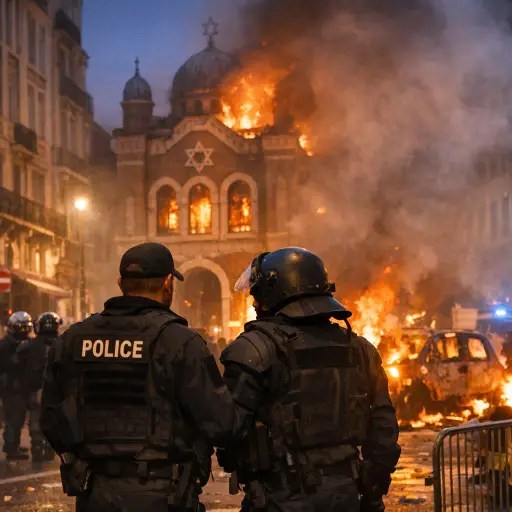
Violence linked to Middle East tensions spreads to major cities, targeting synagogues, schools, and Jewish services as authorities warn of coordinated extremist influence
Across Europe, a troubling escalation of antisemitic violence is unfolding, with Jewish communities increasingly finding themselves at the center of attacks that authorities say are fueled by geopolitical tensions and amplified by extremist networks.
From the streets of London to the port districts of Rotterdam and beyond, incidents ranging from vandalism and arson to physical assaults have risen sharply in recent weeks. Synagogues, Jewish schools, and community centers have become focal points of concern, prompting heightened security measures and urgent responses from governments across the continent.
Officials warn that the surge is not isolated. Instead, it reflects a broader pattern of radicalization and mobilization that appears to echo narratives associated with Iran-backed groups and other transnational actors. While investigations are ongoing, intelligence services in several countries have pointed to coordinated messaging campaigns and online incitement as key drivers behind the violence.
A Climate of Fear
In multiple European cities, Jewish residents describe a growing sense of vulnerability. Religious services have been disrupted by threats, and in some cases, congregants have required police escorts. Schools have implemented emergency protocols, with some temporarily closing their doors after receiving credible warnings.
Community leaders report that the attacks are not only increasing in frequency but also in intensity. What began as graffiti and verbal harassment has, in several cases, escalated into targeted acts of destruction. Windows have been shattered, entrances set alight, and symbols of Jewish identity defaced in public spaces.
“This is not just random hostility,” said one European security official speaking on condition of anonymity. “We are seeing patterns that suggest organization, influence, and intent to intimidate on a broader scale.”
London and Rotterdam: Flashpoints
In London, police have stepped up patrols around Jewish neighborhoods following a series of incidents involving vandalism and attempted arson at community buildings. Authorities have made several arrests, though they caution that the threat environment remains elevated.
Meanwhile, in Rotterdam, tensions have spilled into the streets with clashes reported near areas known for their cultural diversity. Local officials have condemned the attacks and pledged additional resources to protect vulnerable communities. Surveillance has been increased, and cooperation with national intelligence agencies intensified.
Across both cities, authorities emphasize that while individual perpetrators are being identified, the underlying drivers of the violence are more complex and interconnected.
Extremist Narratives and Digital Mobilization
Security analysts point to a surge in online content that frames Jewish communities as proxies in broader geopolitical conflicts. This rhetoric, often disseminated through encrypted messaging platforms and social media, has been linked to networks with ideological or operational ties to groups backed by Iran.
“These narratives are designed to inflame and mobilize,” said a European counterterrorism expert. “They exploit existing tensions and channel them into real-world actions.”
Governments are increasingly concerned about the speed at which such content spreads and the difficulty of countering it. Efforts to monitor and disrupt these networks are underway, but officials acknowledge that the digital landscape presents significant challenges.
Political and Social Responses
European leaders have issued strong condemnations of the attacks, reaffirming commitments to protect Jewish communities and uphold the principles of tolerance and coexistence. Emergency meetings have been convened in several capitals, with discussions focusing on both immediate security measures and longer-term strategies to address radicalization.
Law enforcement agencies have expanded coordination across borders, sharing intelligence and best practices. At the same time, civil society organizations are calling for renewed efforts to combat antisemitism through education and public awareness.
Yet, some critics argue that responses have been reactive rather than preventative. They warn that without addressing the root causes of extremism and polarization, the cycle of violence may persist.
A Broader European Challenge
The current wave of antisemitic attacks underscores a deeper challenge facing Europe: how to navigate the intersection of global conflicts and domestic cohesion. As international tensions reverberate within local communities, the risk of spillover violence becomes increasingly pronounced.
For many Jewish Europeans, the situation is a stark reminder of historical vulnerabilities. While authorities insist that every effort is being made to ensure safety, the psychological impact of the recent attacks is undeniable.
“We want to live openly and without fear,” said a community representative in Rotterdam. “But right now, that feels more difficult than it should.”
Looking Ahead
As investigations continue and security measures remain heightened, the coming weeks will be critical in determining whether the current surge can be contained. Authorities are urging vigilance, cooperation, and restraint, emphasizing that the actions of a few must not be allowed to fracture broader society.
The challenge, however, extends beyond policing. It lies in confronting the narratives, networks, and conditions that enable such violence to take root.
For Europe, the stakes are not only about protecting one community, but about preserving the values that underpin its social fabric.



 The Tower Post