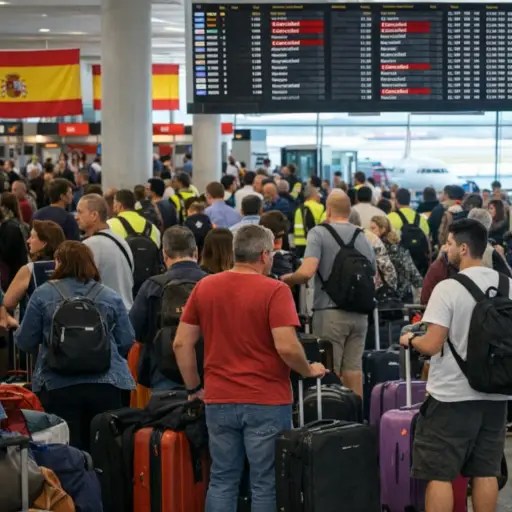
Mounting labor tensions and political stalemate raise fears of widespread disruption across key transport hubs, with millions of holiday travelers caught in the crossfire.
As Europe prepares for one of its busiest travel periods, anxiety is building across Spain’s aviation sector. Plans for coordinated strike action at a dozen major airports have triggered warnings of severe disruption, threatening to derail Easter holiday travel for millions of passengers and expose deeper fractures within the country’s political and economic landscape.
Airport workers, including ground staff, security personnel, and baggage handlers, are at the center of the unfolding crisis. Unions representing these groups have signaled their intent to escalate industrial action, citing long-standing grievances over working conditions, wages, and staffing shortages. While negotiations continue, progress has been slow, and the timing—coinciding with peak seasonal demand—has heightened both public concern and political pressure.
Spain’s airports, among the busiest in Europe during the Easter getaway period, are bracing for what industry insiders describe as a “perfect storm.” With passenger volumes surging and operational margins already stretched, even limited strike participation could lead to cascading delays, cancellations, and overcrowding at terminals.
The situation is further complicated by the fragmented political environment in Madrid. A divided government, balancing competing priorities and coalition dynamics, has struggled to present a unified response. Critics argue that the administration’s reluctance to intervene decisively reflects broader governance challenges, while officials maintain that labor disputes must be resolved through dialogue rather than decree.
Behind the immediate travel disruption lies a more structural issue. Spain’s tourism-dependent economy relies heavily on efficient transport infrastructure, particularly during high-demand periods. Any breakdown in airport operations risks not only inconvenience for travelers but also reputational damage at a time when the country is competing aggressively for international visitors.
Airlines and travel operators are already preparing contingency plans, though options remain limited. Rerouting flights, adjusting schedules, and increasing customer support capacity can mitigate some impact, but the scale of potential disruption may overwhelm even the most robust preparations. Travelers are being advised to monitor updates closely and allow extra time for airport procedures.
For many workers, however, the strikes are about more than short-term leverage. Union leaders argue that years of underinvestment and growing workloads have pushed staff to a breaking point. They insist that the timing of the action is not opportunistic but necessary to force meaningful engagement from both employers and policymakers.
Public opinion appears divided. While there is sympathy for workers facing difficult conditions, frustration is mounting among passengers whose long-awaited holidays may be jeopardized. Social media has become a flashpoint for debate, with competing narratives highlighting the human cost on both sides of the dispute.
The broader European context adds another layer of complexity. Labor unrest has been a recurring theme across several sectors in recent months, reflecting inflationary pressures and shifting labor dynamics. Spain’s airport strikes are part of this wider pattern, raising questions about how governments and industries adapt to evolving workforce expectations.
As the holiday period approaches, the urgency to reach a resolution is intensifying. Behind closed doors, negotiations are continuing, with mediators attempting to bridge gaps that remain significant. Whether a last-minute agreement can be reached remains uncertain, but the stakes are clear: the smooth functioning of one of Europe’s key travel corridors hangs in the balance.
For now, travelers, airlines, and officials alike are preparing for disruption. The coming days will test not only the resilience of Spain’s transport system but also the ability of its political and economic institutions to navigate a crisis where labor rights, public expectations, and national interests intersect.
In the absence of a breakthrough, the prospect of Easter travel chaos is no longer hypothetical—it is fast becoming a reality.



 The Tower Post