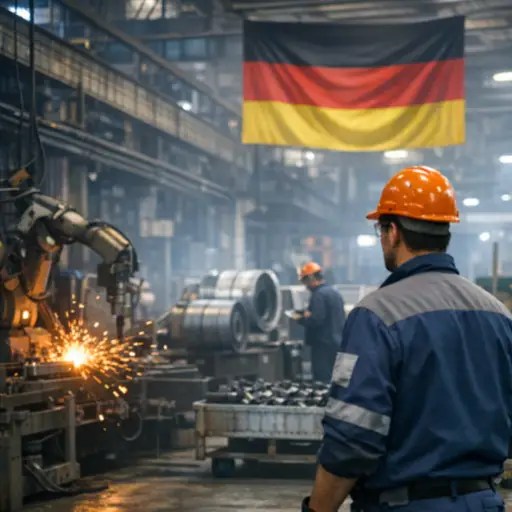
From Germany to the wider continent, manufacturers freeze hiring, delay investments, and warn that global competitiveness is slipping
Factories across Europe are entering a period of quiet retrenchment. From Germany’s industrial heartlands to manufacturing clusters in Central and Southern Europe, companies are slowing hiring, postponing major investments, and, in some cases, preparing for layoffs. The shift is not abrupt enough to trigger alarm bells in isolation, but taken together, it signals mounting strain on the continent’s industrial backbone.
At the center of this pressure lies a persistent rise in production costs. Energy prices, while no longer at peak crisis levels, remain structurally higher than in competing regions. At the same time, labor costs have continued to climb, reflecting both inflationary adjustments and long-term demographic constraints. For many manufacturers, the combined effect is eroding margins that were already under pressure from global competition.
Germany, long regarded as Europe’s industrial engine, illustrates the trend most clearly. Its export-driven manufacturing sector—spanning automotive, chemicals, and machinery—has begun to show signs of fatigue. Executives across these industries increasingly describe a cautious outlook, with capital expenditure plans being reassessed and hiring pipelines quietly scaled back.
“We are not in crisis mode,” one senior industry executive noted privately, “but we are certainly no longer in expansion mode.” That sentiment is echoed across boardrooms where uncertainty has become the dominant factor shaping decisions.
Energy remains a central concern. While supply disruptions have eased, the structural shift toward more expensive energy sources continues to weigh on energy-intensive industries such as steel, chemicals, and glass production. Companies that rely heavily on continuous, high-temperature processes face particular challenges, as even marginal cost increases can have significant operational impacts.
In parallel, regulatory and environmental compliance costs are rising as Europe accelerates its transition toward greener industrial practices. While broadly supported in principle, the pace and complexity of these changes are adding layers of cost and uncertainty for manufacturers already navigating tight margins.
The result is a growing sense that Europe’s cost base is drifting out of alignment with global competitors. Manufacturers increasingly compare their operating environment not only with neighboring countries but also with regions such as North America and parts of Asia, where energy costs and regulatory burdens can be lower.
This comparison is influencing strategic decisions. Some companies are reconsidering where to allocate future investments, with a noticeable tilt toward regions offering more favorable cost conditions. While large-scale relocations remain limited, incremental shifts in investment patterns can, over time, reshape industrial geography.
Employment trends are reflecting this caution. Rather than widespread layoffs, many firms are adopting softer measures—freezing recruitment, not replacing departing workers, and relying on temporary contracts to maintain flexibility. These steps, while less visible than headline job cuts, signal a clear change in momentum.
Labor unions and policymakers are watching closely. The concern is not only immediate job losses but also the longer-term risk of industrial erosion. If investment continues to slow, Europe could face a gradual hollowing out of key manufacturing sectors, with implications for economic resilience and technological leadership.
Small and medium-sized enterprises, which form the backbone of Europe’s industrial supply chains, are particularly vulnerable. With less financial cushioning than large multinational firms, they are more exposed to cost fluctuations and demand uncertainty. For many, the current environment is forcing difficult choices between maintaining operations and preserving competitiveness.
Governments across Europe are attempting to respond, balancing fiscal constraints with the need to support industry. Measures under discussion or implementation include targeted energy subsidies, tax incentives for investment, and initiatives to streamline regulatory processes. However, the effectiveness of these policies remains uneven, and businesses continue to call for more predictable and coordinated frameworks.
At the European level, there is increasing recognition that industrial policy must adapt to a more competitive global landscape. The challenge lies in reconciling ambitious climate goals with the need to maintain a viable industrial base. Achieving both simultaneously is proving more complex than anticipated.
Despite the pressures, industry leaders emphasize that Europe retains significant strengths. Advanced engineering capabilities, highly skilled workforces, and strong research ecosystems continue to underpin the continent’s industrial competitiveness. The question is whether these advantages can offset the growing cost disadvantages.
For now, the prevailing mood is one of cautious recalibration rather than outright decline. Companies are not abandoning Europe, but they are becoming more selective, more cost-conscious, and more risk-averse. The decisions being made in this period—on hiring, investment, and production—may shape the trajectory of European industry for years to come.
As factories adjust their pace and policymakers weigh their responses, the stakes are becoming clearer. Europe’s industrial backbone is not breaking, but it is under strain—and how that strain is managed will determine whether it emerges more resilient or gradually weakened in the face of global competition.



 The Tower Post