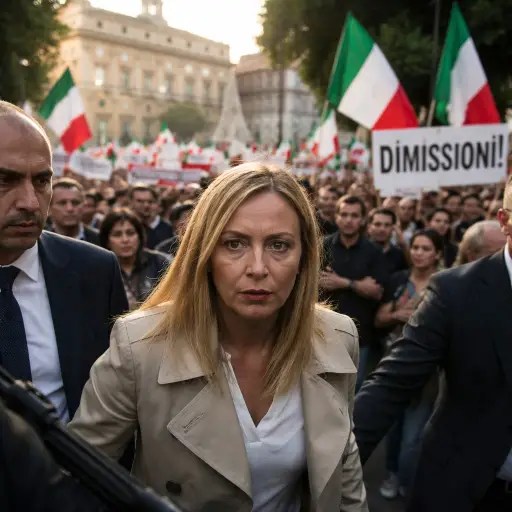
Italian prime minister faces political fallout as voters reject flagship proposal, emboldening opposition and protest movements
Italy’s political landscape has been sharply shaken after Prime Minister Giorgia Meloni suffered a significant defeat in a nationwide referendum on her government’s proposed judiciary reforms. With a clear majority of voters rejecting the measure, the result marks the most serious political setback of her premiership and raises fresh questions about her authority at a delicate moment for the country.
The referendum, centered on restructuring elements of the judicial system, had been framed by Meloni as a necessary step to increase efficiency, accountability, and public trust. Instead, it has become a lightning rod for criticism, with opponents portraying it as an attempt to consolidate political influence over the courts. The rejection—by a margin large enough to leave little room for interpretation—signals a decisive rebuke from the electorate.
In the immediate aftermath, Meloni struck a composed tone, acknowledging the outcome while insisting her government would continue its broader reform agenda. Yet beneath the measured response lies mounting pressure. The vote has exposed vulnerabilities in her coalition and energized a fragmented opposition that has struggled to gain traction since her rise to power.
Across major cities, demonstrators took to the streets, calling not only for a reconsideration of the reform but, increasingly, for Meloni’s resignation. Protesters have framed the referendum as a referendum on her leadership itself, arguing that the result reflects growing unease over her governing style and policy direction. While turnout patterns varied, the consistency of the “no” vote across regions has amplified the political significance of the defeat.
For Meloni, who built her political narrative on decisiveness and a break from past instability, the setback cuts deeply. The judiciary reform had been one of the cornerstones of her platform—both symbolically and practically. Its failure now risks slowing legislative momentum and complicating negotiations within her governing alliance, where differing priorities are already beginning to surface more visibly.
Analysts suggest the referendum outcome may not immediately threaten her hold on power but could gradually erode her political capital. This is less about immediate collapse and more about a shift in perception. She no longer appears invulnerable, and that changes the dynamics both inside parliament and among voters.
The opposition, sensing opportunity, has moved quickly to capitalize on the moment. Leaders from across the political spectrum have called for renewed dialogue on institutional reforms, emphasizing transparency and consensus. Some factions are pushing for early elections, though such a scenario remains uncertain given the current parliamentary arithmetic.
At the same time, the result reflects broader tensions within Italian society. Debates over the balance between political authority and judicial independence have long been contentious, and the referendum has brought those divisions into sharp focus. For many voters, the issue transcended technical legal changes, touching instead on deeper concerns about democratic safeguards and institutional trust.
Internationally, the outcome is being closely watched. Italy’s role within the European Union, particularly in areas related to governance standards and rule-of-law commitments, means that domestic political developments often carry wider implications. While European partners have so far reacted cautiously, the referendum result adds a layer of uncertainty to Italy’s political trajectory.
Meloni now faces a critical juncture. She must decide whether to recalibrate her approach—seeking compromise and rebuilding consensus—or double down on her agenda in an effort to reassert control. Either path carries risks. A softer stance could alienate core supporters, while a more confrontational strategy might deepen divisions and prolong political instability.
For now, the message from voters is unmistakable. The rejection of the judiciary reform has not only halted a key policy initiative but has also reshaped the political conversation in Italy. What was intended as a demonstration of strength has instead become a moment of reckoning—one that will likely define the next phase of Meloni’s leadership.
As the dust settles, one question looms large: whether this defeat marks a temporary setback or the beginning of a more profound shift in Italy’s political balance.



 The Tower Post