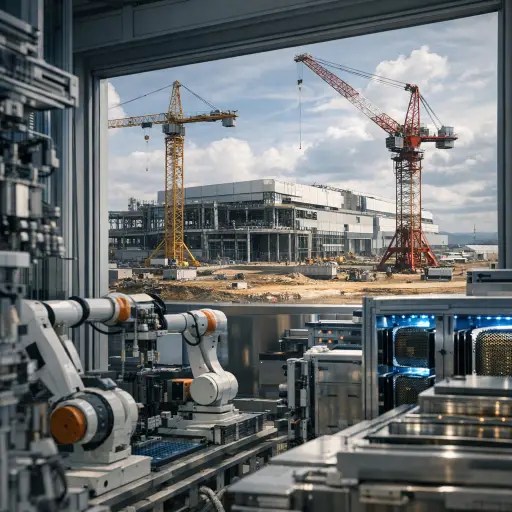
Tesla and SpaceX set sights on a massive Texas-based chip factory, signaling a new phase in the global race for AI dominance
In a move that could reshape the technological landscape, Elon Musk has revealed plans for a sprawling artificial intelligence chip manufacturing facility in Texas, dubbed “Terafab.” The project, backed by Tesla and SpaceX, is positioned as a cornerstone in the next generation of AI infrastructure, aiming to produce high-performance processors tailored for autonomous systems, robotics, and space exploration.
The announcement underscores Musk’s growing commitment to controlling the full stack of AI development—from hardware to deployment—at a time when global competition over advanced computing capabilities is intensifying. Industry analysts see Terafab as both an industrial gamble and a strategic necessity, reflecting a broader shift among tech giants to secure domestic chip production amid geopolitical tensions and supply chain vulnerabilities.
According to early details, Terafab would be one of the largest facilities of its kind, integrating advanced semiconductor fabrication with AI-specific chip design. The factory is expected to focus on producing specialized processors optimized for machine learning workloads, including training large-scale neural networks and enabling real-time inference in autonomous vehicles and spacecraft systems.
The Texas location is no coincidence. The state has increasingly become a hub for Musk’s ventures, offering a combination of favorable regulatory conditions, access to land, and proximity to existing Tesla and SpaceX operations. The proposed site would likely benefit from established infrastructure while reinforcing Texas’s growing role as a center for advanced manufacturing.
Terafab’s ambitions extend beyond sheer scale. Insiders suggest the facility is designed to push the boundaries of efficiency, integrating automation and robotics throughout the production process. By leveraging Tesla’s expertise in manufacturing automation, the factory could operate with unprecedented speed and precision, reducing costs while increasing output.
The initiative comes at a pivotal moment for the AI industry. Demand for advanced chips has surged dramatically as companies race to develop more powerful models and deploy AI across sectors ranging from healthcare to defense. Traditional chipmakers have struggled to keep pace, leading to shortages and rising costs. Musk’s plan appears aimed at addressing this bottleneck directly, ensuring a steady supply of cutting-edge hardware for his companies’ growing AI needs.
Tesla, in particular, has been expanding its reliance on custom-designed chips to support its Full Self-Driving system and robotics projects. Meanwhile, SpaceX has increasingly incorporated AI into its satellite networks and deep-space missions. A dedicated manufacturing facility could allow both companies to accelerate development timelines while maintaining tighter control over critical technologies.
However, the scale and complexity of Terafab present significant challenges. Building a semiconductor fabrication plant is one of the most capital-intensive endeavors in modern industry, requiring vast investments in equipment, materials, and expertise. The project will also need to navigate environmental concerns, workforce development, and the technical hurdles associated with producing next-generation chips.
Experts caution that while Musk’s track record includes ambitious successes, from electric vehicles to reusable rockets, the semiconductor industry operates under its own unique constraints. Precision manufacturing at the nanoscale leaves little room for error, and even established players face steep learning curves when adopting new processes.
Despite these risks, the announcement has already sparked reactions across the tech sector. Competitors and policymakers alike are closely watching the development, viewing it as a potential catalyst for further investment in domestic chip production. The project aligns with broader efforts in the United States to reduce reliance on overseas manufacturing and strengthen technological independence.
There is also a geopolitical dimension to the move. As nations compete for leadership in artificial intelligence, control over the underlying hardware has become increasingly critical. Terafab could position Musk’s companies at the forefront of this competition, enabling them to scale AI capabilities without depending on external suppliers.
For Texas, the economic implications could be substantial. The construction and operation of such a facility would likely generate thousands of jobs, spanning engineering, manufacturing, and support roles. Local officials have expressed cautious optimism, highlighting the potential for long-term growth while acknowledging the need for careful planning.
Musk’s announcement reflects a broader vision that goes beyond immediate commercial gains. By investing heavily in AI infrastructure, he appears to be laying the groundwork for future technologies that could redefine transportation, communication, and even humanity’s presence beyond Earth.
Whether Terafab ultimately delivers on its promise remains to be seen. The project represents both a bold bet and a strategic maneuver in an increasingly competitive landscape. If successful, it could mark a turning point in how AI systems are built and deployed, reinforcing the importance of hardware innovation in shaping the future of technology.
As the global race for artificial intelligence accelerates, initiatives like Terafab highlight a fundamental reality: the next breakthroughs may depend not only on software ingenuity but also on the physical systems that power it. In that sense, Musk’s latest venture is as much about infrastructure as it is about ambition—a reminder that the future of AI will be forged as much in factories as in code.




 The Tower Post