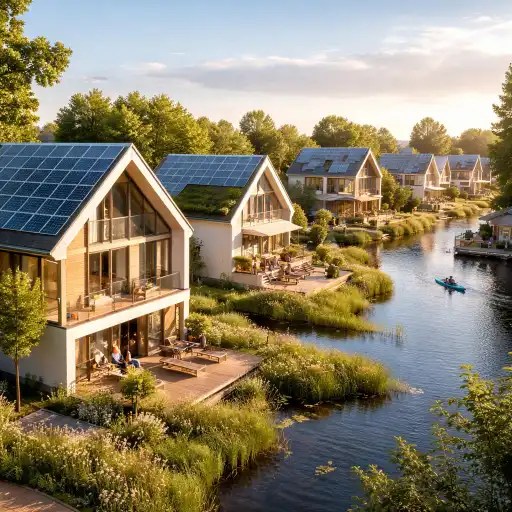
From Denmark to the Netherlands, a new generation of houses is producing more energy than it consumes—reshaping climate ambitions and the future of urban living
Across Northern Europe, a quiet but transformative shift is unfolding in residential architecture. In countries long associated with progressive environmental policy, a new housing model is rapidly gaining ground: energy-positive homes. These buildings do more than minimize consumption—they generate surplus energy, feeding it back into the grid and redefining what sustainable living can look like.
From coastal Danish communities to newly developed Dutch neighborhoods reclaimed from the sea, the concept is moving beyond experimental prototypes into mainstream construction. What began as a niche innovation is now emerging as a cornerstone of climate-neutral urban planning.
A House That Gives Back
Unlike traditional energy-efficient homes, which focus on reducing demand through insulation and efficient systems, energy-positive homes go a step further. Equipped with rooftop solar panels, advanced heat pumps, and intelligent energy management systems, they produce more electricity than they consume over the course of a year.
In Denmark, entire residential districts are being designed around this principle. Homes are oriented to maximize sunlight, while shared energy storage systems allow neighborhoods to balance supply and demand collectively. The result is not just individual efficiency, but a localized energy ecosystem.
The Netherlands is following closely. With limited land and a long history of water management innovation, Dutch planners are integrating energy-positive housing into broader sustainability strategies. New developments combine floating homes, green roofs, and solar-integrated facades, creating neighborhoods that are as resilient as they are efficient.
Technology Meets Design
At the heart of the movement is a convergence of technology and architecture. Solar panels are no longer an afterthought but an integral design feature. Windows are engineered to capture heat in winter while deflecting it in summer. Smart home systems continuously optimize energy use, shifting consumption to times when renewable production is highest.
Battery storage plays a crucial role. Homeowners can store excess energy generated during sunny or windy periods and use it later, reducing reliance on external sources. In some cases, electric vehicles double as mobile energy units, feeding power back into the home when needed.
This technological sophistication is paired with a strong emphasis on aesthetics. Architects are moving away from the utilitarian look once associated with sustainable buildings, creating homes that are both visually striking and environmentally advanced.
Policy Driving Momentum
Government policy has been instrumental in accelerating the trend. Incentives for renewable energy installation, strict building regulations, and ambitious climate targets have created fertile ground for innovation.
In both Denmark and the Netherlands, building codes are increasingly aligned with the goal of climate neutrality. Developers are encouraged—or required—to meet high performance standards, pushing the market toward energy-positive solutions.
Public-private partnerships are also playing a key role. Municipalities collaborate with developers, energy companies, and research institutions to pilot new concepts and scale successful models. This coordinated approach has allowed Northern Europe to move faster than many other regions.
A Model for Future Cities
The implications extend far beyond individual homes. Energy-positive housing is influencing how entire cities are planned and built. Instead of centralized power generation, urban areas are evolving into decentralized networks of micro-producers.
This shift has profound consequences for infrastructure. Grids must become more flexible, capable of handling two-way energy flows. Urban planners are rethinking zoning, transportation, and public space to integrate energy production seamlessly into daily life.
The concept also aligns with broader societal changes. As remote work becomes more common and communities seek greater self-sufficiency, energy-positive homes offer a tangible way to reduce environmental impact while enhancing quality of life.
Challenges and Opportunities
Despite its promise, the transition is not without challenges. Upfront costs remain higher than conventional construction, although they are decreasing as technology advances and economies of scale take effect. There is also a need for skilled labor and updated regulatory frameworks to support widespread adoption.
Equity is another concern. Ensuring that energy-positive housing is accessible to a broad range of income levels will be critical to avoiding a divide between sustainable and non-sustainable living.
Yet the opportunities are significant. For homeowners, the prospect of lower energy bills—or even income from surplus energy—is a powerful incentive. For governments, the model offers a pathway to meeting climate goals without sacrificing economic growth.
A Glimpse of Tomorrow
As Northern Europe continues to refine and expand this approach, energy-positive homes are becoming more than a regional trend. They are a blueprint for the future of housing worldwide.
What sets this movement apart is its practicality. These are not theoretical concepts or distant ambitions—they are real homes, inhabited by families, integrated into functioning communities. They demonstrate that climate-neutral living is not only possible but desirable.
In a world grappling with the urgency of climate change, the message from Northern Europe is clear: the homes of tomorrow will not just consume less—they will actively contribute to a more sustainable energy system.
And in doing so, they may redefine what it means to live well in the modern age.


 The Tower Post