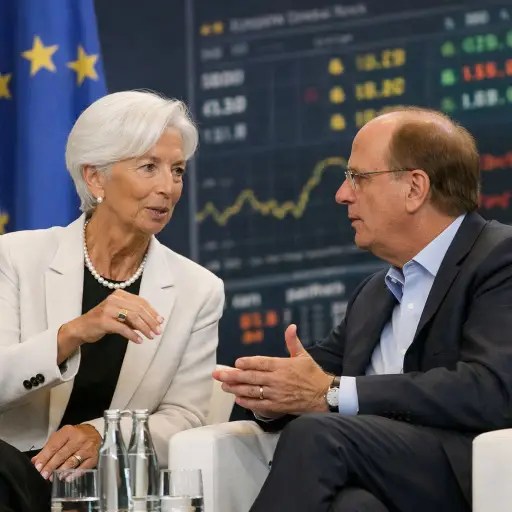
ECB President tells global investors Europe trails the U.S. in AI development but remains competitive in applying the technology across its economy
In a private exchange that has quickly captured the attention of financial markets, European Central Bank President Christine Lagarde offered a striking historical analogy: the economic transformation underway in the 2020s, she suggested, bears notable similarities to the upheavals of the 1920s. Speaking to one of the world’s most influential asset managers, Lagarde framed the current decade as a moment of both opportunity and fragility—defined by technological acceleration, shifting capital flows, and the risk of widening inequality.
Her remarks come at a time when investors are recalibrating expectations around artificial intelligence, productivity growth, and geopolitical fragmentation. While the United States continues to dominate the development of cutting-edge AI systems, Lagarde emphasized that Europe’s strength lies elsewhere—not in invention, but in implementation.
“The comparison with the 1920s is not about nostalgia,” Lagarde said, according to participants familiar with the discussion. “It is about recognizing the scale of transformation. Then, as now, technology is reshaping economies faster than institutions can adapt.”
The analogy is not without precedent. The 1920s were marked by rapid industrial innovation, financial exuberance, and deep structural imbalances. Electrification, mass production, and new communication technologies fueled growth but also contributed to volatility that would eventually culminate in crisis. Lagarde’s warning appears to hinge on a similar tension: the promise of AI-driven productivity gains alongside the risk of uneven distribution and speculative excess.
For global investors, the message was clear. The current cycle is not a conventional one driven solely by monetary policy or business cycles. Instead, it reflects a deeper shift in how economies function—one that may redefine competitiveness across regions.
On artificial intelligence, Lagarde struck a nuanced tone. Europe, she acknowledged, lags behind the United States in fundamental AI research, venture capital scale, and the creation of large technology platforms. Silicon Valley’s ecosystem remains unmatched in its ability to translate research breakthroughs into globally dominant companies.
Yet Europe’s position is more resilient than headline comparisons suggest. “When it comes to deploying AI across industries—manufacturing, logistics, healthcare, and finance—Europe is not behind,” she noted. “In many cases, it is competitive.”
This distinction between innovation and implementation is increasingly central to Europe’s economic strategy. Rather than attempting to replicate the U.S. model of tech giants, European policymakers have focused on integrating AI into existing industrial strengths. The region’s dense network of mid-sized firms, often deeply embedded in global supply chains, provides fertile ground for incremental but widespread technological adoption.
Investors have begun to take notice. While U.S. markets continue to reward companies at the frontier of AI development, European equities are seeing renewed interest tied to productivity gains from AI integration. The narrative is shifting from “who builds the technology” to “who uses it most effectively.”
Lagarde also addressed concerns about Europe’s regulatory framework, which has often been criticized as a constraint on innovation. She defended the continent’s approach, arguing that clear rules can enhance trust and accelerate adoption. “Confidence is a form of capital,” she said. “Without it, technology cannot scale sustainably.”
Still, the challenges are significant. Europe faces slower growth, demographic pressures, and a fragmented capital market that limits the ability of startups to scale rapidly. Bridging the gap with the United States will require not only policy coordination but also a cultural shift toward risk-taking and investment.
The conversation also touched on monetary policy and financial stability, though Lagarde avoided signaling any immediate changes. Instead, she emphasized the importance of maintaining flexibility in an environment shaped by structural transformation rather than cyclical fluctuations.
For the world’s largest fund managers, the implications are profound. If the 2020s do indeed mirror the dynamics of the 1920s, then the coming years may be defined by both extraordinary opportunity and heightened risk. Asset allocation strategies will need to account for technological disruption, regulatory divergence, and the potential for sudden market corrections.
Lagarde’s remarks suggest that Europe’s role in this new era will not be defined by technological leadership alone. Rather, it may hinge on its ability to embed innovation across its economy—quietly, systematically, and at scale.
As the discussion concluded, one theme stood out: history does not repeat itself, but it often rhymes. For policymakers and investors alike, the challenge is to recognize the pattern early enough to shape its outcome.
In Lagarde’s view, the 2020s are still being written. Whether they become a new “roaring” decade or a prelude to instability will depend on how effectively economies manage the forces now reshaping them.



 The Tower Post