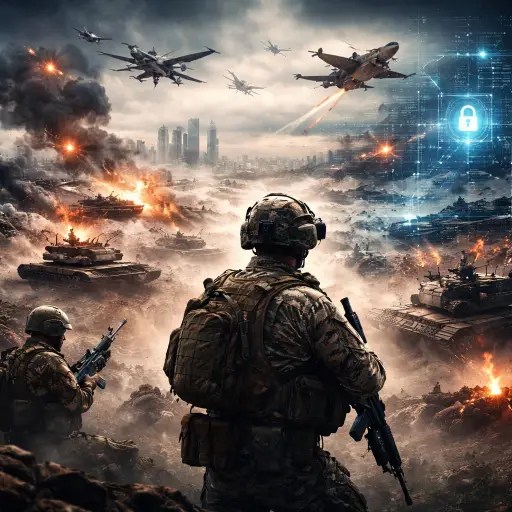
From Eastern Europe to the Middle East, interconnected conflicts and rising geopolitical tensions signal a shifting global order—and a growing call for Europe to prepare.
The notion of war is changing. No longer confined to traditional battlefields or clearly defined alliances, today’s conflicts are increasingly overlapping, interdependent, and difficult to contain. A growing number of defense analysts and geopolitical experts are warning that the world may be entering what they describe as a “multi-dimensional war” era—one in which military, economic, cyber, and informational fronts converge into a single, complex landscape of confrontation.
At the center of this concern lies the convergence of multiple ongoing crises. The war in Ukraine continues to reshape Europe’s security architecture, while escalating tensions in the Middle East threaten to spill across borders and draw in regional and global powers. Meanwhile, flashpoints in Asia, Africa, and cyberspace add further layers to an already volatile environment.
What makes the current moment particularly alarming, experts say, is not simply the existence of multiple conflicts, but the growing connections between them.
Interconnected Battlefields
In previous decades, regional wars were often treated as largely isolated events. Today, that distinction is fading. Military support, economic sanctions, energy dependencies, and digital warfare are linking conflicts in ways that amplify their global impact.
For example, supply chains disrupted by one conflict can influence another theater entirely. Energy markets, strained by geopolitical instability, ripple across continents. Cyberattacks tied to one conflict may target infrastructure in countries far removed from the original dispute. The result is a web of tensions where actions in one region can trigger consequences elsewhere.
Analysts point out that major powers are increasingly involved—directly or indirectly—in multiple theaters at once. This creates a situation in which localized escalations risk cascading into broader confrontations.
The Rise of Hybrid Warfare
Compounding this complexity is the rise of hybrid warfare. Traditional military engagements are now accompanied by cyber operations, disinformation campaigns, economic pressure, and political interference.
In this environment, war is no longer declared in clear terms. Instead, it unfolds across multiple domains simultaneously—often below the threshold of conventional conflict. Governments, corporations, and even civilians find themselves on the front lines, whether through cyber vulnerabilities, information exposure, or economic disruption.
Experts argue that this blending of tactics makes conflicts harder to contain and more difficult to resolve. It also increases the risk of miscalculation, as actors respond to perceived threats that may not be immediately visible or clearly attributable.
Echoes of a Systemic Shift
Some analysts draw parallels between the current geopolitical climate and earlier periods that preceded large-scale global conflicts. While direct comparisons remain debated, there is a growing consensus that the international system is undergoing a significant transformation.
The post-Cold War order, characterized by relative stability and clear power structures, appears to be giving way to a more fragmented and competitive landscape. Emerging powers are asserting themselves, alliances are evolving, and long-standing norms are being challenged.
In such an environment, uncertainty becomes a defining feature. Decision-makers must navigate a world where the rules are less clear and the stakes increasingly high.
Europe’s Strategic Crossroads
For Europe, these developments carry particular urgency. The continent finds itself geographically close to several major conflict zones while also deeply integrated into global economic and political systems.
Security experts are urging European nations to reassess their defense readiness. This includes not only increasing military capabilities but also strengthening resilience against cyber threats, securing critical infrastructure, and enhancing coordination among allies.
There is also a growing recognition that defense is no longer solely a military matter. Economic stability, energy security, and technological independence are now seen as integral components of national and regional security strategies.
Calls for increased defense spending and closer cooperation within European institutions have gained momentum. However, balancing these priorities with domestic political and economic pressures remains a significant challenge.
A New Era of Risk—and Responsibility
The concept of a “multi-dimensional war” era does not necessarily imply an imminent global conflict. Rather, it reflects a shift in how conflicts are structured and experienced.
In this emerging landscape, boundaries blur: between war and peace, domestic and international security, physical and digital domains. The implications are profound, affecting not only governments and militaries but societies as a whole.
Experts emphasize that managing this complexity will require new approaches to diplomacy, conflict prevention, and international cooperation. Traditional frameworks may no longer be sufficient to address the interconnected nature of modern threats.
As tensions continue to evolve, one message is becoming increasingly clear: the world is entering a period where conflicts are not isolated events, but parts of a larger, dynamic system. Understanding—and adapting to—this reality may prove to be one of the defining challenges of our time.
 The Tower Post