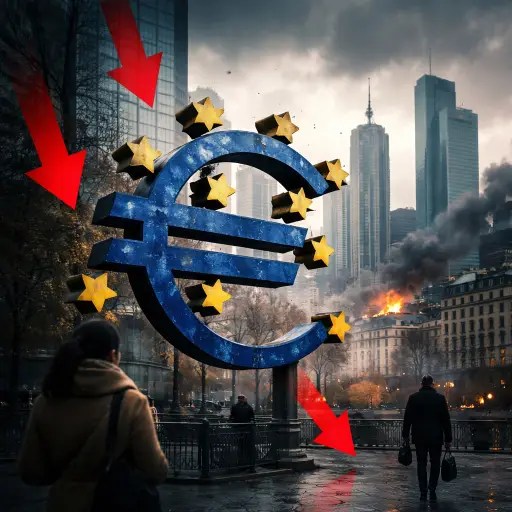
Rising uncertainty, fragile industry, and cautious consumers leave Europe’s monetary union on the brink of stagnation
The euro zone economy is edging closer to a standstill, as the prolonged effects of war on the continent’s periphery continue to ripple through supply chains, energy markets, and investor confidence. What was once expected to be a gradual recovery has instead become a fragile balancing act, with growth losing momentum across several of the bloc’s largest economies.
From industrial hubs in central Europe to service-driven economies in the south, signs of fatigue are becoming increasingly difficult to ignore. Business activity has softened, manufacturing orders remain subdued, and households—still grappling with elevated living costs—are tightening their spending. The result is an economic landscape marked less by contraction than by inertia: an economy moving, but only just.
At the heart of the slowdown lies the enduring impact of geopolitical tensions. The war has not only disrupted trade routes and energy flows but has also reshaped the strategic priorities of governments and corporations alike. Defense spending has risen, public finances are under renewed strain, and long-term investment decisions are being delayed amid persistent uncertainty.
Energy remains a central concern. Although prices have stabilized compared to earlier peaks, they continue to weigh heavily on energy-intensive industries such as chemicals, steel, and manufacturing. Many firms have scaled back production or relocated parts of their operations, citing both cost pressures and unpredictability. This industrial retrenchment is now feeding into broader economic weakness.
Germany, long regarded as the euro zone’s economic engine, has shown particular vulnerability. Its export-oriented model, heavily reliant on global demand and stable energy supplies, has struggled to adapt to the new environment. Meanwhile, France and Italy are experiencing slower growth as consumer demand weakens and business investment hesitates.
The labor market, once a source of resilience, is beginning to show subtle signs of strain. While unemployment remains relatively low, hiring momentum has cooled, and some sectors are reporting reduced working hours or hiring freezes. Wage growth, though still present, is no longer accelerating at the pace seen during the post-pandemic rebound.
Monetary policy has added another layer of complexity. The European Central Bank, having spent an extended period tightening policy to combat inflation, now faces a delicate dilemma. Inflationary pressures have eased but have not disappeared entirely, leaving policymakers cautious about easing too quickly. At the same time, maintaining restrictive conditions risks further dampening already weak growth.
Financial markets are reflecting this uncertainty. Bond yields have fluctuated as investors reassess the trajectory of interest rates, while equity markets have shown uneven performance across sectors. Companies with strong balance sheets and diversified operations are faring better, but smaller firms—particularly those exposed to domestic demand—are under increasing pressure.
Beyond the immediate economic indicators, there is a growing concern about longer-term competitiveness. The combination of higher energy costs, regulatory complexity, and geopolitical fragmentation is prompting some businesses to reconsider their presence in Europe altogether. Investment flows are becoming more selective, with capital increasingly directed toward regions perceived as more stable or cost-efficient.
Policymakers across the euro zone are attempting to respond, but coordination remains challenging. Fiscal measures aimed at supporting households and businesses have provided some relief, yet they also risk adding to already elevated public debt levels. Structural reforms—long discussed but often delayed—are once again being highlighted as essential to restoring growth potential.
There are, however, pockets of resilience. The services sector continues to provide some support, particularly in tourism-dependent economies, where demand has remained relatively steady. Additionally, the transition toward renewable energy and digital infrastructure offers potential avenues for future growth, though these benefits are unlikely to materialize in the immediate term.
For now, the prevailing mood is one of cautious vigilance. Economists warn that while a deep recession may be avoided, the risk of prolonged stagnation is rising. Much will depend on the evolution of the geopolitical situation, as well as the policy choices made in the months ahead.
As Europe navigates this uncertain terrain, the challenge will be not only to stabilize the present but also to lay the groundwork for a more resilient economic future. The stakes are high, and the margin for error is narrowing.

 The Tower Post