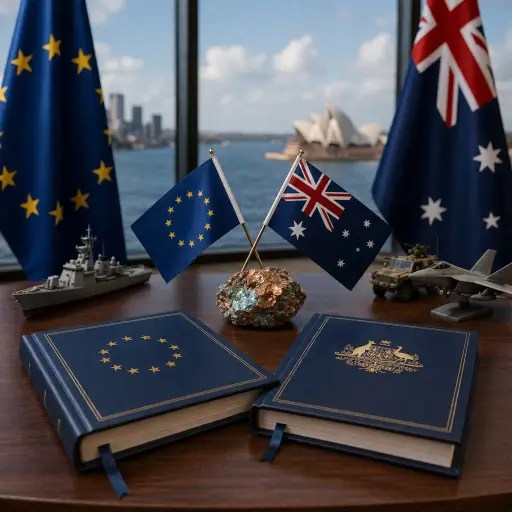
A new strategic accord signals a broader shift in global power dynamics and economic alignment
In a move that underscores a changing global order, the European Union has finalized a sweeping trade and strategic partnership agreement with Australia, marking one of the most ambitious external alignments in its recent history. The agreement spans critical minerals, defense cooperation, and long-term economic coordination, positioning both partners to navigate an increasingly fragmented geopolitical landscape.
The pact arrives at a moment when traditional alliances are being reassessed and economic dependencies are under scrutiny. For Europe, the agreement reflects a deliberate effort to diversify supply chains, secure access to vital resources, and project influence beyond its immediate neighborhood. For Australia, it represents a deepening of ties with a major economic bloc that is seeking stable, like-minded partners in an era of uncertainty.
At the heart of the agreement lies access to critical minerals, a sector that has become central to the global energy transition and advanced manufacturing. Australia, rich in lithium, rare earth elements, and other strategic resources, offers Europe a reliable alternative to more concentrated and geopolitically sensitive supply chains. European industries, particularly those involved in electric vehicles, renewable energy infrastructure, and high-tech production, stand to benefit significantly from this diversification.
The deal establishes frameworks for investment, extraction, and processing cooperation, aiming to create more resilient and transparent supply networks. European firms are expected to increase their presence in Australia’s mining and refining sectors, while Australian exports will gain more predictable access to European markets. This mutual dependency is designed not as a vulnerability, but as a stabilizing force in a volatile global economy.
Beyond economics, the agreement carries a strong defense and security dimension. Both sides have committed to expanding joint exercises, intelligence sharing, and technological collaboration. While not a formal military alliance, the partnership signals a convergence of strategic interests, particularly in safeguarding maritime routes and ensuring the stability of key regions.
This defense cooperation reflects a broader trend in which economic and security concerns are increasingly intertwined. The protection of supply chains, especially those involving critical minerals and advanced technologies, has become a matter of national and regional security. By aligning more closely, Europe and Australia aim to reduce exposure to disruptions and reinforce their capacity to respond to emerging threats.
The agreement also emphasizes regulatory alignment and standards cooperation, areas often overlooked but crucial for long-term integration. By harmonizing rules in sectors such as digital trade, environmental protection, and industrial policy, both parties seek to reduce friction and create a more predictable business environment. This alignment is expected to encourage investment and innovation, particularly in green technologies and sustainable industries.
Observers have noted that the partnership reflects what could be described as a quieter form of globalization. Unlike earlier waves characterized by rapid expansion and minimal oversight, this new phase is more selective and strategic. It prioritizes trusted partners, shared values, and resilience over sheer scale. In this sense, the EU-Australia agreement can be seen as part of a broader recalibration of global economic relations.
For Europe, the deal is also a statement of intent. It demonstrates a willingness to act beyond its traditional sphere of influence and to engage more actively in the Indo-Pacific region. This geographic shift is not merely symbolic; it reflects the growing importance of the region in global trade, technology, and security dynamics.
Australia, for its part, gains a strengthened connection to one of the world’s largest economic blocs. The partnership offers opportunities to diversify its own trade relationships and to play a more prominent role in shaping international standards and practices. It also reinforces Australia’s position as a key supplier of resources that are essential for the global transition to cleaner energy systems.
While the agreement has been widely welcomed by industry and policymakers, it is not without challenges. Questions remain about implementation, particularly in balancing economic growth with environmental and social considerations. The expansion of mining activities, for instance, will require careful management to ensure sustainability and community engagement.
There are also broader geopolitical implications to consider. As regions and countries form more tightly knit partnerships, the global system may become more segmented, with overlapping networks of cooperation and competition. The EU-Australia pact is a clear example of this evolving landscape, where alliances are shaped as much by economic priorities as by traditional security concerns.
Despite these complexities, the agreement represents a significant step forward for both parties. It reflects a shared recognition that in a world of shifting alliances and increasing uncertainty, collaboration among trusted partners is more important than ever.
Ultimately, the EU-Australia partnership is about more than trade or defense. It is about building a framework for long-term cooperation that can adapt to changing circumstances and support mutual prosperity. As the contours of the global order continue to evolve, such agreements may well define the next phase of international relations.
In this context, the deal stands as a signal of intent: a move toward a more deliberate, strategic form of globalization, where influence is extended not through dominance, but through partnership.
 The Tower Post