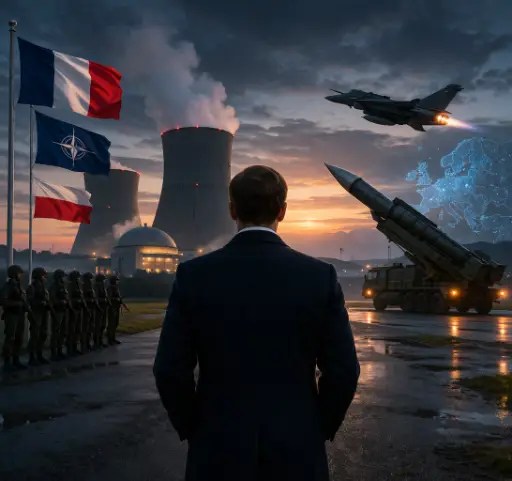
Macron’s renewed emphasis on deterrence coincides with growing interest in nuclear coordination across NATO’s eastern flank, reflecting a continent adapting to a more volatile security era.
Europe is entering a new phase of strategic thinking—one defined less by post-Cold War optimism and more by a sober reassessment of power, deterrence, and risk. At the center of this shift stands France, where President Emmanuel Macron has intensified calls to reinforce the country’s nuclear posture, framing it as essential not only to national sovereignty but to broader European security.
The message from Paris is clear: in an era marked by rising geopolitical tensions, nuclear deterrence remains a cornerstone of stability. French officials have increasingly signaled that their independent nuclear force—long a symbol of strategic autonomy—must be preserved, modernized, and, if necessary, expanded in both capability and political relevance.
This renewed emphasis comes amid a changing threat landscape. War on Europe’s borders, heightened rivalry among global powers, and uncertainty about long-term security guarantees have pushed defense questions back to the forefront of political debate. Macron’s rhetoric reflects a belief that Europe must prepare for a world where deterrence once again plays a central role in preventing escalation.
France’s nuclear doctrine has traditionally been rooted in strict national control. Unlike other nuclear-armed allies, Paris has maintained full sovereignty over its arsenal, resisting integration into shared command structures. Yet recent signals suggest a subtle evolution: while the weapons remain under French authority, their strategic value may increasingly be framed in a European context.
This shift is being closely watched across the continent—particularly in Central and Eastern Europe, where security concerns are most acute. Countries such as Poland have openly explored the possibility of deeper nuclear cooperation within the NATO framework. Though such discussions remain politically sensitive, they underscore a broader trend: the desire among frontline states to strengthen deterrence through closer alignment with nuclear capabilities.
For Poland and its neighbors, the debate is not abstract. The proximity of military threats has transformed defense planning from long-term policy into immediate necessity. Discussions around nuclear sharing, extended deterrence, and enhanced presence are gaining traction, even as they raise complex legal and political questions within NATO.
The alliance itself finds itself at a crossroads. NATO’s nuclear posture has historically relied on a combination of American capabilities and allied participation. However, shifting global dynamics—and concerns about the durability of transatlantic commitments—have prompted some European leaders to consider additional layers of deterrence.
In this context, France’s role becomes particularly significant. As the only nuclear power within the European Union, it occupies a unique position. Macron has, on several occasions, hinted at the possibility of a broader strategic dialogue on how French deterrence might contribute to the security of Europe as a whole. While details remain deliberately अस्पष्ट, the implication is unmistakable: France is positioning itself as a central pillar in Europe’s evolving defense architecture.
This development is not without controversy. Critics argue that expanding the political role of nuclear weapons risks normalizing their presence in strategic calculations, potentially lowering the threshold for their use. Others warn that discussions of nuclear sharing or cooperation could provoke countermeasures, further destabilizing an already tense security environment.
Supporters, however, contend that credible deterrence is precisely what prevents conflict. From this perspective, clarity and capability are essential. By reinforcing its nuclear posture and engaging allies in strategic dialogue, France is seen as contributing to a stronger, more resilient Europe.
Beyond policy debates, the shift reflects a deeper transformation in European strategic culture. For decades, many European states prioritized diplomacy, economic integration, and soft power as primary tools of influence. While those elements remain important, they are now being complemented by a renewed focus on hard power—military readiness, defense spending, and deterrence.
This broader recalibration is visible across the continent. Defense budgets are rising, procurement programs are accelerating, and joint military initiatives are expanding. The conversation around nuclear deterrence fits within this larger trend: a recognition that security in the current environment requires a more robust and multifaceted approach.
France’s push for nuclear reinforcement also carries domestic dimensions. Maintaining a credible deterrent requires sustained investment in technology, infrastructure, and personnel. By emphasizing its importance, Macron is reinforcing political support for these commitments, even as economic pressures and competing priorities persist.
At the same time, the French approach remains distinct in its emphasis on independence. While cooperation with allies is being explored, the underlying principle of national control is unlikely to change. This balance—between autonomy and partnership—will be a defining feature of France’s nuclear policy in the years ahead.
As Europe navigates this new strategic landscape, the implications of these developments are profound. The reemergence of nuclear deterrence as a central theme signals a departure from assumptions that dominated the post-Cold War era. It reflects a world in which uncertainty is the norm, and where traditional concepts of power are once again shaping policy decisions.
For policymakers, the challenge will be to manage this transition carefully. Strengthening deterrence must be balanced with efforts to reduce risks, maintain stability, and avoid unintended escalation. Dialogue—both within Europe and with global partners—will remain essential.
What is clear is that Europe is no longer content to rely solely on past frameworks. The continent is adapting, recalibrating, and, in many ways, rediscovering the strategic realities that defined earlier generations. France’s renewed focus on nuclear strength is both a reflection of this shift and a catalyst for further change.
In the evolving equation of European security, deterrence is once again taking center stage—and with it, the recognition that peace, in uncertain times, often depends on the credibility of power.
 The Tower Post