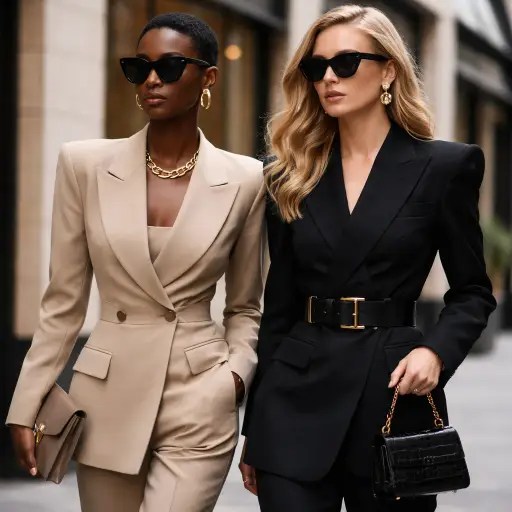
After seasons of restraint, fashion reclaims boldness as designers embrace structure, identity, and unapologetic presence
The era of “quiet luxury” — defined by hushed palettes, discreet branding, and an almost ascetic devotion to minimalism — is undergoing a visible transformation. What once signaled refined taste through understatement is now evolving into something far more assertive. Across runways, ateliers, and city streets, a new fashion language is emerging: one that favors presence over subtlety, structure over softness, and confidence over concealment.
This shift does not reject luxury’s recent past so much as it reframes it. The pared-back aesthetic that dominated wardrobes in recent seasons served as a visual response to uncertainty, a kind of sartorial grounding in times of global tension. But as the cultural mood recalibrates, so too does fashion. Designers are now channeling a collective appetite for strength, clarity, and individuality — expressed through what is increasingly being described as a new era of power dressing.
Where quiet luxury once relied on perfect tailoring in neutral tones, today’s collections reinterpret those foundations with heightened intention. Blazers are sharper, shoulders more pronounced, silhouettes more sculptural. Fabrics retain their richness but are cut with architectural precision. The result is not excess, but emphasis — a deliberate amplification of form and identity.
This evolution is visible across major fashion capitals, where designers are exploring the intersection of elegance and authority. Structured coats cinch at the waist with commanding belts. Trousers elongate the body with exaggerated lines. Dresses, once fluid and understated, now assert their presence through bold construction and strategic detailing. Even color, long subdued in the quiet luxury era, is returning with purpose: deep crimsons, saturated blacks, and luminous metallics punctuate collections with renewed intensity.
Industry insiders point to a broader cultural context behind the change. Fashion has always mirrored the psychological landscape of its time, and today’s shift reflects a growing desire for self-definition. In a world shaped by rapid transformation, clothing becomes more than aesthetic — it becomes armor, language, and statement.
Power dressing, in its modern interpretation, moves beyond the corporate symbolism of past decades. It is less about conformity to authority and more about the projection of personal agency. Designers are expanding the concept to include diverse expressions of strength: femininity that is unapologetically bold, masculinity that embraces fluidity, and silhouettes that defy traditional categorization altogether.
Luxury brands, in particular, are navigating this transition with calculated precision. Their challenge lies in maintaining the craftsmanship and restraint that define high-end fashion while introducing elements that resonate with a more expressive consumer. The result is a hybrid aesthetic: garments that feel both timeless and immediate, refined yet unmistakably powerful.
Accessories, too, reflect this new direction. Jewelry is larger, more sculptural, often serving as focal points rather than accents. Handbags adopt structured forms with pronounced hardware. Footwear emphasizes presence, with heels and soles designed to command attention without sacrificing elegance. Each element contributes to a cohesive narrative of confidence.
At the retail level, this shift is translating into changing consumer behavior. Shoppers who once gravitated toward understated essentials are now seeking pieces that communicate identity more explicitly. Investment dressing is no longer solely about longevity; it is about impact. The value of a garment lies not only in its craftsmanship but in its ability to convey a sense of self.
Yet, despite the movement toward boldness, the principles of quiet luxury have not disappeared. Instead, they serve as a foundation upon which this new aesthetic is built. Quality remains paramount. Materials are still chosen with care. The difference lies in intention: where subtlety once reigned, expression now leads.
Fashion historians suggest that such cycles are inevitable. Periods of restraint often give way to moments of exuberance, as cultural energies shift and creative voices seek new forms of articulation. What distinguishes the current transition, however, is its nuance. This is not a return to excess for its own sake, but a considered embrace of visibility and strength.
As the industry continues to evolve, the line between minimalism and maximalism becomes increasingly blurred. The future of luxury fashion appears to lie not in choosing one over the other, but in balancing both — merging the discipline of restraint with the freedom of expression.
In this emerging landscape, clothing is no longer content to whisper. It speaks clearly, confidently, and with purpose. The new power dressing does not abandon elegance; it amplifies it, transforming quiet luxury into a language of presence that reflects a world ready to be seen.
 The Tower Post