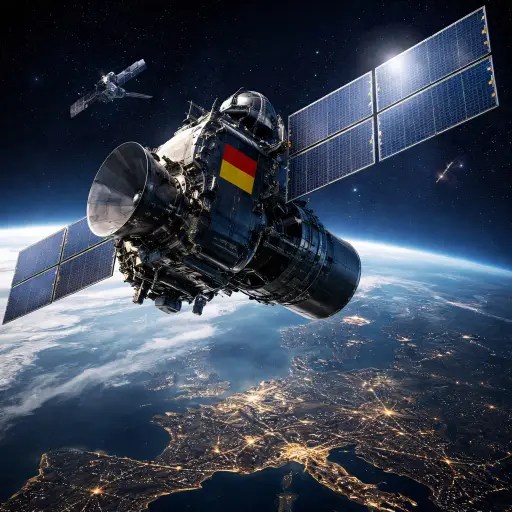
Berlin’s push for a sovereign military space network exposes growing tensions between national ambition and European unity.
A major shift is quietly unfolding above Europe—far beyond its borders, yet deeply rooted in its political future. Germany’s decision to build its own military satellite network, separate from the European Union’s shared systems, marks a turning point in how the continent approaches defense, sovereignty, and cooperation. Though framed as a pragmatic response to evolving security threats, the move is increasingly seen by critics as a signal of fragmentation within Europe’s strategic vision.
At its core, the German plan reflects a growing unease among EU member states about reliance—both on external allies and on collective European mechanisms that can be slow, politically entangled, or insufficiently responsive in times of crisis. The proposed network, with a projected cost of roughly €10 billion, aims to deliver secure communications, enhanced surveillance, and independent operational capability for Germany’s armed forces.
Officials in Berlin argue that the initiative is not intended to undermine European cooperation but to strengthen it. They describe the system as complementary, filling capability gaps and ensuring that Germany can act swiftly when necessary. In a world where cyber threats, hybrid warfare, and geopolitical tensions are escalating, the need for resilient and autonomous infrastructure has become increasingly urgent.
Yet beneath the official narrative lies a more complex reality.
Across Brussels and other European capitals, concerns are mounting that Germany’s move could set a precedent—encouraging other nations to pursue parallel systems rather than investing in shared ones. The European Union has already been working on its own secure satellite constellation, designed to serve both civilian and military needs. If major member states begin to sidestep these collective efforts, the result could be duplication, inefficiency, and a dilution of the EU’s strategic coherence.
Critics warn that Europe risks building multiple overlapping systems, each costly and potentially incompatible. In an era where defense budgets are under pressure, such fragmentation could mean billions spent without achieving the intended level of collective security. More importantly, it raises questions about trust: if member states increasingly prioritize national solutions, what does that say about confidence in the European project itself?
The timing of Germany’s decision adds to the unease. Europe is navigating a period of heightened geopolitical uncertainty, with security concerns stretching from its eastern borders to the wider global stage. In this context, unity has been repeatedly emphasized as essential. A coordinated approach to defense, intelligence, and technology is widely seen as Europe’s best chance to assert itself in an increasingly multipolar world.
Germany’s satellite plan, however, suggests a parallel trend—one where national governments hedge their bets.
Supporters of the initiative argue that this is not fragmentation but realism. They point out that Europe’s defense integration has long been constrained by political differences, bureaucratic delays, and divergent strategic priorities. In practice, they say, national capabilities remain the backbone of European security. From this perspective, Germany’s investment is less a departure from unity than an acknowledgment of existing limitations.
There is also a technological dimension to consider. Space is rapidly becoming a contested domain, with satellites playing a crucial role in communication, navigation, intelligence, and military coordination. The vulnerability of these assets—whether to cyberattacks, jamming, or physical threats—has underscored the need for redundancy and resilience. By developing its own network, Germany aims to reduce dependence on external systems and ensure continuity in high-risk scenarios.
Still, the broader implications are difficult to ignore.
The European Union has spent years trying to build a more integrated defense framework, promoting joint procurement, shared capabilities, and coordinated strategy. Initiatives such as common funding mechanisms and collaborative research projects were designed to reduce fragmentation and enhance efficiency. Germany’s move, while not explicitly rejecting these efforts, appears to diverge from their underlying logic.
For smaller member states, the development is particularly sensitive. Many rely heavily on EU-level programs to access advanced capabilities that would be prohibitively expensive to develop independently. If larger countries increasingly invest in national systems, the gap between them and smaller nations could widen, potentially creating a two-tier security landscape within Europe.
There is also a political dimension that extends beyond defense.
The European project has always been a delicate balance between unity and sovereignty. In recent years, that balance has been tested by crises ranging from economic instability to migration and security threats. Germany, as one of the EU’s leading powers, has traditionally been a strong advocate for deeper integration. Its decision to pursue a national satellite network may therefore carry symbolic weight, signaling a shift—however subtle—toward a more sovereignty-focused approach.
Some analysts see this as part of a broader trend across Europe. As global uncertainties increase, governments are placing greater emphasis on control, resilience, and national capability. While cooperation remains important, it is no longer seen as sufficient on its own. The result is a hybrid model, where states participate in collective frameworks but simultaneously build their own parallel capacities.
Whether this approach will strengthen or weaken Europe remains an open question.
Proponents argue that a more capable Germany ultimately benefits the EU as a whole. By investing in advanced technology and infrastructure, Berlin could contribute to a stronger, more resilient European defense ecosystem. If managed carefully, national and collective systems could coexist, providing both flexibility and depth.
Critics, however, are less optimistic. They warn that without clear coordination and shared standards, Europe risks drifting into a patchwork of systems that are difficult to integrate and maintain. The financial cost is one concern, but the strategic cost may be even greater. In a rapidly changing global landscape, fragmentation could undermine Europe’s ability to act decisively and present a unified front.
For now, the debate remains largely subdued, unfolding in policy circles rather than in the public spotlight. There are no dramatic confrontations or explicit ruptures—only a gradual recalibration of priorities. Yet the implications are significant.
Germany’s satellite plan is more than a technological investment; it is a reflection of how Europe is redefining itself in an uncertain world. It highlights the tension between the ideal of unity and the reality of national interests, between shared ambition and individual responsibility.
As Europe looks to the future, the challenge will be to navigate this tension without allowing it to become a fault line. The choices made today—quietly, and often out of view—will shape the continent’s strategic landscape for years to come.
In orbit, satellites may appear distant and detached. But on the ground, the decisions that put them there are anything but.

 The Tower Post