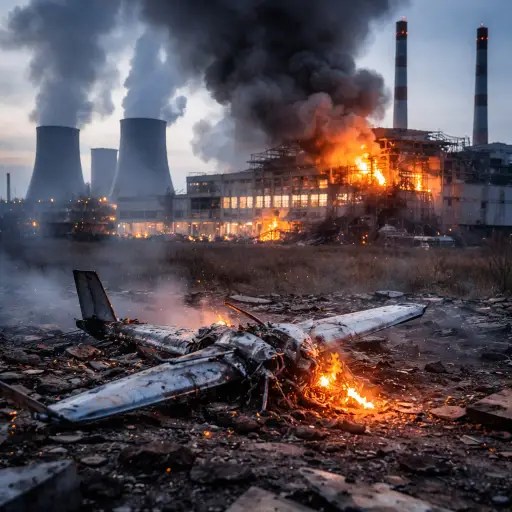
Explosive-laden drone crosses into Estonia, marking a stark escalation as conflict edges into EU territory
A drone carrying explosives struck a power generation facility in Estonia, igniting fires and triggering widespread concern across European capitals, in what officials describe as a direct spillover of the ongoing Ukraine–Russia conflict into European Union territory.
The unmanned aerial vehicle is believed to have crossed into Estonian airspace from Russia before impacting the site, causing structural damage and forcing a temporary shutdown of operations. Emergency crews responded swiftly, containing the blaze and preventing further escalation, while authorities moved to secure the surrounding area.
Preliminary assessments suggest the drone was part of broader military activity linked to the conflict in Ukraine, though responsibility remains under investigation. Estonian officials have framed the incident as a serious breach of sovereignty and a significant escalation in the regional security environment.
“This is no longer a distant war,” a senior Estonian security official said on condition of anonymity. “What we are seeing is the physical manifestation of that conflict reaching into the European Union.”
The strike has intensified fears that the war, long contained within Ukraine and its immediate periphery, is increasingly spilling beyond its borders—raising the stakes for NATO and EU member states. While incidents involving stray missiles and airspace violations have occurred previously, a deliberate or uncontrolled drone strike causing infrastructure damage inside EU territory marks a new phase.
Energy infrastructure has been a consistent target throughout the Ukraine conflict, with both sides accused of attempting to disrupt power generation and distribution. The Estonian facility, while not among Europe’s largest, plays a critical role in regional energy stability, particularly given ongoing efforts to reduce dependence on Russian energy sources.
Officials confirmed that there were no immediate reports of casualties, though several workers were evacuated as a precaution. Damage assessments are ongoing, and authorities are evaluating the extent of operational disruption. Initial indications suggest the impact may be contained, but the psychological and political ramifications are far broader.
European leaders reacted with urgency, convening emergency consultations and calling for a coordinated response. NATO representatives emphasized the importance of collective defense while stopping short of attributing the strike to a specific actor pending further investigation.
“This incident underscores the volatility of the current security landscape,” a NATO spokesperson said. “We are closely monitoring developments and remain committed to the defense of all member states.”
The event is likely to accelerate discussions around air defense systems, particularly in Eastern Europe, where nations bordering Russia and Belarus have long warned of heightened vulnerability. Estonia, along with Latvia and Lithuania, has repeatedly called for stronger NATO presence and enhanced surveillance capabilities.
Security analysts note that drones, due to their relatively low cost and increasing sophistication, have become a central feature of modern warfare—capable of reaching targets far beyond traditional frontlines. The incident highlights the difficulty of defending against such threats, especially in peacetime airspace.
“This is exactly the kind of gray-zone escalation that policymakers have feared,” said a European defense analyst. “It blurs the line between accident, provocation, and warfare.”
Russia has not issued an official statement regarding the incident, and it remains unclear whether the drone was intentionally directed toward Estonian territory or strayed off course during operations elsewhere. Ukrainian officials have also not commented directly, though they have previously warned of the unpredictable nature of drone warfare near contested borders.
For residents in the affected region, the strike has brought a sudden and unsettling proximity to a war that, until now, had been perceived as geographically contained. Authorities have urged calm while reinforcing security measures and increasing aerial monitoring.
The broader implications are still unfolding. Diplomatic channels are expected to play a key role in the coming days, as European leaders seek clarity and attempt to prevent further escalation. At the same time, the incident may prompt a reassessment of defense readiness and crisis response mechanisms across the EU.
As investigations continue, one reality is becoming increasingly difficult to ignore: the boundaries of the Ukraine–Russia conflict are no longer as fixed as they once seemed. The strike on Estonian infrastructure signals a shift—one that carries profound consequences for European security and stability.
What was once a war at Europe’s edge is now, unmistakably, touching its core.



 The Tower Post