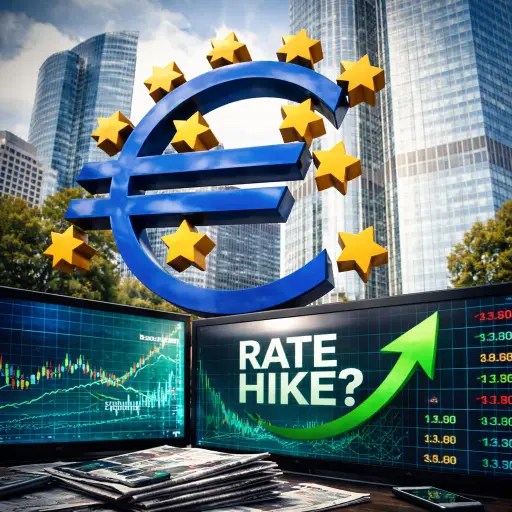
Monetary tightening signals ripple across currencies, bonds, and borrowing costs worldwide
The European Central Bank is once again at the center of global financial attention, as policymakers signal that another interest rate increase may be on the horizon. The message, delivered with characteristic caution but unmistakable intent, has already begun to reverberate across markets, from sovereign bond yields to currency trading floors and household borrowing expectations.
At the core of the ECB’s stance lies a persistent concern: inflation, while easing in some areas, remains sufficiently elevated to justify continued vigilance. Officials appear determined to prevent premature financial loosening, wary of the risks that entrenched price pressures could pose to long-term economic stability. The signal is clear—policy is not yet restrictive enough to declare victory.
Markets have responded swiftly.
In European bond markets, yields have edged higher as investors recalibrate expectations for future rate paths. Government borrowing costs across the euro area have risen modestly, reflecting the anticipation of tighter monetary conditions ahead. This adjustment has not been confined to Europe. US Treasury yields and other global benchmarks have also reacted, highlighting the interconnected nature of financial systems in an era of synchronized policy sensitivity.
Currency markets, too, have been active. The euro has shown renewed strength against several major counterparts, supported by the prospect of relatively higher interest rates. Traders are increasingly positioning for a scenario in which European yields remain competitive, potentially attracting capital inflows. However, volatility remains elevated, as investors weigh the ECB’s signals against broader global dynamics, including growth concerns and policy moves from other central banks.
For households and businesses, the implications are more tangible.
Mortgage rates across the eurozone are expected to face renewed upward pressure. Borrowers who had hoped for stabilization may now confront higher financing costs, particularly in countries where variable-rate mortgages are prevalent. This could dampen housing demand and slow price growth, adding another layer of complexity to already cooling real estate markets.
Corporate borrowers are similarly affected. Higher rates translate into increased costs of capital, potentially influencing investment decisions and expansion plans. For small and medium-sized enterprises, which often rely on bank lending, the tightening cycle could prove especially consequential.
Yet the ECB’s approach is not without nuance.
Policymakers have emphasized data dependence, leaving room for flexibility should economic conditions shift. Growth indicators across the euro area have shown signs of fragility, and any further tightening must be carefully balanced against the risk of stifling recovery. This delicate calibration underscores the central bank’s challenge: to restrain inflation without triggering an undue economic slowdown.
Globally, the ECB’s posture feeds into a broader narrative of cautious persistence among central banks. While some institutions are approaching the end of their tightening cycles, the ECB’s signal suggests that divergence in policy trajectories may persist. This divergence has implications for capital flows, exchange rates, and cross-border investment strategies.
Investors are already adjusting.
Asset managers are reassessing portfolio allocations, with increased attention to fixed income opportunities in Europe. Higher yields may enhance the attractiveness of euro-denominated assets, particularly for international investors seeking returns in a still uncertain environment. At the same time, equity markets face a more complex outlook, as higher rates can weigh on valuations and corporate earnings prospects.
The ripple effects extend beyond developed markets. Emerging economies, often sensitive to shifts in global liquidity and interest rate differentials, are closely monitoring the ECB’s stance. A stronger euro and higher European yields could influence capital flows, potentially tightening financial conditions in regions already navigating their own economic challenges.
Despite the immediate market reactions, a degree of uncertainty remains.
The ECB has not committed to a specific timeline or magnitude for future rate adjustments, maintaining strategic ambiguity. This approach allows policymakers to retain flexibility but also leaves markets in a state of heightened sensitivity to incoming data and official communication.
What is clear, however, is that the era of easy money remains firmly in the past.
The ECB’s signal reinforces a broader shift toward a more disciplined monetary environment, one in which borrowing costs are no longer artificially suppressed and financial conditions reflect a renewed emphasis on price stability. For governments, businesses, and households alike, this transition requires adaptation.
As the global financial system digests the implications, one theme stands out: central bank communication continues to wield significant influence. Even the suggestion of a rate hike—carefully phrased and cautiously delivered—can reshape expectations, reprice assets, and redirect capital flows across continents.
In the coming weeks, attention will remain firmly fixed on the ECB’s next moves. Economic data releases, inflation readings, and official statements will all be scrutinized for clues. Markets, ever forward-looking, will continue to adjust in real time.
For now, the message has landed.
The ECB is not done yet—and the world is already responding.



 The Tower Post