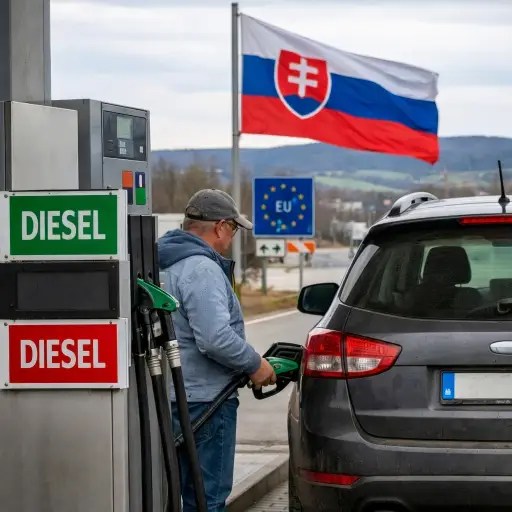
Brussels confronts Bratislava over diesel pricing policy seen as undermining the single market and free movement principles
The European Union has opened a fresh dispute with Slovakia over a controversial fuel pricing policy that, according to officials in Brussels, discriminates against foreign drivers and violates core principles of the bloc’s single market.
At the center of the dispute is a measure introduced by Slovak authorities that effectively limits access to lower-priced diesel fuel for non-resident motorists. Under the policy, domestic drivers are able to purchase diesel at regulated or subsidized rates, while foreign drivers — particularly those from neighboring countries — are charged significantly higher prices at the pump. The European Commission argues that this dual-pricing structure constitutes indirect discrimination based on nationality and residency, both of which are prohibited under EU law.
The issue has quickly escalated beyond a technical regulatory disagreement, touching on one of the most fundamental pillars of European integration: the free movement of goods and services. Fuel, as a tradable commodity and a critical cross-border necessity, sits squarely within the scope of these rules.
A Policy Under Scrutiny
Slovakia introduced the pricing mechanism amid rising energy costs and domestic political pressure to shield households and businesses from volatility in global fuel markets. By prioritizing residents, the government aimed to ensure affordability for its own population while discouraging so-called “fuel tourism” — the practice of drivers crossing borders to take advantage of cheaper fuel.
Officials in Bratislava have defended the policy as a temporary and proportionate response to extraordinary economic conditions. They argue that without such measures, domestic consumers would face higher prices driven by increased demand from foreign drivers, particularly from neighboring countries where fuel costs are higher.
However, the European Commission has taken a firm stance, asserting that such justifications do not override EU treaty obligations. According to the Commission, any measure that results in unequal treatment between EU citizens must meet strict criteria of necessity, proportionality, and non-discrimination. In this case, officials believe those thresholds have not been met.
Legal Foundations and Market Principles
The dispute hinges on the interpretation of rules governing the single market, particularly those prohibiting restrictions on the free movement of goods and services. While member states retain the right to regulate their energy markets, they must do so in a way that does not distort competition or create barriers between EU citizens.
Dual pricing based on residency raises particular concerns. Even if nationality is not explicitly referenced, policies that disproportionately affect non-residents can still be deemed discriminatory under EU law. The Commission has signaled that Slovakia’s approach falls into this category, as it effectively penalizes drivers from other member states.
Legal experts note that the case could set an important precedent. If left unchallenged, similar policies could emerge elsewhere, potentially fragmenting the single market and undermining decades of integration.
“This is not just about fuel prices,” said one Brussels-based policy analyst. “It’s about whether member states can prioritize their own citizens in ways that disadvantage others within the Union. That cuts to the heart of what the EU stands for.”
Cross-Border Tensions Rise
The policy has already triggered friction in border regions, where daily cross-border travel is common for work, commerce, and tourism. Drivers from neighboring countries have reported frustration and confusion at Slovak fuel stations, with some claiming they were unaware of the pricing differences until reaching the pump.
Transport associations and logistics companies have also raised concerns, warning that the policy could disrupt supply chains and increase costs for businesses operating across borders. For freight operators, even small price differences can have significant cumulative impacts.
Neighboring governments have begun to take notice as well. While no formal retaliatory measures have been announced, there is growing unease that such policies could spark a cycle of protectionist responses, eroding trust between member states.
Economic Pressures and Political Realities
Slovakia’s move reflects broader challenges facing European governments as they navigate the aftermath of energy shocks and inflationary pressures. Balancing domestic political demands with EU obligations has become increasingly difficult, particularly in sectors as sensitive as energy.
In many countries, fuel prices remain a highly visible and politically charged issue. Governments are under pressure to act decisively to protect consumers, even if those actions risk legal challenges at the European level.
The Slovak government has indicated a willingness to engage with the Commission but has stopped short of committing to immediate changes. Officials have emphasized the need for flexibility in times of crisis and have called for a broader discussion on how EU rules should apply in exceptional circumstances.
What Comes Next
The European Commission has initiated formal proceedings, which could eventually lead to the case being referred to the Court of Justice of the European Union if no resolution is reached. Such cases can take months or even years to conclude, but interim pressure often leads to policy adjustments before a final ruling is issued.
In the meantime, the dispute serves as a reminder of the delicate balance at the heart of the European project. The single market relies on a shared commitment to common rules, even when those rules constrain national policy choices.
For businesses, consumers, and policymakers alike, the outcome of this case will be closely watched. It will not only determine the fate of Slovakia’s fuel policy but also signal how far member states can go in protecting domestic interests without breaching the principles that bind the Union together.
As Europe continues to grapple with economic uncertainty and shifting geopolitical dynamics, tensions like these are likely to become more frequent. The challenge for the EU will be to uphold its core values while allowing enough flexibility for member states to respond to local pressures — a balance that is becoming increasingly difficult to maintain.
In the end, the dispute over diesel pricing is about more than fuel. It is a test of the resilience of the single market and the willingness of member states to adhere to a shared set of rules, even when doing so comes at a political cost.

 The Tower Post