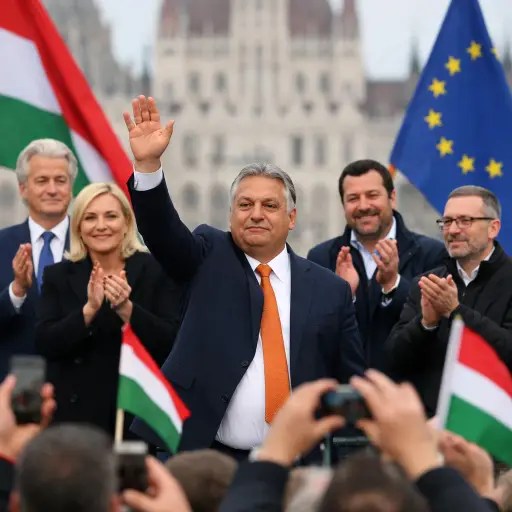
A pivotal vote places Viktor Orbán’s political model under scrutiny while allies across Europe watch closely for signals about the future of nationalist movements
As Hungary approaches a consequential national election, Prime Minister Viktor Orbán finds himself at the center of a broader European political moment. For more than a decade, Orbán has positioned his leadership as a model for a new kind of governance—one that blends electoral legitimacy with a strong nationalist agenda, skepticism toward liberal institutions, and an assertive stance on migration and cultural identity. Now, with political winds shifting across the continent, this election is shaping up to be more than a domestic contest; it is a referendum on the durability and appeal of Orbán’s brand of politics.
Across Europe, far-right and nationalist parties are watching closely—and increasingly, they are lining up behind him. From Rome to Paris, from Vienna to Madrid, political leaders who share Orbán’s worldview have offered vocal or tacit support, framing Hungary as a frontline state in a larger ideological struggle over sovereignty, identity, and the limits of European integration.
For Orbán’s allies, Hungary represents proof that a defiant stance toward Brussels can coexist with electoral success. His government’s policies—tight control over migration, resistance to EU legal pressure, and a redefinition of democratic norms—have been both criticized and emulated. Supporters argue that Orbán has tapped into a deep reservoir of public concern about globalization, cultural change, and economic insecurity. Critics counter that his model undermines democratic institutions and erodes checks and balances.
This election will test whether that model still resonates at home.
Domestically, Orbán faces a more complex political landscape than in previous contests. While his party retains a strong organizational advantage and a loyal base, opposition forces have become more coordinated, seeking to capitalize on voter fatigue and concerns over economic pressures. Inflation, public services, and Hungary’s relationship with the European Union have emerged as key issues, challenging the government’s narrative of stability and sovereignty.
Yet Orbán’s campaign remains rooted in familiar themes. He has cast the election as a choice between national independence and external interference, often portraying EU institutions and liberal critics as threats to Hungary’s autonomy. Migration continues to feature prominently in his rhetoric, even as the issue has evolved across Europe. Cultural identity and traditional values are also central, reinforcing a message that has been consistent throughout his tenure.
For many voters, the appeal lies in continuity. Orbán has cultivated an image of strong leadership, particularly during periods of crisis, and has positioned himself as a protector of national interests. This messaging has proven resilient, even amid criticism from international observers and domestic opponents.
The broader European context adds another layer of significance. In recent years, far-right parties have gained ground in several countries, influencing political discourse even where they have not secured power. Orbán’s Hungary is often cited as a blueprint—or a warning—depending on one’s perspective.
Leaders aligned with Orbán see his potential re-election as validation of their own strategies. A victory would reinforce the argument that nationalist platforms can achieve long-term success within the EU framework, potentially emboldening similar movements elsewhere. It could also strengthen informal alliances among these parties, shaping debates on migration, climate policy, and the future of European governance.
Conversely, a weaker-than-expected performance—or a loss—would carry implications beyond Hungary’s borders. It would suggest limits to the appeal of Orbán’s approach, particularly in a context where economic concerns are increasingly pressing. It might also signal that voters are seeking alternatives to confrontational politics, even in countries where such rhetoric has previously found fertile ground.
European institutions are also watching closely. Hungary’s relationship with the EU has been marked by tension, particularly over rule-of-law issues and the allocation of funds. The outcome of the election could influence how these disputes evolve, as well as the broader balance between national governments and supranational authority.
In many ways, this election encapsulates a larger question facing Europe: how to reconcile competing visions of democracy, sovereignty, and integration. Orbán has been one of the most prominent advocates of a model that challenges liberal norms while maintaining electoral legitimacy. Whether that model continues to attract voter support will be a key indicator of where the continent may be headed.
For now, the focus remains on Hungary. Campaigns are intensifying, rhetoric is sharpening, and the stakes are clear. What happens here will not only shape the country’s political trajectory but also reverberate across Europe’s evolving political landscape.
As voters prepare to cast their ballots, the outcome will be interpreted far beyond Hungary’s borders—not simply as a national result, but as a signal of the strength, adaptability, and future of Europe’s far-right movements.

 The Tower Post