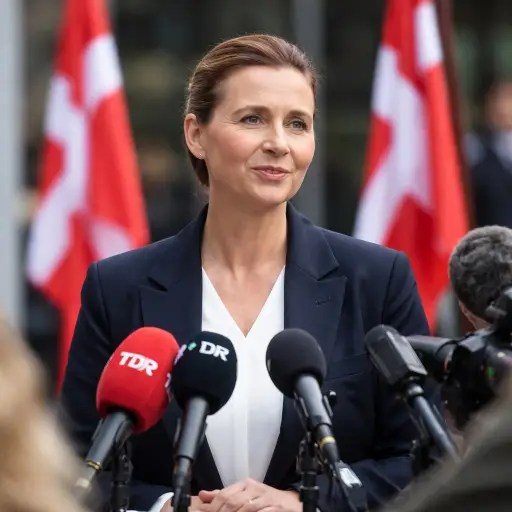
Caretaker prime minister signals readiness to lead again as fragmented election result triggers complex negotiations
Denmark has entered a new phase of political uncertainty after Prime Minister Mette Frederiksen announced her resignation following a tightly contested national election, setting the stage for intricate coalition negotiations that could reshape the country’s leadership.
Frederiksen, who has led the country through a period marked by economic pressures, geopolitical tensions, and domestic reform debates, confirmed that she would step down formally while remaining in office in a caretaker capacity. Addressing supporters shortly after the results became clear, she struck a tone of resilience, stating she was “ready to take on the responsibility” of leading Denmark for another four years if a viable governing majority could be formed.
The election outcome has produced a highly fragmented parliament, with no single bloc securing a decisive mandate. Both the traditional center-left and center-right alliances appear short of a clear majority, forcing parties into a complex round of negotiations that may test longstanding political boundaries.
Frederiksen’s Social Democratic Party remains one of the largest forces in parliament, but its ability to return to power hinges on forging agreements beyond its usual partners. Observers suggest that the coming days will see intense dialogue not only within blocs but potentially across ideological lines, reflecting a broader trend in European politics toward more fluid coalition-building.
In her initial remarks, Frederiksen emphasized stability and responsibility, signaling that her resignation should be viewed as a procedural step rather than a withdrawal from leadership ambitions. “The country needs a functioning government,” she said, underscoring the importance of continuity during the negotiation period.
Her decision to step down aligns with Danish constitutional practice, where an incumbent government resigns after an election to allow for the formation of a new administration. However, her continued role as caretaker ensures that day-to-day governance remains intact while political leaders seek a durable coalition.
The negotiations are expected to revolve around key policy areas that dominated the campaign, including economic management, climate commitments, and migration policy. Differences between parties on these issues are significant, raising questions about how quickly a consensus can be reached.
Political analysts note that Frederiksen’s leadership style—often characterized as pragmatic and results-oriented—could play a decisive role in the talks. Her willingness to engage with parties outside her traditional base in the past may provide a foundation for broader cooperation, though such efforts are likely to face resistance from factions wary of ideological compromise.
Meanwhile, opposition leaders have signaled their own readiness to explore alternative governing arrangements. Some have called for a “new direction” in Danish politics, arguing that the election result reflects voter fatigue with established approaches and a desire for change.
Despite the uncertainty, there is little indication of instability in the immediate term. Denmark’s political system is well accustomed to coalition governance, and caretaker administrations have historically managed transitions smoothly. Markets and institutions have so far responded calmly, reflecting confidence in the country’s democratic processes.
Public sentiment appears mixed. While some voters express frustration at the lack of a clear outcome, others see the result as an opportunity for more inclusive and representative policymaking. The coming negotiations will likely be closely watched not only domestically but also across Europe, where similar electoral dynamics are unfolding.
Frederiksen’s personal political future remains closely tied to the outcome of these talks. Her statement of readiness to continue suggests she intends to remain a central figure in Danish politics, regardless of the eventual coalition structure. Whether she can secure the necessary support to form a government again will depend on her ability to navigate competing interests and build trust among potential partners.
As discussions begin, the focus now shifts from the ballot box to the negotiating table. The shape of Denmark’s next government—and the direction it will take—will emerge from a process that is as much about compromise as it is about conviction.
For now, Frederiksen remains at the helm in a caretaker role, guiding the country through a transitional moment while seeking a renewed mandate. The outcome of the negotiations will determine whether her tenure continues or whether Denmark turns to new leadership in the weeks ahead.


 The Tower Post