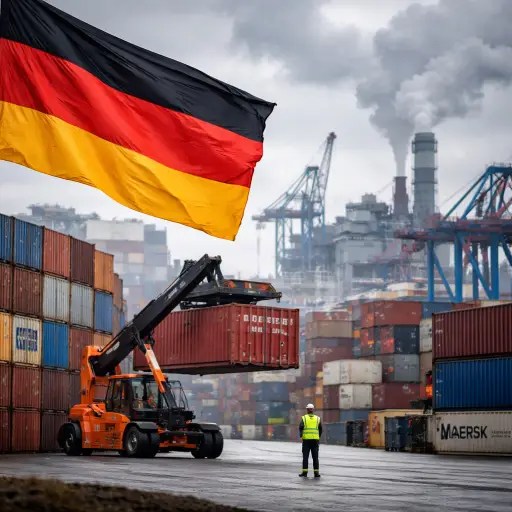
Weak industrial output and slowing exports raise concerns for Europe and global trade
Germany’s economic engine, long regarded as the backbone of European growth, is once again losing momentum. Recent indicators point to a renewed slowdown in industrial production and export performance, reviving concerns that the continent’s largest economy may be entering another prolonged period of stagnation.
At the heart of the issue lies Germany’s industrial sector — a cornerstone of its economic strength. Manufacturing output has weakened, reflecting both subdued global demand and structural pressures at home. Key industries, including automotive, machinery, and chemicals, are reporting declining orders and cautious outlooks, suggesting that the slowdown is not merely cyclical but also tied to deeper challenges.
Export performance, traditionally Germany’s strongest pillar, is also faltering. Demand from major trading partners such as China and the United States has softened, leaving German exporters increasingly exposed. In China, a combination of slower domestic growth and a shift toward local production has reduced reliance on imported industrial goods. Meanwhile, demand in the United States has become more selective, with supply chain diversification and domestic investment policies altering trade patterns.
The combined effect is a noticeable deceleration in Germany’s export-driven model. For decades, the country has relied on robust external demand to sustain growth. Now, that model appears under strain as global trade dynamics evolve.
Energy costs continue to weigh heavily on German industry. Although pressures have eased compared to previous peaks, businesses still face higher operating expenses than in many competing economies. This has eroded competitiveness, particularly in energy-intensive sectors, and prompted some companies to consider relocating production or scaling back investment.
At the same time, structural issues within Germany are becoming more apparent. Aging infrastructure, bureaucratic hurdles, and a slow pace of digitalization are increasingly cited by business leaders as obstacles to growth. Labor shortages, particularly in skilled sectors, add another layer of complexity, limiting the ability of companies to expand even when demand conditions improve.
The transition toward a greener economy is also reshaping the industrial landscape. While Germany has committed to ambitious climate targets, the shift requires significant investment and adaptation. For many firms, especially smaller manufacturers, the costs and uncertainties associated with this transition are contributing to a more cautious business environment.
Germany’s slowdown is not occurring in isolation. As Europe’s largest economy, its performance has far-reaching implications. Supply chains across the continent are closely tied to German industry, meaning that weaker production can ripple through neighboring economies. Countries that depend on German demand for intermediate goods are already feeling the effects.
Globally, the impact is equally significant. Germany plays a central role in international trade, particularly in high-value manufacturing. A sustained slowdown could disrupt supply chains, alter trade flows, and contribute to broader economic uncertainty at a time when global growth is already uneven.
Policymakers face a delicate balancing act. On one hand, there is a need to support economic activity and maintain competitiveness. On the other, structural reforms — from infrastructure investment to regulatory simplification — are essential for long-term resilience. The challenge lies in addressing immediate pressures without losing sight of deeper transformations required in a changing global economy.
There are, however, signs of cautious optimism. Some sectors are beginning to stabilize, and investment in emerging technologies, including renewable energy and advanced manufacturing, could provide new sources of growth. Germany’s strong industrial base, skilled workforce, and reputation for quality remain significant advantages.
Yet the path forward is far from certain. Much will depend on the evolution of global demand, the success of domestic reforms, and the ability of German industry to adapt to a rapidly changing economic landscape.
For now, the signals are clear: Germany’s economy is once again at a crossroads. Whether this slowdown proves temporary or marks the beginning of a more prolonged shift will be critical not only for Germany but for Europe and the global economy as a whole.

 The Tower Post