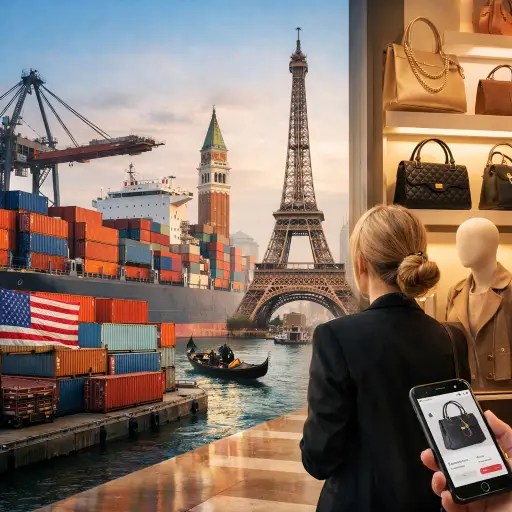
Resilience, regional recalibration, and digital reinvention redefine the future of high-end retail
Luxury is no longer playing by the old rules of expansion. After decades of aggressive global growth, leading brands are now recalibrating their strategies in response to mounting geopolitical tension, shifting consumer behavior, and fragile supply chains. The industry, long associated with stability and timelessness, is entering a phase defined by adaptation, caution, and a renewed focus on resilience.
Across the United States, luxury houses are quietly rethinking their global exposure. While European capitals remain symbolic strongholds of heritage and craftsmanship, recent volatility has prompted American brands to reconsider how deeply they anchor their operations in the region. Executives point to a convergence of economic uncertainty, regulatory complexity, and fluctuating tourism flows as reasons for diversifying geographic risk.
Rather than scaling back entirely, brands are adopting a more nuanced approach. Flagship stores in cities such as Paris, Milan, and London remain essential for brand identity, but expansion plans are increasingly selective. Investment is shifting toward markets perceived as more stable or strategically flexible, including parts of Asia, the Middle East, and domestic U.S. cities experiencing wealth concentration.
At the same time, supply chains—once optimized for efficiency—are being redesigned for durability. The disruptions of recent years exposed vulnerabilities in highly centralized production models. In response, luxury companies are exploring nearshoring, dual sourcing, and smaller, more agile manufacturing networks. While this shift may increase costs, executives argue that reliability and control now outweigh pure margin optimization.
For American brands in particular, the rethink is profound. Many had relied heavily on European artisanship and logistics hubs to maintain authenticity. Today, some are investing in domestic craftsmanship or regional production capabilities to reduce dependency. This does not signal a departure from European heritage, but rather a strategic layering of capabilities designed to withstand shocks.
The emphasis on resilience is also reshaping how brands approach growth. Rapid store rollouts and aggressive market entries are giving way to measured, data-driven expansion. Companies are prioritizing profitability per location over sheer footprint, and focusing on deepening relationships with existing customers rather than chasing new markets indiscriminately.
Central to this transformation is the rise of digital-first luxury experiences. What was once considered supplementary—online engagement, virtual showrooms, personalized digital services—has become a core pillar of strategy. High-end consumers, particularly younger demographics, increasingly expect seamless integration between physical and digital touchpoints.
Luxury brands are responding with sophisticated platforms that blend exclusivity with accessibility. Virtual consultations, augmented reality fittings, and curated online events are becoming standard offerings. These tools not only extend reach but also provide valuable data, enabling brands to refine their understanding of customer preferences and behaviors.
Importantly, digital does not dilute the essence of luxury; it redefines it. Exclusivity is no longer tied solely to physical presence but to the quality of experience, whether in-store or online. Brands are investing heavily in storytelling, immersive content, and personalized communication to maintain emotional connection in a fragmented media landscape.
This digital pivot also supports the broader goal of resilience. By diversifying sales channels, brands reduce reliance on any single market or format. E-commerce platforms can compensate for regional downturns, while data analytics allow for rapid adjustments in strategy. In an unpredictable environment, agility becomes a competitive advantage.
Yet challenges remain. Balancing heritage with innovation is a delicate act. Luxury consumers expect continuity and authenticity, even as brands experiment with new models. Missteps—whether in over-digitization or cost-cutting that compromises quality—can quickly erode trust.
Moreover, the reconfiguration of supply chains and market strategies requires significant investment. Not all players have the resources to adapt at the same pace, potentially widening the gap between industry leaders and smaller or mid-tier brands. Consolidation, already a feature of the luxury sector, may accelerate as companies seek scale to support transformation.
Despite these pressures, industry sentiment is cautiously optimistic. The current phase is seen less as a crisis and more as a structural evolution. By prioritizing resilience, flexibility, and meaningful engagement, luxury brands aim to build a more sustainable foundation for long-term growth.
In this new landscape, success will depend on the ability to navigate complexity without losing identity. The brands that thrive will be those that can honor their heritage while embracing change—redefining what luxury means in a world where certainty is no longer guaranteed.
As the sector moves forward, one thing is clear: the era of unchecked expansion is over. In its place emerges a more disciplined, thoughtful approach—one that values strength over speed, and connection over scale. For luxury, the future is not about being everywhere, but about being relevant, resilient, and unmistakably distinctive.



 The Tower Post