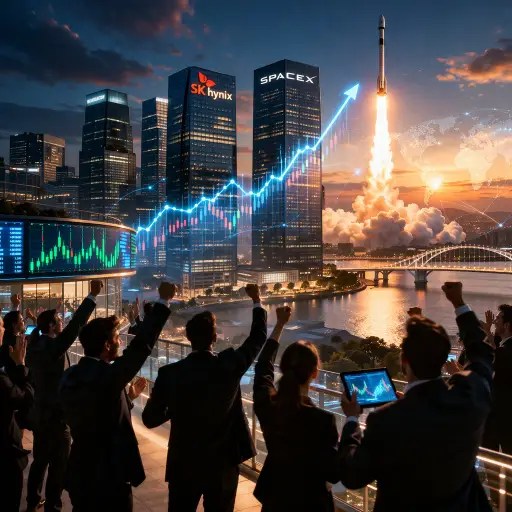
Renewed investor confidence fuels cautious optimism as major technology players prepare to go public
Global equity markets are showing early signs of stabilization, and with that shift has come a renewed appetite for technology listings. After a prolonged period of volatility and muted deal activity, a fresh wave of anticipated initial public offerings is beginning to take shape, signaling what many analysts describe as a cautious but meaningful recovery in the tech sector.
At the center of this emerging trend are high-profile companies such as SK Hynix and SpaceX, both of which are widely seen as potential bellwethers for the broader IPO environment. Their prospective listings, while not yet formally confirmed, are drawing significant attention from institutional investors eager to re-engage with growth-oriented assets after a challenging cycle marked by rising interest rates and geopolitical uncertainty.
The shift in sentiment has been gradual but noticeable. Market participants who had largely retreated to defensive positions are now beginning to rotate back into technology, encouraged by signs that inflationary pressures are moderating and central banks may be nearing the end of their tightening phases. This evolving macroeconomic backdrop is creating more favorable conditions for companies seeking to go public, particularly those with strong fundamentals and exposure to long-term innovation themes.
Semiconductor firms like SK Hynix are benefiting from a resurgence in demand linked to artificial intelligence infrastructure, cloud computing, and next-generation devices. As the global race for advanced chips intensifies, investors are increasingly viewing the sector as strategically indispensable, despite lingering supply chain risks and geopolitical tensions in key manufacturing regions.
Meanwhile, SpaceX represents a different but equally compelling narrative. The private aerospace company, long regarded as one of the most valuable startups in the world, sits at the intersection of commercial space exploration, satellite communications, and defense technology. Any move toward a public listing would likely be one of the most closely watched market events in recent years, potentially reshaping investor exposure to the rapidly evolving space economy.
Despite the growing momentum, the road to a full-fledged IPO rebound remains uneven. Geopolitical risks continue to cast a shadow over global markets, with ongoing tensions affecting trade flows, regulatory environments, and investor confidence. In addition, valuations remain a point of contention. Many companies are still adjusting expectations after the sharp repricing of growth assets seen in prior periods, and investors are showing greater discipline in assessing profitability and cash flow prospects.
This recalibration is, in many ways, a defining feature of the current cycle. Unlike previous IPO booms characterized by aggressive valuations and speculative enthusiasm, the emerging wave appears more measured. Investors are demanding clearer paths to profitability, stronger governance structures, and tangible competitive advantages. As a result, only the most resilient and strategically positioned companies are likely to succeed in the public markets.
Bankers and advisors are also playing a more cautious role, encouraging potential issuers to time their offerings carefully and to prioritize long-term credibility over short-term valuation peaks. This more disciplined approach could ultimately lead to a healthier IPO ecosystem, reducing the risk of post-listing volatility that has plagued recent cohorts of tech listings.
For now, the signals point to a sector in transition. The technology industry is not yet in full recovery mode, but the foundations for renewed activity are clearly being laid. If market stability holds and macroeconomic conditions continue to improve, the coming months could see a steady increase in IPO activity, led by companies that combine innovation with financial discipline.
In that sense, the anticipated listings of firms like SK Hynix and SpaceX may represent more than isolated events. They could mark the beginning of a broader shift, one that redefines how investors engage with technology markets in a more cautious, yet ultimately more sustainable, era of growth.



 The Tower Post