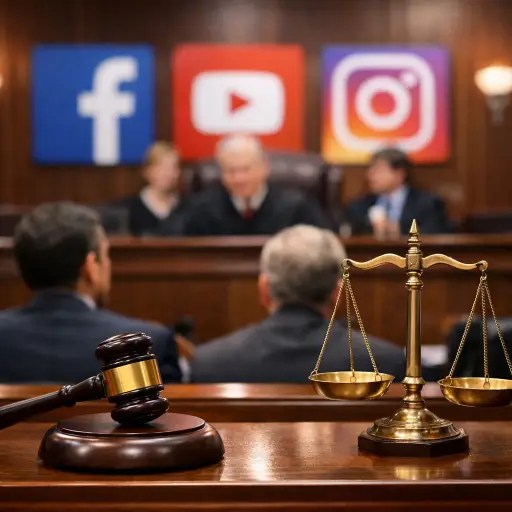
A landmark American verdict puts Meta and YouTube under fresh legal pressure and could accelerate a global shift in how digital platforms are regulated.
The balance of power between Silicon Valley and the courts shifted sharply this week after a landmark US jury verdict found Meta and YouTube liable in a case centered on social media addiction and harm to a young user. The decision, seen by legal analysts as a breakthrough in the long-running battle over platform accountability, is already being described as a moment that could reshape how the world treats the design of digital products.
For years, major technology companies have largely succeeded in arguing that they should not be held responsible for harms linked to material posted by users. That legal shield remains powerful. But this case turned on a different argument: not the content itself, but the architecture of the platforms. Jurors concluded that design features associated with Instagram and YouTube contributed to compulsive use and mental health harm, and that the companies failed to provide adequate warning about those risks.
That distinction may prove decisive far beyond one courtroom. The verdict is widely being viewed as a test case for thousands of similar lawsuits already moving through the American legal system, many of them brought by families, school districts and state authorities who argue that social media companies knowingly built products that keep young people hooked.
The case centered on claims that the platforms used mechanisms familiar to anyone who has spent time online: endless scrolling, personalized recommendation systems, autoplay functions, feedback loops built around likes and visibility, and notifications designed to pull users back in. Critics have argued for years that these tools do not merely improve convenience. They are also systems of behavioral engineering, optimized to hold attention for as long as possible. The jury’s finding suggests that this argument is no longer confined to academic debate or political speeches. It now has legal force.
The immediate targets are Meta, whose platforms include Instagram, and Google through YouTube. Both companies have indicated they will appeal. They maintain that online well-being is shaped by many factors and point to parental controls, youth-safety features and time-management tools as evidence that they take the issue seriously. Even so, the verdict lands at a delicate moment for the industry, which is already under pressure from lawmakers, regulators and investors over child safety, harmful recommendation systems and transparency.
The broader significance lies in what the ruling says about responsibility. For much of the social media era, public debate has focused on moderation: what platforms should remove, what they should leave up, and whether they are publishers or neutral intermediaries. This verdict pushes the conversation in a new direction. It asks whether a platform can be treated not just as a forum, but as a product whose built-in features may carry foreseeable risks.
That shift matters because product liability is a very different kind of legal problem from speech regulation. Once the spotlight moves to design choices, courts can ask whether companies understood the dangers, whether they tested for harm, whether they ignored warning signs, and whether safer alternatives existed. In that sense, the ruling may mark the start of a new chapter in tech litigation, one that feels less like the old battles over internet freedom and more like earlier public health fights over harmful consumer products.
The effect could spread quickly beyond the United States. European regulators have already moved more aggressively in recent years, especially on child protection, transparency and platform risk. A high-profile American verdict gives extra political momentum to those who argue that voluntary safeguards are no longer enough. Policymakers in other regions are also likely to watch closely, not because US juries set rules for the world, but because the case offers a template for how legal systems can approach digital harm without relying solely on content-based arguments.
There is also a practical consequence for the companies themselves. If more plaintiffs succeed with claims tied to addictive design, the business model of the attention economy comes under direct scrutiny. Features once celebrated as drivers of engagement may increasingly be described in court as sources of avoidable harm. That raises difficult questions inside boardrooms. Can platforms preserve advertising revenue while making their products meaningfully less compulsive? Can they prove that child-safety tools are more than cosmetic? And how much internal research might eventually surface in future trials?
Those questions are no longer theoretical. More trials are expected, and legal experts see this outcome as a bellwether for a much larger wave of cases. The ruling does not settle the matter. Appeals could narrow its reach or even overturn parts of it. But the symbolic impact is already unmistakable: juries are showing a willingness to look at social media companies not as untouchable innovators, but as corporations whose product decisions can produce measurable damage.
For families and campaigners, the decision is a validation of concerns they have voiced for years. For the platforms, it is a warning that the legal climate has changed. And for governments around the world, it may be the clearest signal yet that regulation of digital platforms is entering a more assertive phase.
The most important shift may be cultural as much as legal. A generation ago, the tech sector was largely treated as a force moving too quickly for the law to catch up. Now, that assumption is being challenged. The courtroom is becoming one of the places where society decides what acceptable innovation looks like.
That is why this verdict feels larger than a single damages award. It suggests that the central question is no longer whether social media can influence behavior. That is broadly accepted. The question is whether companies that intentionally design for dependence can continue to avoid responsibility when that dependence causes harm.
After this week, that answer looks far less certain than it once did.




 The Tower Post