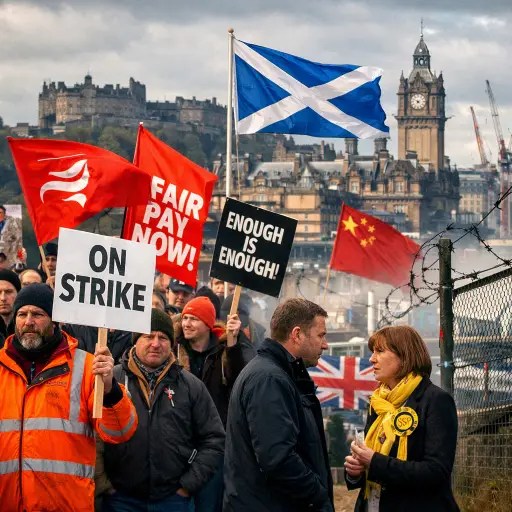
Economic strain from global conflict constrains wage growth, while Scotland’s election battle and foreign investment concerns deepen national tensions
The United Kingdom finds itself navigating a period of mounting political and social strain, as waves of industrial action, heightened security concerns, and renewed constitutional debates converge to test the stability of the government and the resilience of its institutions.
Across key sectors—from transport to healthcare—strike action has intensified, reflecting growing frustration among workers facing persistent cost-of-living pressures. Trade unions argue that real wages continue to lag behind inflation, leaving households increasingly vulnerable despite a gradual easing of headline economic indicators. Yet ministers have remained firm, warning that the broader economic climate, shaped in part by ongoing geopolitical conflict, leaves little room for significant pay rises.
Government officials have pointed repeatedly to the financial burden of international instability, particularly the continued ripple effects of war-driven disruptions in energy markets and global supply chains. These pressures, they argue, have constrained public spending capacity at a time when demands on the state remain elevated. The message from the Treasury has been consistent: fiscal discipline is essential to prevent further economic deterioration.
This position, however, has done little to quell unrest. Union leaders have accused the government of failing to shield workers from the consequences of global shocks, insisting that the burden is being unfairly distributed. The result has been a cycle of negotiations and walkouts that continues to disrupt daily life, with commuters, patients, and businesses bearing the brunt of the standoff.
At the same time, the political temperature is rising sharply in Scotland, where election campaigns have entered a critical phase. The debate over independence—long a defining feature of Scottish politics—has regained urgency, with parties setting out sharply contrasting visions for the country’s future. Pro-independence voices argue that economic and political decisions taken in London no longer reflect Scotland’s priorities, particularly in areas such as energy policy and public spending.
Unionist parties, meanwhile, have sought to emphasize the economic risks of separation, pointing to uncertainties over currency, trade, and fiscal sustainability. The campaign has taken on an increasingly intense tone, with both sides framing the election as a decisive moment that could reshape the constitutional balance of the United Kingdom.
Observers note that the renewed focus on independence comes at a time when broader national cohesion is already under strain. The interplay between economic grievances and constitutional ambitions has created a complex political environment, in which local and national issues are deeply intertwined.
Adding another layer of concern is the growing scrutiny of foreign involvement in critical infrastructure projects. Security officials have signaled unease over the extent to which overseas entities—particularly those linked to strategic competitors—are participating in sectors deemed vital to national security. These include energy networks, telecommunications, and transport systems.
While foreign investment has long been a cornerstone of the UK’s economic model, the current climate has prompted calls for a more cautious approach. Analysts warn that dependencies created through such partnerships could expose vulnerabilities, especially in times of heightened geopolitical tension. The government has indicated that it is reviewing existing safeguards, with the possibility of tighter regulations on future deals.
Critics argue that previous administrations underestimated the strategic implications of allowing extensive foreign participation in sensitive industries. They contend that the challenge now lies in balancing economic openness with the need to protect national interests—a task made more urgent by the shifting global landscape.
Taken together, these developments paint a picture of a country grappling with multiple, overlapping pressures. Economic constraints, political fragmentation, and security anxieties are feeding into one another, creating a sense of uncertainty about the direction of the nation.
For the government, the immediate challenge is to maintain stability while addressing public discontent. For opposition parties, the moment offers both opportunity and risk, as they seek to capitalize on dissatisfaction without exacerbating divisions. And for citizens, the coming period is likely to be defined by continued debate over how best to navigate a rapidly changing world.
As the situation evolves, the United Kingdom stands at a crossroads—its choices shaped not only by domestic considerations, but also by forces far beyond its borders. The outcome will have lasting implications for its economy, its political structure, and its place on the global stage.


 The Tower Post