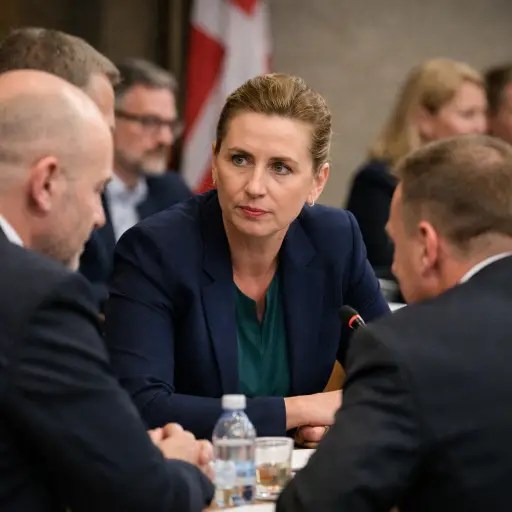
Prime Minister Mette Frederiksen navigates a divided political landscape where a single kingmaker party could reshape the nation’s direction
Denmark has entered a period of intense political negotiation following an election that delivered no clear majority, leaving the country’s traditionally stable parliamentary system facing an unusually complex test. With neither the left-leaning nor right-leaning blocs able to secure sufficient seats to govern alone, coalition talks have become both inevitable and fraught.
At the center of this delicate process stands Mette Frederiksen, whose leadership is once again under scrutiny. Known for her pragmatic approach and ability to bridge ideological divides, Frederiksen now faces one of the most challenging moments of her tenure. The fragmentation of the vote reflects deeper shifts within Danish society, where voters appear increasingly willing to move away from traditional party loyalties.
The election results underscore a broader European trend: the erosion of dominant political blocs and the rise of smaller, more issue-focused parties. In Denmark, this has translated into a parliament where negotiation is not just necessary but decisive. Any governing coalition will require careful balancing of priorities, ranging from economic policy and welfare reform to immigration and climate commitments.
Central to the unfolding drama is the emergence of a potential kingmaker party — a mid-sized political force whose support could tip the balance of power. While not commanding the largest share of votes, this party now holds disproportionate influence, capable of determining whether Denmark leans toward a center-left or center-right governing agenda. Its leadership has signaled openness to negotiation but has also outlined firm policy demands, raising the stakes for all involved.
For Frederiksen, the challenge is twofold. First, she must secure enough parliamentary backing to form a stable government. Second, she must do so without alienating key voter groups or compromising core policy commitments that defined her campaign. This balancing act is particularly delicate in a political climate marked by heightened public expectations and growing polarization on certain issues.
Observers note that Denmark’s political culture, historically rooted in consensus and compromise, may ultimately prove an asset. Coalition governments are not new to the country, and Danish politicians are accustomed to negotiation. However, the current level of fragmentation introduces a new degree of uncertainty. Unlike previous cycles, where alliances were more predictable, the present landscape allows for multiple plausible coalition configurations — each with distinct policy implications.
Economic concerns are expected to play a central role in the negotiations. Denmark, like many European nations, faces pressures related to inflation, energy transition, and maintaining the sustainability of its welfare state. Parties across the spectrum have proposed differing solutions, and reconciling these approaches will require careful compromise. At the same time, immigration policy remains a contentious issue, with diverging views even within traditional blocs.
The role of the kingmaker party adds another layer of complexity. By positioning itself as a pragmatic broker, it has the opportunity to extract significant concessions in exchange for its support. Yet this position also carries risks. Aligning too closely with one bloc could alienate parts of its electorate, while prolonged indecision could frustrate voters eager for stability.
For the Danish public, the outcome of these negotiations will have tangible consequences. Beyond determining who governs, the coalition agreement will set the direction of national policy for years to come. Issues such as healthcare funding, green transition strategies, and Denmark’s role within the European Union are all likely to be shaped by the eventual compromise.
As talks continue behind closed doors, the tone remains cautious but determined. Political leaders have emphasized the importance of reaching an agreement that ensures both stability and effective governance. However, the path forward is anything but straightforward.
In the coming days, Denmark’s political future will hinge on a series of strategic decisions made in negotiation rooms rather than at the ballot box. Whether Frederiksen can once again assemble a workable coalition — and whether that coalition can hold — will define not only her leadership but also the next chapter in Danish politics.
What is clear is that Denmark stands at a crossroads. The fragmentation revealed by the election is not merely a temporary disruption but a signal of evolving political dynamics. How the country responds to this moment will shape its governance, its policies, and its political identity in the years ahead.


 The Tower Post