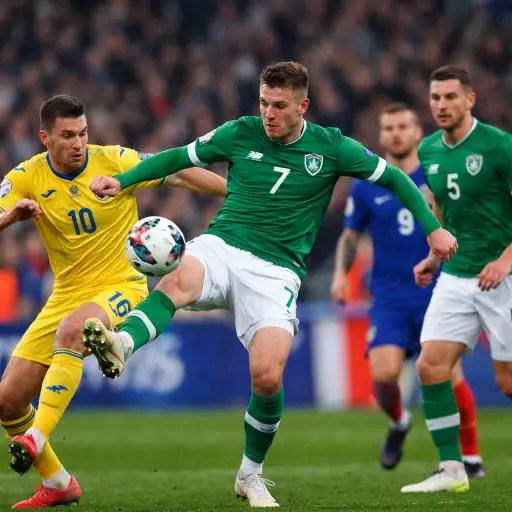
Ireland and Ukraine surge in form while decisive clashes redefine qualification hopes across the continent
The road to the FIFA World Cup has entered a decisive and emotionally charged phase across Europe, where playoff fixtures and late-stage qualifiers are rapidly reshaping expectations. With margins thinner than ever, every match now carries consequences that extend far beyond the final whistle.
Across packed stadiums and tense training camps, national teams are navigating a landscape defined by urgency. Established contenders are being pushed to their limits, while emerging sides are seizing the moment with confidence and cohesion. As the latest round of fixtures unfolds, the spotlight has shifted firmly onto high-stakes encounters that will determine who continues the journey—and who falls short.
Among the teams drawing increasing attention is Republic of Ireland national football team. Once considered outsiders in a competitive group, Ireland have quietly built momentum through disciplined performances and a renewed tactical identity. Their recent displays suggest a team growing not only in confidence but also in belief, with a blend of youthful energy and experienced leadership proving effective at a crucial time.
Observers note that Ireland’s approach has evolved significantly. A more structured defensive line, combined with sharper transitions in attack, has allowed them to remain competitive even against technically superior opponents. As they prepare for pivotal clashes, there is a sense that Ireland could disrupt established hierarchies if their form continues.
Equally compelling is the trajectory of the Ukraine national football team. Amid challenging circumstances off the pitch, Ukraine have demonstrated remarkable resilience and unity. Their performances in recent qualifiers have been marked by intensity, organization, and moments of individual brilliance that have captured the attention of fans and analysts alike.
Ukraine’s strength lies in their adaptability. Capable of shifting between defensive solidity and attacking flair, they have proven difficult to predict and even harder to break down. As playoff scenarios tighten, their ability to remain composed under pressure could be decisive in determining their path forward.
Elsewhere across Europe, traditional powerhouses are feeling the strain of expectation. The qualifying campaign has exposed vulnerabilities, with several high-ranked teams struggling to assert dominance. Tactical experimentation, injuries, and the sheer competitiveness of the European field have combined to produce a series of unpredictable results.
This unpredictability is precisely what defines the current stage of qualification. Matches are no longer about gradual progress; they are about survival. Coaches are making bold decisions, often prioritizing pragmatism over style, while players are being asked to deliver under immense psychological pressure.
In this environment, playoff matches have emerged as the focal point of the narrative. These fixtures, often decided by the narrowest of margins, encapsulate the drama and intensity of international football. A single moment—a defensive lapse, a moment of brilliance, or a refereeing decision—can alter the course of a nation’s campaign.
The significance of these games extends beyond immediate results. Qualification for the World Cup represents not only sporting achievement but also national pride, financial opportunity, and global visibility. For smaller nations, reaching the tournament can redefine the trajectory of their footballing future, inspiring a new generation of players and supporters.
As the current round progresses, several key themes have begun to emerge. Defensive organization has become paramount, with teams prioritizing structure to avoid costly errors. Midfield battles are increasingly decisive, as control of possession often dictates the tempo and outcome of matches. Meanwhile, set pieces have gained renewed importance, frequently providing the breakthrough in tightly contested encounters.
Another defining feature of this stage is the role of leadership. Experienced players are stepping forward to guide their teams through moments of adversity, while younger talents are embracing the responsibility of performing on a major stage. This blend of experience and ambition is shaping the identity of teams still in contention.
For Ireland and Ukraine, the coming fixtures represent both opportunity and challenge. Each match carries the weight of expectation, with the margin for error continuing to shrink. Their recent form suggests they are well-equipped to compete, but the unpredictability of playoff football ensures that nothing can be taken for granted.
Across the continent, fans are witnessing a qualification campaign that defies easy prediction. The traditional narratives of dominance are giving way to a more balanced and competitive landscape, where determination and tactical discipline can level the playing field.
As Europe edges closer to finalizing its representatives for the World Cup, the intensity will only increase. Every pass, every tackle, and every goal will carry heightened significance, as teams strive to secure their place on football’s biggest stage.
In the end, it is this combination of pressure, passion, and possibility that defines the current moment. The qualifiers are no longer just a pathway—they are a spectacle in their own right, showcasing the very essence of the game.
And as the next round of decisive matches approaches, one truth remains clear: in European World Cup qualification, nothing is certain until the final whistle blows.

 The Tower Post