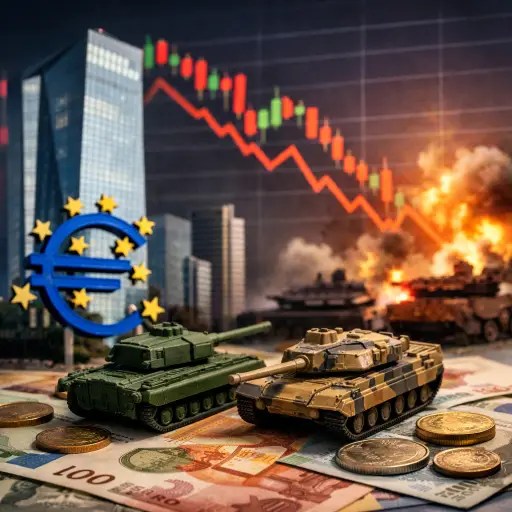
ECB signals resilience in Europe’s banking sector, but warns that a prolonged conflict could test stability and heighten recession risks.
Europe’s financial system is, for now, holding firm in the face of ongoing geopolitical tensions, according to recent assessments from the European Central Bank. While the immediate economic shock stemming from the war has been largely absorbed, policymakers and economists are increasingly cautious about what lies ahead.
The ECB’s latest communication reflects a careful balance: reassurance without complacency. Officials emphasize that banks across the euro area remain well-capitalized and liquid, supported by years of regulatory tightening and stress testing. Yet beneath this stability lies a more fragile reality shaped by uncertainty, prolonged conflict, and the risk of broader economic slowdown.
Resilience Built Over Time
The eurozone banking sector entered this period of geopolitical strain from a position of relative strength. Following the global financial crisis and subsequent sovereign debt turmoil, European regulators imposed stricter capital requirements and enhanced supervisory frameworks. As a result, many institutions now hold stronger buffers against shocks.
This resilience has proven crucial. Despite volatility in energy markets, disrupted trade flows, and fluctuating investor sentiment, banks have continued to function without significant systemic stress. Lending activity, while moderating, has not collapsed, and financial markets have avoided the kind of panic seen in earlier crises.
ECB officials point to these developments as evidence that the financial system can withstand short-term disruptions. However, they also stress that the current environment is not without risks.
The Shadow of Prolonged Conflict
The central concern is duration. While the immediate impact of the war has been contained, a prolonged conflict could gradually erode economic stability. Higher energy costs, persistent inflationary pressures, and weakened consumer confidence all have the potential to weigh on growth.
Over time, these factors could begin to affect banks more directly. Rising loan defaults, particularly among businesses exposed to energy-intensive sectors, may increase. Households facing higher living costs could struggle to meet debt obligations. In such a scenario, the strength of banks’ balance sheets would be tested more severely.
Moreover, geopolitical fragmentation may disrupt global supply chains further, creating additional uncertainty for European exporters and manufacturers. This, in turn, could dampen investment and hiring, feeding into a broader economic slowdown.
Economists Warn of Recession Risks
A growing number of economists are cautioning that the eurozone may be edging closer to a recessionary environment. While not inevitable, the combination of geopolitical uncertainty, tight financial conditions, and subdued demand presents a challenging outlook.
Monetary policy adds another layer of complexity. The ECB has spent recent years tightening policy to combat inflation, raising interest rates to levels not seen in over a decade. While this has helped stabilize prices, it has also increased borrowing costs for businesses and households.
The interplay between high rates and slowing growth is delicate. If economic activity weakens further, policymakers may face difficult choices between supporting growth and maintaining price stability. A misstep in either direction could amplify financial stress.
Market Sentiment and Investor Behavior
Financial markets have so far reacted with cautious optimism. Equity markets have shown resilience, and bond spreads, while occasionally widening, have not signaled systemic alarm. Investors appear to be pricing in a scenario of moderate disruption rather than crisis.
However, sentiment remains sensitive to geopolitical developments. Sudden escalations or unexpected shifts in the conflict could quickly alter market dynamics. Volatility, particularly in energy and commodity markets, continues to pose a risk to financial stability.
Banks themselves are also navigating a more complex operating environment. While higher interest rates can boost profitability through wider margins, they also increase the risk of credit losses. Balancing these dynamics will be a key challenge in the months ahead.
A System Under Watchful Eyes
Regulators are maintaining close oversight of the situation. The ECB and national authorities are actively monitoring liquidity conditions, credit quality, and market developments. Stress-testing frameworks are being used to evaluate how banks might perform under more severe scenarios, including prolonged conflict and deeper economic downturns.
There is also a broader recognition that financial stability cannot be taken for granted. The interconnected nature of modern economies means that shocks can propagate quickly across borders and sectors. Vigilance, therefore, remains essential.
At the same time, policymakers are emphasizing coordination. Fiscal measures aimed at cushioning households and businesses, such as energy subsidies and targeted support, have played a role in mitigating the immediate impact of the crisis. Continued alignment between monetary and fiscal policy will be critical in sustaining stability.
Looking Ahead
The outlook for Europe’s financial system is one of cautious resilience. The foundations built over the past decade have provided a buffer against immediate shocks, allowing banks and markets to absorb the initial impact of geopolitical tensions.
Yet the path forward is uncertain. Much depends on how the conflict evolves and how long its economic consequences persist. A prolonged period of instability could gradually strain the system, testing the robustness that has so far held.
For now, the message from the ECB is clear: the system is stable, but risks remain. The challenge for policymakers, banks, and investors alike will be to navigate this uncertain landscape without allowing temporary pressures to evolve into lasting vulnerabilities.
In a world where geopolitical and economic forces are increasingly intertwined, maintaining financial stability will require not only strong institutions, but also constant vigilance and adaptability.

 The Tower Post