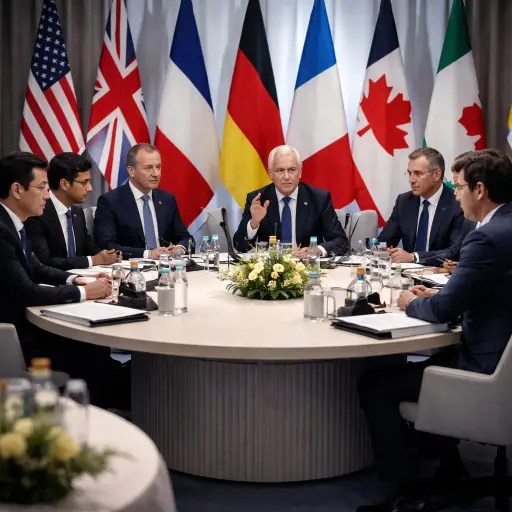
As conflicts in Ukraine and Iran deepen uncertainty, leaders struggle to define a common strategy while alliances show signs of strain
World leaders convened this week under the banner of the G7, but the familiar image of coordinated Western resolve has grown increasingly complicated. Against a backdrop of protracted war in Ukraine and rising tensions surrounding Iran, the gathering unfolded less as a demonstration of unity and more as a forum marked by hesitation, recalibration, and, at times, visible divergence.
Diplomats arriving at the summit described the mood as “serious but unsettled.” The expectation was not necessarily to produce sweeping agreements, but rather to clarify direction—particularly regarding the role of the United States, whose shifting priorities have left allies seeking reassurance.
At the heart of the discussions lies Ukraine. Years into the conflict, fatigue is evident among some member states, even as others push for sustained or increased support. Eastern European countries continue to advocate for firm military backing, warning that any wavering could embolden adversaries. Meanwhile, several Western European leaders are increasingly vocal about the need to explore diplomatic pathways, even if such options remain distant or politically sensitive.
The divergence is not merely rhetorical. Behind closed doors, disagreements have surfaced over the scale and nature of future aid packages, the timing of potential negotiations, and the broader strategic objective—whether the goal is outright victory, containment, or eventual settlement.
Complicating matters further is the evolving situation involving Iran. Escalating tensions in the Middle East have introduced a second major axis of instability, forcing leaders to balance attention and resources across multiple theaters. While some G7 members favor a hardline approach toward Tehran, including expanded sanctions and deterrence measures, others caution against steps that could trigger wider regional escalation.
This dual focus has exposed the limits of coordinated policymaking. “We are no longer dealing with a single crisis that commands full alignment,” one senior official noted. “We are managing several, each with different risks, timelines, and political pressures.”
The question of U.S. leadership looms large over all discussions. Allies have grown increasingly attentive to signals from Washington, particularly as domestic political dynamics influence foreign policy posture. While U.S. representatives have reiterated commitments to both Ukraine and broader global security, partners are quietly assessing how durable those commitments may be.
This uncertainty has prompted some countries to explore more autonomous strategies. There is a growing emphasis on regional defense capabilities, diversified energy partnerships, and independent diplomatic initiatives. In Europe, conversations about strategic autonomy—once largely theoretical—are gaining practical urgency.
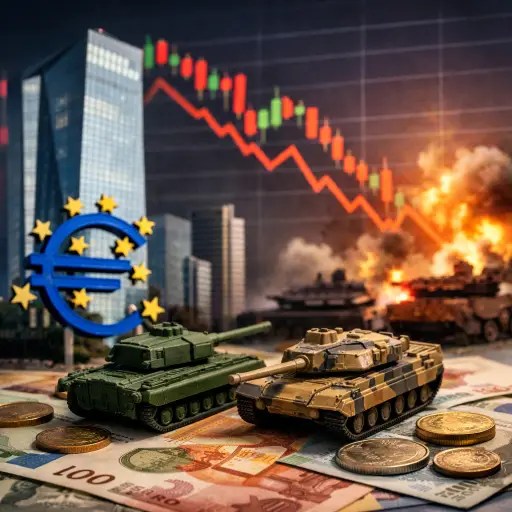
Economic concerns are also intertwined with geopolitical tensions. The prolonged conflict in Ukraine continues to impact energy markets and supply chains, while instability linked to Iran raises fears of disruptions in global oil flows. Leaders are under pressure to address domestic economic vulnerabilities even as they navigate international crises.
Despite these challenges, the summit has not been devoid of cooperation. Agreements on targeted sanctions, humanitarian assistance, and intelligence sharing have been reaffirmed. There remains a shared recognition of the importance of maintaining at least a baseline level of coordination, particularly in the face of complex and interrelated threats.
Yet the broader picture is one of an alliance system under strain. The G7, long seen as a cornerstone of Western cohesion, is adapting to a world in which consensus is harder to achieve and strategic interests are less aligned than in previous decades.
Observers note that this moment may represent a transition rather than a breakdown. The nature of alliances is evolving, shaped by shifting power dynamics, emerging conflicts, and domestic political considerations within member states. The challenge for the G7 is not simply to respond to immediate crises, but to redefine how cooperation functions in an increasingly fragmented global landscape.
As the summit draws to a close, clarity remains elusive. What has emerged instead is a more nuanced reality: a group of nations still committed to working together, but navigating a far more complex and unpredictable environment than in years past.
In that sense, the meeting may be remembered less for decisive outcomes and more for what it revealed—a candid snapshot of an alliance grappling with the demands of a new era, where unity is no longer assumed, and strategy must be continuously renegotiated.

 The Tower Post