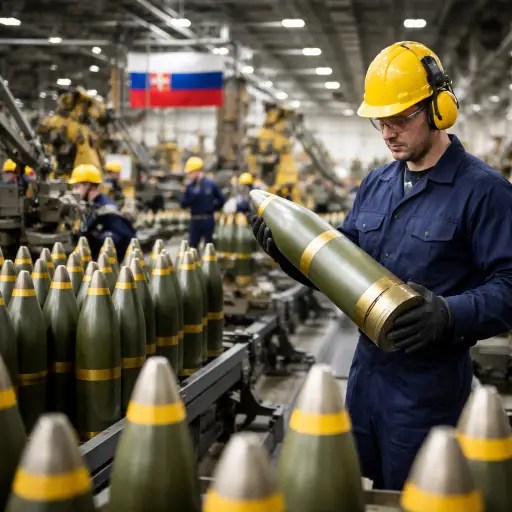
As demand for munitions surges, a former automotive powerhouse reshapes its factories—and its future—around defense production.
In the heart of Central Europe, Slovakia’s industrial identity is undergoing a striking transformation. Long celebrated as one of the continent’s most concentrated automotive manufacturing hubs, the country is now rapidly repositioning itself at the center of Europe’s defense production network. Where vehicles once rolled off assembly lines in vast numbers, artillery shells and military components are increasingly taking their place.
This shift is not merely symbolic. It reflects a broader recalibration underway across Europe, as governments and industries adapt to a new security environment marked by sustained military demand. In Slovakia, the change is particularly visible: factories, supply chains, and skilled labor once optimized for car production are being redirected toward ammunition manufacturing at a pace that underscores the urgency of the moment.
A Strategic Industrial Shift
For decades, Slovakia’s economy has been tightly intertwined with the automotive sector. Global carmakers established major production facilities across the country, drawn by its skilled workforce and central location. At one point, Slovakia produced more cars per capita than any other nation in the world.
But the evolving geopolitical climate has prompted a reassessment of priorities. Defense firms, both domestic and international, are expanding their footprint in the country, capitalizing on existing industrial infrastructure and engineering expertise. The result is a growing network of facilities dedicated to the production of artillery shells, explosives, and related military equipment.
Executives within the sector describe the transition as both pragmatic and inevitable. Automotive production, while still significant, has faced headwinds ranging from supply chain disruptions to the global shift toward electric vehicles. Defense manufacturing, by contrast, is experiencing a surge in demand that shows little sign of abating.
Scaling Up for Sustained Demand
At the center of Slovakia’s transformation is the rapid scaling of artillery shell production. Defense manufacturers are investing heavily in new machinery, workforce training, and expanded production lines to meet rising orders from European governments and allied partners.
The focus on artillery is particularly notable. Modern conflicts have underscored the critical importance of sustained ammunition supply, especially for conventional ground warfare. As a result, the production of standard-caliber shells has become a strategic priority across the continent.
In Slovakia, this has translated into round-the-clock operations at certain facilities. Engineers and technicians, many of whom previously worked in automotive plants, are being retrained to handle the precise and highly regulated processes required in munitions manufacturing. The transition, while complex, has been facilitated by overlapping skill sets in areas such as metallurgy, machining, and quality control.
Industry insiders note that the shift is not a temporary response but part of a longer-term restructuring. Contracts being signed today often extend well into the future, signaling confidence that demand will remain elevated.
Economic Opportunity and Political Calculus
For Slovakia, the pivot presents both opportunities and challenges. On one hand, increased defense production is driving investment, job creation, and technological development. Regions that once depended heavily on automotive output are finding new avenues for economic activity, helping to cushion the impact of broader industry changes.
On the other hand, the transition raises questions about the country’s long-term industrial identity. Balancing its role as a key automotive producer with its emerging position in defense manufacturing will require careful policy coordination.
Government officials have largely embraced the shift, framing it as a necessary adaptation to changing security realities. Support measures, including incentives for defense investment and streamlined regulatory processes, have been introduced to accelerate the expansion of production capacity.
At the same time, policymakers are mindful of the sensitivities surrounding arms manufacturing. Public discourse reflects a mix of pragmatism and unease, as citizens weigh economic benefits against the ethical and geopolitical implications of increased weapons production.
Europe’s Broader Signal
Slovakia’s transformation is emblematic of a wider trend across Europe. As nations reassess their defense capabilities, there is growing recognition that industrial capacity is as critical as military strategy. The ability to produce and sustain supplies of ammunition and equipment over extended periods has become a central concern.
In this context, Slovakia’s existing industrial base offers a valuable asset. Its factories, logistics networks, and skilled workforce provide a foundation that can be rapidly adapted to meet defense needs. This has positioned the country as a key contributor to Europe’s evolving security architecture.
Analysts suggest that the shift also reflects a deeper change in mindset. Rather than viewing current military demand as a short-term spike, European governments appear to be preparing for a prolonged period of heightened security challenges. Investments in production capacity are therefore being made with a long horizon in mind.
The Road Ahead
As Slovakia continues its industrial pivot, the implications will extend beyond its borders. The country’s growing role in ammunition production is likely to influence supply chains, defense partnerships, and economic dynamics across the region.
For workers on the factory floor, the change is tangible and immediate. The products they assemble, the skills they apply, and the industries they support are all evolving. For policymakers and industry leaders, the challenge lies in managing this transition in a way that balances economic resilience with strategic necessity.
What is clear is that Slovakia’s transformation is not an isolated phenomenon. It is part of a broader reorientation that is reshaping Europe’s industrial landscape—one that suggests the continent is preparing not just for the present, but for a future in which sustained defense readiness becomes a defining feature of its economic and political reality.



 The Tower Post